
Board game explainer filming from above
You mainly film the board, cards and gameplay. You want to check that the whole playing area is clearly visible.


A ring light is best suited to filming yourself when you want front-facing light. For an overhead view of the whole board, a separate, adjustable LED panel gives you more freedom to position the light in relation to the camera and playing area, as Ulanzi and Canon Europe explain. A larger ring light can work for both types of shot, provided test footage shows that the board remains easy to read and glossy cards don’t have distracting reflections. Also check what’s included in the complete kit and the camera support: a phone holder or light stand doesn’t prove that your camera can be safely suspended above the table.
You mainly film the board, cards and gameplay. You want to check that the whole playing area is clearly visible.
You often speak directly to the camera and want to start with a simple lighting setup.
You alternate between filming yourself and the table. In that case, adjustable positioning and clarity about what’s included are important.
Start by asking what viewers mainly need to see: you on camera, the whole playing area from above, or both. Your choice of a ring light or a separate, adjustable light source depends on the camera angle.
When to choose it: Go for this option if you mainly speak directly to the camera and want a simple, front-facing setup.
Trade-off: A ring light for your face won’t automatically illuminate the whole board. Check the corners and watch out for reflections on glossy components.
When to choose it: Consider this option if you want to film short clips of yourself and the board with one light, and can position it appropriately.
Trade-off: A larger ring doesn’t guarantee even lighting across the playing area. Nor does a standard light stand confirm that a camera can be safely mounted above it.
When to choose it: Consider a separate panel if the board is the main subject or you want to position the light outside the camera’s field of view.
Trade-off: You can position the camera and light independently. If your footage shows harsh shadows, you may need fill light on the other side.
| What to consider | What should you check? | Who should prioritise this? |
|---|---|---|
| Playing area visibility | Film a test at the distance you plan to use and check the cards and tokens in every corner. | I want components at the edges to be easy to read too. This is the top priority for around 33% of consumers. |
| Reflections and shadows | Test with your glossiest card and move the light or camera to assess how the light falls. | If I use glossy cards, I want to reduce reflections without casting distracting shadows across the board. Managing reflections is the main reason to buy for around 27% of consumers. |
| Stable mounting | Check the holder, connection, working height and whether the chosen support is suitable for the intended camera angle. | I want to position the camera and light securely, including for an overhead view. That’s why mounting is a top priority for around 20% of consumers. |
| Light colour and adjustability | Compare the same game components using your preferred settings. Check whether the colour temperature is adjustable or changed with filters. | If I compare game colours and a white background across different shots, I want to be able to adjust the lighting settings. Consistent colour is the main reason to buy for around 20% of consumers. |
A light’s diameter alone won’t tell you how much of the table it will cover. The distance from the camera and the position of the light also affect what you see on screen.
Film a test from the planned distance and check the corners of the board before choosing your setup.
You may need additional, separately adjustable light for the playing area.
A phone holder or tilting light bracket doesn’t automatically mean you can safely suspend a camera above the table.
Compare what’s included in your chosen kit with the mounting points you need, and check that the support is suitable for your planned height and camera angle.
You may need a separate, suitable support for the camera or light.
The manufacturer of the NEEWER RL-18 kit specifies 3200 K and 5600 K using white and orange filters. The Godox LR150 manual lists an adjustable range of 3000–6000 K.
Check how you can adjust the light colour while filming on the exact variant you’re considering.
The examples below refer to specific models and product ranges. They aren’t recommendations for the brand as a whole and don’t, by themselves, indicate availability.
The RL-18 kit may be worth considering if you’re looking for a larger ring light with accessories for front-facing shots.
The LR150 is an option to look at if you want to adjust the light colour while filming.
The DVR-300DVC is a tilting ring light to compare if you want to position the light separately.
The LR-650 is aimed at creators looking for a larger ring with manual light controls and a connection for a light stand.
According to Ulanzi, the U200 is a rechargeable ring light setup for creators who move between filming locations.
These ring lights are for front-facing video where you’re on camera.
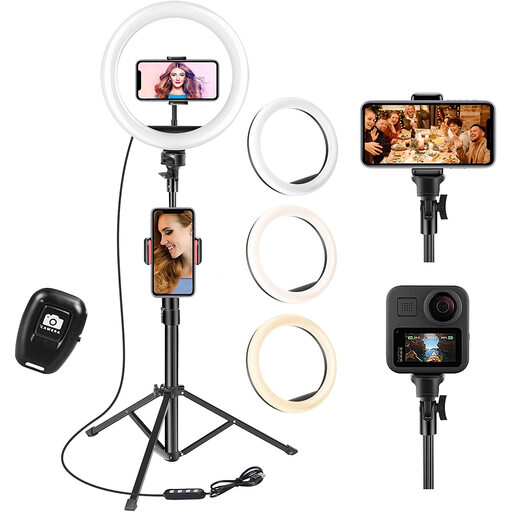 No image available
An option for front-facing video where you’re on camera.
The product name specifies a 63-inch tripod, remote control, 3 colour settings and 10 brightness levels.
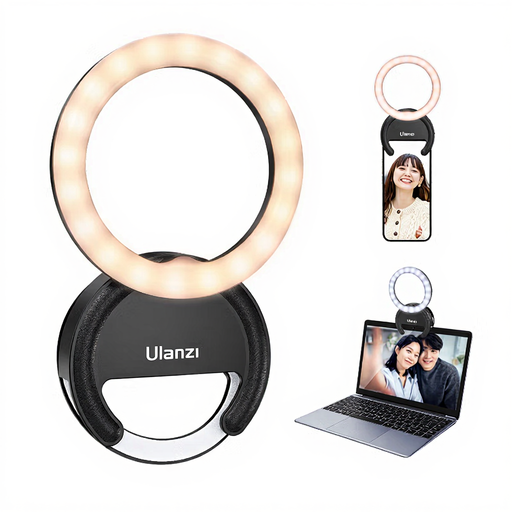 No image available
An option for front-facing video, video calls and streaming.
The product name specifies 3 colour temperatures from 3000 K to 7000 K and 5 brightness levels.
That depends on your complete camera and lighting setup. An included phone holder or light stand doesn’t, by itself, confirm that the camera can be safely suspended above the table. Check the support, mounting and working height, and film a test of the whole board.
Review footage featuring your glossiest game components and adjust the angle between the camera, cards and light. A separately positioned panel gives you more freedom to move the light source. If shadows remain visible on the other side, a lower-level fill light may help you adjust the setup.
No, not necessarily. According to the manufacturer, the NEEWER RL-18 uses white and orange filters for its specified settings, while the Godox LR150 manual lists an adjustable range of 3000–6000 K. Check the exact variant and how its controls work.
CE marking is only required when the product falls under EU rules that require it, according to Your Europe. The applicable rules depend on the light’s design and whether a power supply is included. Check the information for the specific product; a visible mark doesn’t, by itself, prove that all applicable requirements have been met.