
Explainer focused on readability
You film a game board and cards against a dark background, and want the rules, symbols and text to remain visible. Canon Europe explains how key and fill lighting affect shadows in video.


Start by considering the position of the light and camera: they should show the whole game board without accidentally lighting up the background. A ring light close to the camera is easy to set up. If you get glare on cards or want deeper shadows, an angled or diffused light source may work better. Canon Europe and B&H eXplora explain how the direction of light affects reflections and shadows, so test your setup with a trial shot of your game.
You film a game board and cards against a dark background, and want the rules, symbols and text to remain visible. Canon Europe explains how key and fill lighting affect shadows in video.
You film cards, laminated components or game pieces that can catch the light, and want to be able to adjust the angle. B&H eXplora discusses how diffused light can reduce harsh shadows and reflections.
You need a stable place for your camera and light, without tripod legs, clamps or arms getting in the way of the game. Benel Europe points out that a ring light may have limitations when you need plenty of freedom to move.
When to choose it: choose this setup if you want to film a simple, compact explainer and the text across the whole board is clearly visible.
Trade-off: front lighting is easy to position, but can make shapes and textures look flatter. Check glossy components in a test shot.
When to try it: try this position if reflections in a front-on shot obscure details and you can point the light independently of the camera.
Trade-off: changing the angle of the light can move the reflection, but may also cast a shadow over the text. Canon Europe explains how the direction of light changes shadows.
When to consider it: consider a separate, diffused light source if avoiding reflections or achieving the desired depth of shadow matters more than the convenience of a single ring light.
Trade-off: you can control the direction of the light separately, but you’ll need more space and adjustment. B&H eXplora discusses diffusion as a way to soften harsh shadows and reflections.
| What to consider | What to look for | Who is this important for? |
|---|---|---|
| Readability and a dark background | Check whether the brightness is adjustable and take a test shot of the whole board. A lux rating at a single distance doesn’t prove that your game will be lit evenly. | If I want to keep the rules and symbols readable without accidentally lighting up the dark background, I look at how well the light covers the whole board. Around 36% of consumers put readability first. |
| Reflections on cards and game pieces | Test the glossiest components from the intended camera angle and check whether you can tilt or move the light. Diffused light can soften harsh reflections, but doesn’t guarantee that they will disappear. | Anyone filming reflective cards or game pieces will want to limit glare without losing important details. For around 29% of consumers, controlling reflections is the top priority. |
| Mounting and camera angle | Check that the holder and connection are suitable for your phone or camera, the tilt range, and the space available for tripod legs or clamps around the table. | If I want to point the camera and light steadily at the board without blocking the game, the mounting options and available table space are key. Around 21% of consumers prioritise this setup. |
| Colour settings and power | Check the stated colour temperature range, how you can control the light while filming and what power supply comes with the version you’ve chosen. | For consumers who want to match the light colour to their footage and film conveniently, the controls and power supply are both key considerations. This applies to around 14% of consumers. |
Light that looks even on a face doesn’t necessarily make the edges of a board easy to read or prevent reflections on cards.
Take a test shot from the intended camera angle and check the text, symbols, edges of the board and darkness of the background before settling on your setup.
If the test shot means you need a different mount or a separate light source, allow for the extra space and adjustment involved.
These values don’t describe the same thing. A lux rating is tied to a measurement distance; Godox lists approximately 1,400 lux at 0.5 m for the LR150.
Only compare specifications when the units and measurement conditions match, and assess how well the light covers the table with a test shot.
A light, phone holder, tripod and power supply aren’t necessarily included together in every kit or version.
Check what’s in the box and the connections for the version you’ve chosen. Godox lists an adapter and phone holder for the LR150; Ulanzi offers the U200 in different kits, so don’t assume a tripod or phone holder is included without checking.
The RL-18 is a ring light kit with a tripod and phone holder, for a larger, adjustable setup.
According to Godox, the LR150 has an adjustable colour temperature and is designed for use with an external power supply.
The U200 is a compact, ring-shaped video rig for anyone who values battery power and multiple mounting points.
The Ring Light is an example of a ring light with a desk stand and device-based controls, but it isn’t a current recommendation for a new purchase.
These Joybuy products are ring lights for video recording with adjustable light settings. Check how you can mount the light and camera around your gaming table for each version.
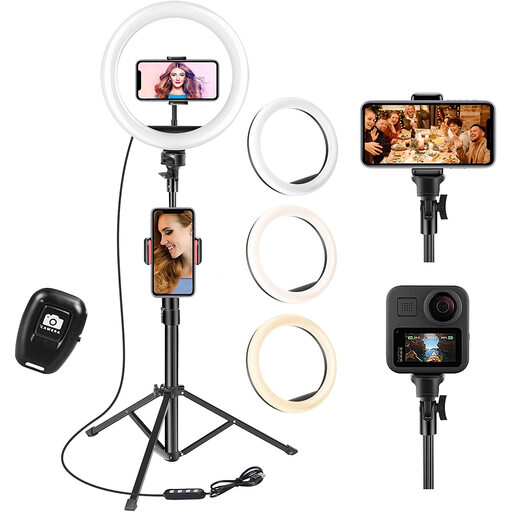 No image available
A ring light for video recording with a tripod, according to the product title.
The title lists a 63-inch tripod, three colour modes and ten brightness levels.
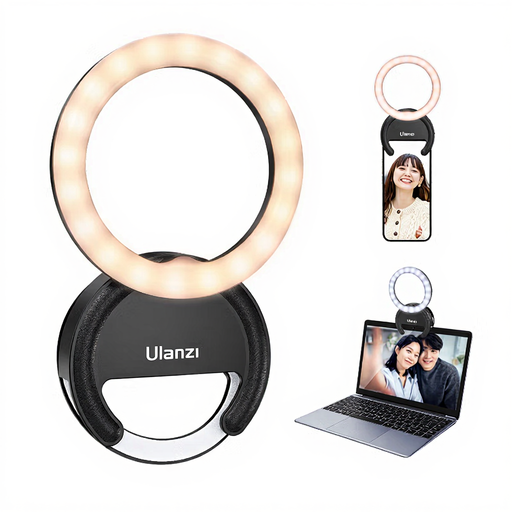 No image available
A compact ring light designed for video recording, according to the product title.
The title lists three colour temperatures from 3000–7000 K and five brightness levels.
No, that isn’t a general requirement. Start with a test shot that shows the edges of the board, the cards and the dark background. Change the angle of the light if reflections obscure details. A ring light near the camera is easy to set up, while a separate light source gives you more freedom to direct the light.
Check that your phone or camera dimensions and connection are compatible with the holder, and exactly what’s included in the kit you’ve chosen. For the Neewer RL-18, the manufacturer recommends fully spreading the tripod legs; for other models, follow their own instructions.
Godox says to keep the LR150 dry, not to dismantle it yourself and to have any necessary repairs carried out by an authorised service centre. These model-specific instructions don’t automatically apply to other lights.
Electrical equipment sold in the Netherlands must comply with the applicable European product rules. Business.gov.nl explains that a CE mark isn’t a quality mark. According to the Dutch government, many online purchases from a business come with a 14-day cooling-off period, but there are exceptions. Check the seller and the terms of your purchase.