
Sugar-conscious coffee drinkers
You want something crunchy with your afternoon coffee and mainly compare rice cakes by their sugar content per 100 g. Plain varieties are a sensible place to start.


If keeping sugar low is your priority with your afternoon coffee, choose a plain rice cake: PLUS, Jumbo and Albert Heijn list 0.4 g, 0.6 g and 1.4 g of sugars per 100 g respectively for the plain varieties we checked. If you prefer a sweet coating, bear in mind that the sugar content will be different: Albert Heijn lists 35 g per 100 g for its yoghurt variety and 32 g per 100 g for its milk chocolate variety. Compare the exact varieties per 100 g, then consider the portion you eat.
You want something crunchy with your afternoon coffee and mainly compare rice cakes by their sugar content per 100 g. Plain varieties are a sensible place to start.
You’re considering a rice cake with a yoghurt or chocolate coating, but want to know how much sugar it contains before comparing it with a plain variety.
As well as sugars, you check the salt, ingredients, allergen information and dietary labels for the exact variety you want to buy.
If your main reason for comparing rice cakes is to cut down on sugar, start with the nutritional information per 100 g. Then consider whether taste, portion size or other label details affect your choice.
| What to consider | What to check | Who it matters to |
|---|---|---|
| Sugars | Compare ‘of which sugars’ per 100 g and check separately for any listed added sugars. | With my afternoon coffee, I want something crunchy without a sweet taste taking centre stage. For around 50% of consumers, low sugar content is the most important factor. |
| Sweet coating | Compare coated varieties with plain ones per 100 g, then consider the portion you eat. | If I want something sweet with my coffee, taste matters more to me than having the lowest possible sugar content. Around 30% of consumers prioritise that sweet taste. |
| Other label details | Check the salt content, ingredients and allergen information for the variety you’ve chosen. | If salt, allergens or a dietary preference are decisive for me, the rice cake I choose needs to suit those requirements. For around 20% of consumers, suitability comes first. |
The shape of a product tells you little about its sugar content. Albert Heijn lists 35 g of sugars per 100 g for its yoghurt variety and 32 g per 100 g for its milk chocolate variety; the plain varieties we checked from PLUS, Jumbo and Albert Heijn contain between 0.4 and 1.4 g per 100 g.
Choose a coating for its taste, and compare the sugars per 100 g with those in a plain variety before you buy.
According to Albert Heijn’s product information, a portion of plain rice cakes is 7 g, compared with 17 g for the coated varieties mentioned. This means that comparing the amount per portion doesn’t compare the same quantity of product.
First, use the nutritional information per 100 g to compare varieties. Then check the portion size to see how much you plan to have with your coffee.
Labels and allergen warnings apply to the specific product. Jumbo states that its plain rice cakes may contain sesame and soya.
If you have a relevant allergy, check the ingredients and allergen declaration on the current packaging of the variety you’ve chosen.
When comparing these brands, check the exact plain and coated varieties: nutritional information or a label for one rice cake doesn’t necessarily apply to another.
The own-label range includes both plain rice cakes and varieties with a yoghurt or milk chocolate coating.
The own-label plain rice cake offers an option you can compare separately with coated and savoury products.
The plain rice cake we checked is a sea salt variety.
ALDI Netherlands lists Goud Gebakken rice cakes with sea salt.
Lidl Netherlands lists rice cakes in varieties including milk chocolate, dark chocolate, yoghurt and sea salt.
This salted rice cake is a good option if you’re looking for a simple variety to have with your afternoon coffee. Check the sugars per 100 g on the packaging before treating it as a low-sugar choice.
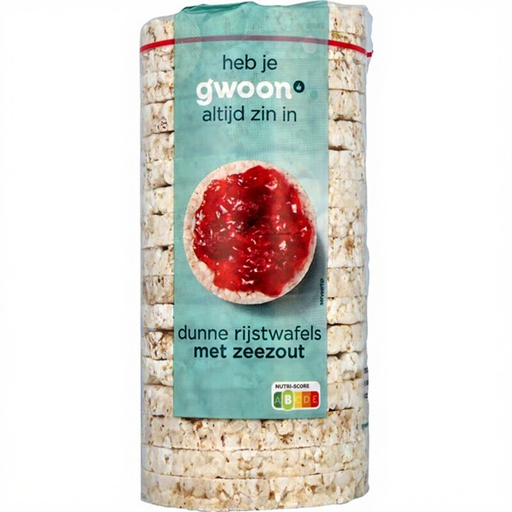 Image unavailable
A salted rice cake for anyone who doesn’t want a sweet coating with their coffee.
130 g pack. Before choosing, check the sugars per 100 g and the allergen information on the current packaging.
Voedingscentrum sets a limit of 5 g of sugars per 100 g for a product to be described as ‘low in sugar’. To check, look at ‘of which sugars’ in the nutritional information table. A small portion or a mild taste won’t tell you how much sugar the product contains per 100 g.
They do for the products we checked: PLUS, Jumbo and Albert Heijn list 0.4 g, 0.6 g and 1.4 g of sugars per 100 g respectively for their plain varieties. Albert Heijn lists 35 g per 100 g for its yoghurt variety and 32 g per 100 g for its milk chocolate variety; compare other varieties separately.
The amount per 100 g lets you compare rice cakes on an equal basis, while the amount per portion shows what’s in the stated quantity of product. Albert Heijn lists 7 g per portion for plain rice cakes and 17 g for the coated varieties we checked, so also consider how much you eat yourself.
No, check the information for the exact variety. Albert Heijn labels its plain rice cake we checked as vegan, while Jumbo states that its plain rice cake may contain sesame and soya. If you have an allergy, always read the current packaging.
Seal the pack well after opening and store the rice cakes in a cool, dry place. Albert Heijn recommends storing its plain variety in a sealed tin; PLUS recommends an airtight container for its variety.