If you’re looking for a simple, crunchy snack with your afternoon coffee and want to avoid added salt, compare plain rice cakes rather than automatically reaching for a digestive. If you prefer a biscuit, check the fibre content of a wholemeal digestive alongside its sugars, fat and salt. If you’re losing weight unintentionally or have difficulty chewing or swallowing, neither option is a substitute for personalised dietary advice.
Who might this choice be relevant to?
Older people who fancy something crunchy with their coffee
If you want to limit added salt and sugars, you could start with a plain rice cake with no added salt. Check the pack you choose: a flavoured or salted variety won’t necessarily have the same nutritional profile.
Older people who prefer a biscuit
If you enjoy the taste and texture of a digestive, choosing between a regular and a wholemeal variety may be important. Compare not only the fibre, but also the sugars, fat, salt and ingredients.
Older people who find eating or swallowing difficult
If you have a reduced appetite, are losing weight unintentionally or have difficulty chewing or swallowing, the question goes beyond which snack to have with your coffee. The Voedingscentrum advises contacting your GP if you show signs of malnutrition.
What should you consider when choosing?
First decide whether you’d prefer a rice cake or a biscuit. Then compare the specific varieties: plain, multigrain and wholemeal each tell you something different about the ingredients and nutritional value.
| What to consider | What to check when buying | Who it matters to |
|---|
| Added salt and sugar |
Check the ingredients and compare salt and sugars per 100 g; also consider the flavour you choose. |
If I want something crunchy with my afternoon coffee without added salt or sugars, I look beyond the product name. For around 33% of consumers, this would be their main concern when buying. |
| Biscuit experience |
Choose between a regular and a wholemeal digestive, and check the serving size. |
I’d rather have a familiar biscuit with my coffee than a rice cake, even if that means the nutritional values are different. For around 25% of consumers, the biscuit experience would come first. |
| Fibre and wholemeal ingredients |
Compare fibre per 100 g alongside salt and sugars; check the ingredients of a digestive. |
If I’m paying more attention to fibre, I want to know what else a multigrain rice cake or wholemeal digestive contains. For around 25% of consumers, this comparison would matter most. |
| Intake and texture |
If you have difficulty eating or swallowing, consider not only the snack but also whether its texture and your overall diet are suitable. |
If eating is difficult or I’m losing weight unintentionally, I’d benefit more from an appropriate assessment than simply switching to another dry snack. For around 17% of consumers, getting enough to eat or finding a suitable texture would be the main concern. |
Common mistakes
-
Assuming ‘wholemeal’ means ‘low in sugar’
The AH Digestive wholemeal biscuits with wheat flour included in this comparison list 6 g of fibre, but also 18 g of fat, 20 g of sugars and 1.15 g of salt per 100 g. The word ‘wholemeal’ doesn’t tell you everything about the nutritional value.
Compare fibre, fat, sugars and salt on the same basis, and consider how many biscuits you eat at a time.
-
Assuming all rice cakes contain the same amount of salt
Jumbo lists less than 0.01 g of salt per 100 g for the plain rice cake included in this comparison, and 0.65 g per 100 g for its thick multigrain rice cake.
If salt is important to your choice, check the nutritional information for the specific variety.
-
Overlooking allergen information
The AH digestives included in this comparison contain wheat. The packaging for the Jumbo plain rice cake included here says it may contain sesame and soya; a short ingredients list doesn’t override that warning.
If you have an allergy, check the current ingredients and allergen information on the pack before eating the product.
-
Thinking a snack will solve a reduced appetite
If you’re losing weight unintentionally or have ongoing difficulties eating, the issue is no longer just which snack to choose; it’s your overall diet. The Voedingscentrum advises contacting your GP if you show signs of malnutrition.
Don’t rely on a rice cake or digestive as a solution on its own; discuss these problems with an appropriate healthcare professional.
Brands to compare
Albert Heijn
The products included in this comparison include a rice cake with no added salt, as well as regular and wholemeal digestives.
- Albert Heijn says its rice cake included in this comparison is made from brown rice and lists 0 g of added salt and 0 g of added sugars per 100 g.
- The digestives included in this comparison contain wheat. The wholemeal variety lists 20 g of sugars and 1.15 g of salt per 100 g; check the current pack.
Jumbo
The plain and multigrain rice cakes included in this comparison show why the variety matters.
- Jumbo lists 3.7 g of fibre and less than 0.01 g of salt per 100 g for the plain rice cake included in this comparison.
- The thick multigrain rice cake included in this comparison lists 4.9 g of fibre, but also 0.65 g of salt per 100 g.
ALDI / Goud Gebakken
The Goud Gebakken rice cake included in this comparison is a sea-salt variety.
- ALDI describes this specific variety as gluten-free and vegan.
- If you’re watching your salt intake or checking for allergens, consult the nutritional information and details on the current pack of the sea-salt variety.
Lidl / Sondey
Lidl describes Sondey as a range that includes biscuits and rice cakes.
- Lidl also mentions vegan options within the range it describes.
- For a specific Sondey variety, compare the ingredients, allergens and nutritional information on the pack; features of one variety don’t automatically apply to another.
Bolletje
Echte Beschuit is another dry accompaniment to coffee, but it isn’t a rice cake or a digestive.
- The ingredients list for Bolletje Echte Beschuit makes it possible to compare with biscuits and rice cakes.
- The list includes wheat flour, rye flour and egg; check this product separately if these ingredients are important to your choice.
Rice cakes at Joybuy
If you’re considering a flavoured rice cake with your coffee, this is a barbecue pepper variety. It’s not the same as the plain rice cake with no added salt included in the comparison.
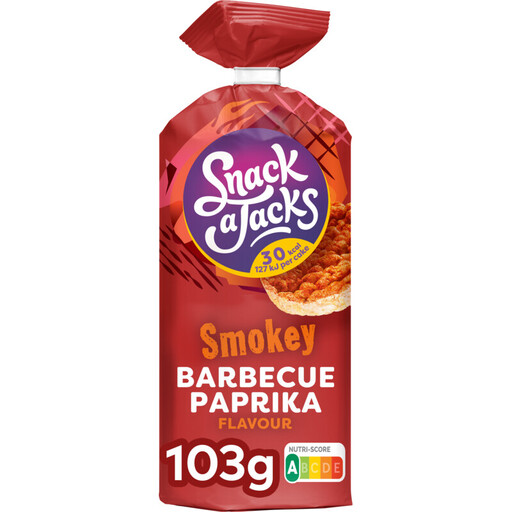 Image unavailable
Snack A Jacks Barbecue Pepper Rice Wafers, 103 g
An option if you’d prefer a flavoured rice cake with your afternoon coffee. Check the nutritional information for salt and sugars, and read the pack if you have allergies. If you have difficulty chewing or swallowing, don’t assume it’s suitable based on the product name.
View at Joybuy
Frequently asked questions
Is a rice cake always a better choice than a digestive with coffee?
No, it depends on the snack you want and the specific variety. A plain rice cake with no added salt is different from a flavoured rice cake, while a digestive is a biscuit. Compare the ingredients and nutritional values of the products you’re actually considering.
What does ‘wholemeal’ mean for a digestive?
The word ‘wholemeal’ doesn’t tell you on its own how much sugar, fat or salt a digestive contains. The AH Digestive wholemeal biscuits with wheat flour included in this comparison list 6 g of fibre, 20 g of sugars, 18 g of fat and 1.15 g of salt per 100 g. Consider these values alongside your portion size.
Can I choose any rice cake if I have coeliac disease?
No, check the current allergen information and whether the specific rice cake is explicitly labelled gluten-free. A simple ingredients list isn’t enough; the AH digestives included in this comparison also contain wheat.
When is choosing between a rice cake and a digestive not the main concern?
If you’re losing weight unintentionally, have a reduced appetite for a long time, or have difficulty chewing or swallowing, your overall diet needs attention. The Voedingscentrum advises contacting your GP if you show signs of malnutrition; a single snack isn’t a substitute for an assessment.


