First, compare a monitor’s measured input lag and motion handling in the picture mode you actually use; a quoted GtG response time is no substitute. OLED is suited to those looking for deep blacks and fast pixel transitions, but you’ll need to consider long periods of static game elements and possible VRR flicker. IPS or VA may be a better fit if you want to avoid the risk of OLED burn-in, although with VA you should also assess dark motion trails.
Who is this choice relevant to?
Rhythm gamers who put timing first
You want to follow notes on time, without distracting motion trails. So look for measurements of both input lag and pixel transitions in the picture mode you use. RTINGS.com treats these as separate characteristics.
Gamers in a dark room
You’ll want to consider how black the background looks and whether moving notes remain easy to see. RTINGS.com describes deep blacks on both OLED and VA, but motion handling varies by panel and model.
Gamers with interface elements that stay on screen
If lanes, scores or menus stay in the same place for a long time, factor in the potential risk of OLED burn-in and the care the panel needs. Also check the terms that apply to the exact model.
What should you look for in a monitor for rhythm games?
OLED
A good fit if: deep blacks and fast pixel transitions matter in a dark room.
The trade-off: static images displayed for long periods can cause burn-in, and VRR flicker can be distracting in dark scenes; assess both for the specific model.
Fast IPS LCD
A good fit if: fixed game elements stay on screen for a long time and you’d rather avoid OLED burn-in.
The trade-off: IPS generally won’t deliver the same deep blacks as OLED in a dark room; a high Hz rating or low GtG figure alone doesn’t prove that timing will be displayed well.
VA LCD
A good fit if: deep blacks matter, but you want to avoid OLED.
The trade-off: dark pixel transitions can leave black smearing; check the motion handling of the exact model.
| What to consider |
What to look for |
Who should pay extra attention? |
| Timing and motion clarity |
Compare input lag and pixel transition measurements at the Hz and overdrive settings you’ll use. |
If I want to hit notes precisely on the beat, I need to know when the image appears and how clear fast transitions remain. Around 36% of consumers put timing and motion handling first. |
| Black levels and visibility |
Assess black levels, dark moving patterns and any VRR flicker on the exact model. |
In a dark room, I want bright notes to stand out clearly against the background. Around 29% of consumers give dark-scene performance and contrast top priority. |
| Play area visible for long periods |
For OLED, check the panel care guidance and the written terms for any burn-in cover. |
If lanes, scores or menus stay on screen for a long time, I want to weigh up the risk and the relevant terms. Around 21% of consumers put long-term static images and lifespan first. |
| Hz and connection |
Check which refresh rate your device, game and monitor port support together. |
I only want to pay for a picture mode that my own gaming setup can actually use. Around 14% of consumers start by checking compatibility with their device and connection. |
Common pitfalls when choosing
-
Mistaking a GtG figure for the total delay from button press to image
GtG describes how a pixel changes shade; input lag is about processing the image signal before it appears on screen. They are different measurements.
Compare measurements for the exact model and picture mode you use. RTINGS.com measures input lag and motion handling separately.
-
Choosing OLED without considering static game elements
Displaying the same lanes, scores or menus for long periods can mean weighing up the risk of burn-in. Care and cover terms may vary by model.
Follow the panel care instructions and read the terms for the exact model. Consider IPS or VA if fixed interface elements often remain on screen for a long time.
-
Assuming VA contrast means moving notes will be clear
Dark pixel transitions can cause black smearing during fast motion, which may be more noticeable against a dark background.
Check motion measurements for the specific VA model, paying particular attention to dark transitions.
-
Going by the highest Hz rating without checking the model and connection
The usable refresh rate depends on the combination of monitor, connection, device and game.
Check the full model number and the official frequency and port specifications before deciding.
Relevant brands to compare
AOC
The Q27G4ZDR and Q27G4ZR offer two panel options for a 27-inch QHD monitor.
- AOC lists QHD, 240 Hz and QD-OLED for the Q27G4ZDR; the specifications consulted are from the US product page.
- AOC Netherlands lists QHD and 240 Hz for the Q27G4ZR, with an optional overclock mode of 260 Hz.
- These specifications aren’t independent measurements of input lag. Don’t infer Dutch warranty terms from the US product page.
Samsung
The Odyssey OLED G6 G60SD is a QHD OLED option for anyone looking for a high refresh rate.
- Samsung Netherlands specifies a 360 Hz refresh rate for model LS27DG602SUXEN.
- Samsung describes panel care features for its OLED monitors.
- A quoted Hz rating doesn’t confirm which mode your game and equipment can use; check this for each connection and setting.
MSI
The MAG 274QRF QD E2 is a 27-inch QHD Rapid IPS model.
- MSI specifies 180 Hz and a 1 ms GtG response time for this model.
- The quoted GtG figure isn’t a measurement of input lag and, by itself, doesn’t prove how motion will look in a dark game.
ASUS
The ROG Swift OLED PG32UCDM Gen3 is a larger 32-inch 4K QD-OLED model.
- ASUS Netherlands specifies 4K and 240 Hz. RTINGS.com includes the model in a selection of OLED monitors.
- The larger 4K model calls for a separate assessment of desk space and your gaming setup’s performance; the RTINGS.com selection isn’t a rhythm gaming ranking.
LG
The UltraGear 27GS95QE-B is a 27-inch QHD OLED model to compare.
- LG lists a 240 Hz refresh rate for this model.
- LG Netherlands marks the 27GS95QE-B as discontinued; this model specification says nothing about current availability.
Joybuy monitors for gaming in a dark room
This Joybuy selection features OLED gaming monitors for anyone looking for deep blacks and a high quoted refresh rate in a dark room. With OLED, it’s also worth considering long periods of static images.
 No image available
AOC Q27G4ZDR 26.5-inch QHD QD-OLED 240Hz
A QD-OLED option for anyone who values deep blacks when playing rhythm games in a dark room.
Resolution: 2560 × 1440. Panel: QD-OLED. Refresh rate: 240 Hz. GtG: 0.03 ms. OLED carries a risk of burn-in with long periods of static images.
View at Joybuy
 No image available
LG UltraGear 34GX900A-B 34-inch Curved WQHD OLED 240Hz
A curved OLED monitor for anyone considering a larger screen for gaming in a dark room.
Size: 34 inches. Resolution: 3440 × 1440. Panel: MLA+ OLED. Refresh rate: 240 Hz. If fixed game elements stay visible for long periods, bear in mind the risk of OLED burn-in.
View at Joybuy
 No image available
MSI MAG 341CQP QD-OLED X28 34.18-inch UWQHD 280Hz
A QD-OLED option for anyone looking for a curved ultrawide screen and deep blacks.
Resolution: 3440 × 1440. Panel: QD-OLED. Refresh rate: 280 Hz. GtG: 0.03 ms. The quoted GtG figure isn’t a measurement of input lag; OLED requires care with long periods of static images.
View at Joybuy
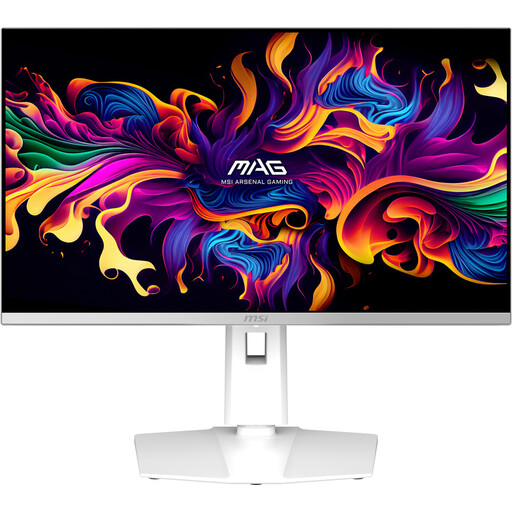 No image available
MSI MAG 272QPW QD-OLED X28 27-inch QHD 280Hz, white
A 27-inch QD-OLED option for anyone looking for a high quoted refresh rate for rhythm games.
Resolution: 2560 × 1440. Panel: QD-OLED. Refresh rate: 280 Hz. Colour: white. OLED carries a risk of burn-in with long periods of static images.
View at Joybuy
 No image available
MSI MAG 272QP QD-OLED X24 26.5-inch WQHD 240Hz
A 26.5-inch QD-OLED option for anyone looking for deep blacks and a quoted 240 Hz refresh rate.
Resolution: 2560 × 1440. Panel: QD-OLED. Aspect ratio: 16:9. Refresh rate: 240 Hz. Brightness: 400 cd/m². GtG: 0.03 ms. With OLED, bear in mind the effects of long periods of static images.
View at Joybuy
Frequently asked questions
Does 0.03 ms GtG mean there’s little delay between pressing a button and seeing the image?
No. GtG describes a pixel transition; input lag describes how long the monitor takes to display a received image signal. For timing, compare measurements of both characteristics in the picture mode you use.
How should you set up a monitor for your rhythm game?
Choose a refresh rate supported by your device, connection and game, then check the monitor mode you’ve selected. If you use VRR, watch out for possible flicker in dark scenes; this can vary by model and usage.
What should you consider if lanes or scores stay on an OLED screen for a long time?
Follow the panel care instructions for the exact model and read the terms for any burn-in cover. AOC links the cover mentioned for the Q27G4ZDR on its US product page to prescribed screen care; check separately which terms apply to a purchase in the Netherlands.
What are your rights in the Netherlands if your monitor develops a fault or you want to cancel an online purchase?
According to the Dutch government, if a product is faulty you’re entitled to an appropriate solution from the retailer; the Netherlands has no fixed statutory two-year warranty period. For eligible distance sales, there is usually a 14-day cooling-off period. This is separate from any manufacturer’s warranty for the monitor.
How do you compare monitors’ energy consumption?
Compare the EU energy label and product information sheet for the exact model. For electronic displays, the European Commission provides details including the energy class and information for SDR and, where applicable, HDR.


