
Vandaag of morgen in huis

Kwaliteit gegarandeerd

Welkomstaanbiedingen ontgrendelen: GRATIS bezorging | Tot 80% korting | Gratis 30 dagen JoyPlus-proefperiode
Download de app
A set of RGB LED interior lighting for your car can transform a standard interior into a personalised space. However, not every kit is equally suitable for DIY installation. A long LED strip, a wide range of colours and an app may sound appealing, but they tell you little about installation, light distribution or electrical connections.
Buyers often run into the same issues with dashboard lighting, footwell lighting and car door lighting. Below, you’ll find the main pitfalls and points to check, followed by practical product options for different needs.
A product with, for example, 175 or 236 inches of lighting material might seem generously sized. In practice, you’ll often need to route the strip along dashboard edges, door panels and the centre console. A rigid or hard-to-bend strip won’t fit neatly into narrow gaps.
So pay attention to the material. An acrylic or fibre-optic LED strip spreads light through a light-guiding profile. Also check whether the strip can be cut at designated points. On some models, cutting in the wrong place can damage a resistor or end segment, making part of the strip dimmer or causing it to fall out of sync.
Music-synchronised LED lighting usually works with a built-in microphone in the controller. According to the product descriptions for the sets mentioned here, the lighting reacts to sound picked up by this sensor. That could be music, but it could also be voices or ambient noise.
The controller’s position is therefore important. If the microphone is covered or positioned too far from the sound source, the lighting effects may react less accurately. If you mainly listen to music in your car, it’s worth positioning the controller so that the microphone remains unobstructed.
Bluetooth LED car lighting usually offers wireless control via a smartphone, but the light strips and sub-controllers still need to be connected to the power supply. Kits with multiple zones will therefore have cables running beneath dashboard or door panels.
Check in advance:
The Dreamcolor kits described are specified for 12V direct current. This is suitable for many cars, SUVs, vans and pick-ups, but always check your vehicle’s requirements. A 24V commercial vehicle isn’t directly compatible without a suitable voltage converter.
Depending on the model, the kit can be connected via a 12V socket, a switched ACC power source or another suitable power connection. Test the lights before fixing the strips in place.
The number of LEDs is a useful guide, but it doesn’t tell you everything about quality. The product information for the Dreamcolor Acrylic Interior Car LED Strip Light lists variants with around 593 or 600 LEDs and an acrylic light-guiding profile. According to the product description, this is designed to create a more even light than an optical fibre illuminated by just one LED.
Also check:
A car dashboard LED strip should also sit neatly in a gap or profile. A strip stuck directly onto the dashboard may become more visible, shift out of place or create distracting reflections.
App-controlled car lighting typically lets you choose fixed colours, brightness, speed and dynamic patterns. Some Dreamcolor models specify 16 million colours, Smart IC effects, touch control and two independently adjustable zones.
Dual-zone control is handy if, for example, you want a different colour for the dashboard and footwell. However, check which sections can actually be controlled separately. On some variants, the main strips can be adjusted separately from the footwell, door-handle or storage-compartment lighting.
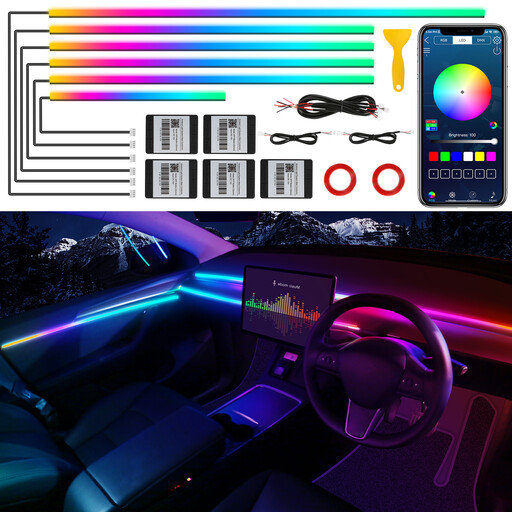
Why it suits this profile: This variant combines six acrylic strips with four footwell lights, making it a straightforward first installation for the dashboard and footwells.
The product information specifies marked cutting points and a 12V connection. This makes it easier to adjust the length without cutting into the strip at random.
Bluetooth app control, fixed colours and dynamic patterns; six acrylic strips and four footwell lights.

Why it suits this profile: A good choice if you’re looking for a more extensive finish covering the dashboard, footwells, door handles and storage compartments.
The kit uses one main controller and four sub-controllers. This lets you connect multiple installation zones and control them in sync.
593 LEDs according to the product information, dual-zone control, Bluetooth app and music-reactive mode.
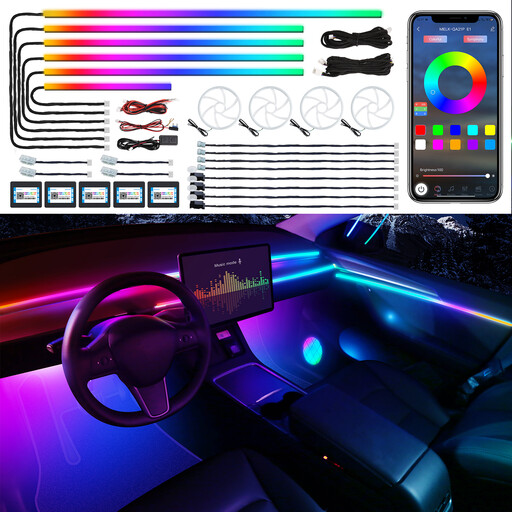
Why it suits this profile: An extensive option for tuning enthusiasts and car-audio fans who also want to add door-speaker lighting and integrate multiple interior zones.
Installation is split between main and sub-controllers. This helps you organise cables by zone, although careful cable management is still essential.
Dashboard, footwell, door-handle, storage-compartment and door-speaker lighting; app and touch control; Smart IC effects.
We’ve put together a complete, up-to-date list of products that meet these strict selection criteria and comply with current European safety regulations.
Interior lighting shouldn’t distract the driver. Choose a suitable brightness and avoid reflections in the windscreen or side windows. Also check that the installation doesn’t interfere with any vehicle functions or safety features.
Most kits connect to a 12V power supply. This may be via a suitable 12V socket or a switched power source. Follow the instructions for your specific kit and test it before refitting the trim permanently.
Lifespan depends on how long the lights are used, heat, moisture, mechanical stress and the quality of the connection. Avoid sharp bends, loose cables and installing the strip where it will be touched constantly. The product descriptions for some kits specify short-circuit protection, a memory function and an operating temperature of -20 °C to 60 °C; check these details for each model.
Power consumption varies depending on the number of strips and lights, as well as the brightness setting. A larger kit with multiple zones will generally use more power than a single dashboard strip. To avoid putting unnecessary strain on the battery, switch the lights off via a switched power source when you leave the car.
