
Vandaag of morgen in huis

Kwaliteit gegarandeerd

Welkomstaanbiedingen ontgrendelen: GRATIS bezorging | Tot 80% korting | Gratis 30 dagen JoyPlus-proefperiode
Download de app
RGB car interior lighting with an app can transform a plain car interior with adjustable colours, music-reactive effects and lighting for the dashboard, doors or footwell. However, many universal LED kits look very similar. The differences often come down to length, connection method, app, light guidance and the accessories included.
If you only look for “16 million colours” or a “Dreamcolor LED strip”, you may encounter practical problems after buying. First check how the kit will fit in your car and which parts of the installation you can carry out yourself.
“Universal” usually means that the kit is designed for many 12V cars. It does not mean that every dashboard seam, door panel or centre console has enough space. A strip that is too thick may come loose or remain visible. With acrylic LED lighting for cars, you also need to consider sharp bends: according to the product information, optical fibres and acrylic profiles must not be folded double or sharply kinked.
A product described as “10-in-1” or “18-in-1” generally refers to a combination of strips, footwell lights, door lighting and controllers. It is not the same as ten fully independent LED strips. Check exactly what is included in the box and whether the zones can be controlled separately.
With music-controlled car lighting, a microphone in or near the controller detects sound. The lighting therefore responds to ambient sound, not necessarily directly to the car’s audio signal. Road noise or conversations can consequently affect the lighting effect too. Treat the feature as a visual effect rather than a precise audio interface.
Most kits in this category are designed as 12V car interior lighting. Check your vehicle’s voltage before connecting the kit. One of the available sets specifies an operating range of 10–16V, while other models specifically state 12V. Do not connect a 24V commercial vehicle, bus or lorry directly to a 12V kit; you will need a suitable voltage converter.
Test the lighting before securing the strips permanently. Keep cables away from pedals, the steering system, seat rails and other moving parts. “Plug and play” reduces the number of connections required, but it does not eliminate the need for careful cable routing.
Traditional fibre optic car lighting carries light through a thin optical fibre from an LED module. Light intensity may vary along the length, particularly when a long fibre is illuminated from one end only. With the reference sets, the fibre length is around 175 inches, or approximately 4.45 metres; some product descriptions state around 236 inches, approximately 6 metres.
An acrylic LED strip uses a light-guiding acrylic profile. According to the product descriptions, this version distributes light more evenly than a fibre supplied by a single LED. This is a claim made in the product information and not an independent measurement. Also check the stated length, cut points and installation space required.
The sets use different apps, including Lotus Lantern, LotusLamp X, Magic Lantern and LED LAMP. Before buying, check which app is compatible with your chosen model and whether your phone uses iOS or Android. Several models state a Bluetooth range of around 0–10 metres, but dashboard materials and the position of the controller also affect performance inside a car.
Useful functions include fixed colours, brightness control, animation speed, a timer, memory function, voice control and dual-zone operation. The exact combination varies by version. Bluetooth LED lighting for cars can also only be paired when Bluetooth and the relevant app have been enabled correctly.
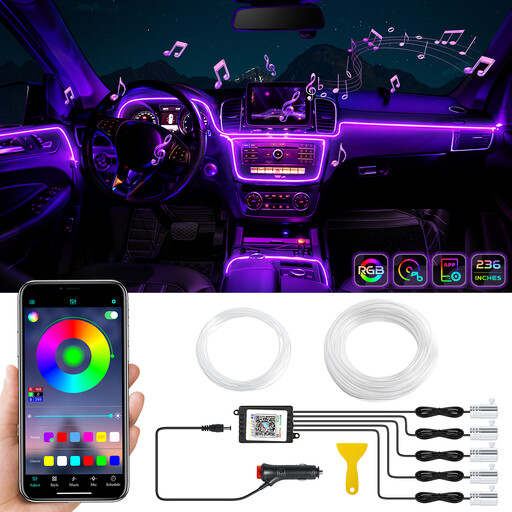
Why it suits this profile: This compact universal kit is aimed at anyone installing car ambient lighting for the first time and wanting to try app control without having to source several separate components.
The product description mentions testing before installation, a 12V connection, a pry tool included in the package and a Bluetooth app. However, check the exact fibre length and cut points yourself.
App-based colour and brightness control, sound function, memory function and a stated range of 10–16V.
Why it suits this profile: Suitable for drivers who want to illuminate the dashboard, footwell, door handles and storage compartments as part of one cohesive installation.
The set specifies six acrylic strips, four footwell lights, four door-handle lights and four door-pocket lights. This makes it clearer which lighting zones are included.
12V system, RGB Smart IC, dual-zone control, multiple controllers and support for fixed and dynamic lighting modes according to the product description.

Why it suits this profile: This comprehensive configuration is suitable for DIY enthusiasts who also want to include door-horn lighting, door pockets and handles.
The product information lists the individual lighting zones, five controllers and cut points. This helps when planning an SUV, van or pick-up, but check the available space for your particular vehicle.
22-in-1 configuration, 593 stated LEDs, 12V power supply, music-reactive mode and separate zones for interior details.
We have put together a complete, up-to-date list of products that fully meet these strict selection criteria and the applicable European safety regulations.
You can with many kits if you are confident working with interior panels and 12V connections. The difficulty depends on the number of zones and controllers. A simple dashboard strip requires less work than a set with door and footwell lighting. Test everything first and, if in doubt, ask a garage to handle the electrical connection.
The lifespan depends on heat, vibration, moisture, installation quality and how the strip is bent or cut. Product descriptions may mention features such as low heat generation or water resistance, but these do not guarantee a fixed lifespan in months or years. A correct 12V power supply and neat installation help prevent unnecessary strain.
Consumption varies depending on the number of lights, brightness and selected effect. A small set with a few strips generally uses less power than an extensive kit with footwell, door-handle and door-pocket lights. Avoid using the lighting unnecessarily when the engine is off, so the vehicle battery is not put under unnecessary strain.
