
Players with an analogue console
You want to record via composite or S-Video, so you’ll first need an input that matches your console’s video output. Elgato and StarTech.com list models with analogue connections.


Start with your retro console’s output: composite or S-Video requires a compatible analogue input, while an HDMI capture card needs a suitable converter first. If you want to play on a separate screen while recording, check the entire signal path and supported signal formats. HDMI pass-through is not the same as the recording preview on your computer.
You want to record via composite or S-Video, so you’ll first need an input that matches your console’s video output. Elgato and StarTech.com list models with analogue connections.
You want to use a separate screen while your computer records. With an analogue console, this may require a signal path via a suitable scaler and HDMI pass-through.
You use consoles with different connection types and want to know whether one device can handle their signals. Magewell lists multiple inputs for the USB Capture AIO.
First, choose a signal path that matches your console’s output. Then decide how you want to play while recording, and only then check your computer, audio and any accessories you’ll need.
Choose this option if: your console outputs composite or S-Video and you want to record that analogue source directly.
Keep in mind: the capture card won’t automatically provide a separate picture on an HDMI screen for you to play on.
Choose this option if: you want to connect your analogue console to an HDMI capture card and a separate screen via a suitable scaler.
Keep in mind: you’ll need a scaler, power supply and suitable cables as well as the capture card.
Choose this option if: you really do want to use several connection types, such as composite, S-Video, component and HDMI.
Keep in mind: check which breakout and conversion cables are included and whether you can play on your chosen screen.
| What to consider | What should you check? | Who is this important for? |
|---|---|---|
| Connection and signal | Make a note of your console’s video and audio outputs, then check that the capture card supports the connection and PAL, PAL/60 or NTSC standard. | If I want to connect my console, I first need to know whether its signal is compatible as is. Around 36% of consumers prioritise this connection. |
| Playing while recording | Plan the signal path to your screen and computer. Check whether the HDMI capture card has a pass-through output and whether an analogue console needs a scaler. | If I want to play on a separate screen while recording, I check the gameplay signal path separately from the computer preview. Around 29% of consumers prioritise the gameplay display. |
| Computer, software and audio | Compare your computer with the model’s system requirements, connect the audio outputs and make a short test recording with picture and sound. | If I want my recording computer ready for both picture and sound, I check the system requirements and audio source in advance. Around 21% of consumers start with the computer and recording setup. |
| Complete setup | Make a list of the components you need for your console, screen and computer. Check what’s in the box and allow for any scaler, power supply and cables you’ll need. | If I need extra converters or cables, I want to include them before choosing a signal path. Around 14% of consumers first consider the complete setup. |
An HDMI input won’t accept a composite or S-Video signal directly. A higher stated resolution doesn’t change the type of input.
First check your console’s video output, then choose a compatible analogue input or a suitable converter to HDMI.
An analogue-to-HDMI setup may also need a scaler, power supply and suitable cables.
Sending a signal to a separate screen and viewing it in your recording software are two different things. A pass-through specification alone tells you nothing about recording-preview latency.
For HDMI capture, connect your screen to the pass-through output and assess the software preview separately.
StarTech.com lists the SVID2USB23 as a discontinued model; it is not the same model number as the SVID2USB232. Elgato says that an HDMI cable is not included with Game Capture Neo.
Check the full model number and box contents before planning your connections.
If an HDMI, console or breakout cable is missing, you may not be able to connect your setup straight away.
Elgato describes both an analogue Video Capture option and the HDMI-based Game Capture Neo.
According to StarTech.com, the SVID2USB232 is a USB recording option for Windows, designed for composite or S-Video.
According to Magewell, the USB Capture AIO is designed for a range of analogue and digital input types.
According to AVerMedia, the Live Gamer MINI GC311 is an HDMI capture option for a compatible HDMI source.
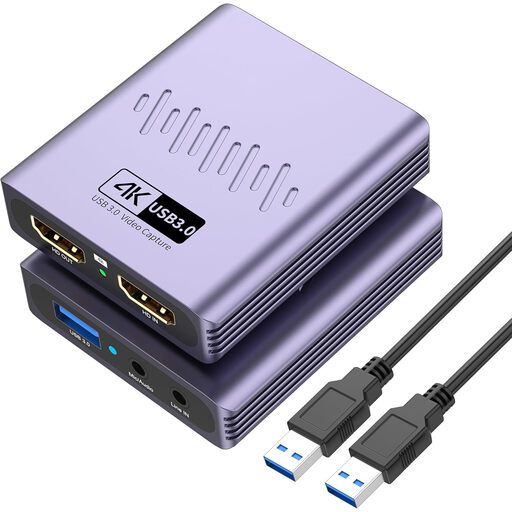
This product selection is for an HDMI setup with a screen connected via pass-through. An analogue retro console will first need a suitable converter to HDMI.
 No image available
Designed for an HDMI source. If you have an analogue console, you’ll need a suitable converter to HDMI before you can connect this card.
The product name lists USB 3.0, 4K pass-through and video recording up to 1080p.
The product name also mentions driver-free installation, a microphone input and a headphone output. HDMI pass-through alone tells you nothing about recording-preview latency.
Not if your console outputs composite video: an HDMI input isn’t an analogue input. Use a capture device with suitable analogue inputs, or check for a converter that’s compatible with your console’s signal and the HDMI capture card.
For an analogue setup, connect the audio outputs too, then select the video and audio sources in your recording software. Make a short test recording; OBS warns that selecting the same audio source twice can cause an echo.
Check the source, cable, signal standard, device detection and software settings in turn. For the SVID2USB23, StarTech.com recommends testing the cable, source and capture device separately, among other steps. Apply these checks to the model you have, but don’t assume they prove general compatibility with consoles.
According to the Dutch government, when you buy online from a business you’ll often have a 14-day cooling-off period. The same guidance doesn’t apply in the same way to purchases from a private individual. If a product is faulty, the seller is your point of contact for your statutory guarantee. The Netherlands doesn’t have a fixed statutory two-year guarantee period for all products.
Don’t assume that rules allowing private use automatically give you permission to make gameplay public. The Dutch government distinguishes between a private copy for personal use and sharing or making content public. Before publishing, check the game footage, music and any relevant permissions or terms of use.