
Vandaag of morgen in huis

Kwaliteit gegarandeerd

Welkomstaanbiedingen ontgrendelen: GRATIS bezorging | Tot 80% korting | Gratis 30 dagen JoyPlus-proefperiode
Download de app
A resistance band with handles looks simple: an elastic band, two handles and you’re ready to go. Yet many people buy a model that isn’t right for their training. The resistance may be too light, the handles may turn in your hands or the material may show signs of wear after only a short time.
To make the right choice, look beyond terms such as “professional”, “extra strong” or “for all exercises”. Ask yourself: what material is it made from, how long is the band, and can you adjust the resistance to suit you?
A label such as medium-resistance fitness band isn’t fully standardised. What feels challenging to a beginner may be too light for an experienced athlete. The tension also changes as you stretch the band further.
Check whether the product description gives a specific resistance level, includes multiple bands or has interchangeable parts. A single band can be practical for a set routine, while a set gives you more scope to adjust the resistance.
Foam handles can feel comfortable, but comfort also depends on their shape and width, and on how they’re attached to the band. A resistance band with foam handles isn’t automatically suitable for long or intensive sessions.
Look for a secure attachment and, if available, a safety loop. While using the band, check that it doesn’t pull to one side and that the handles have no sharp edges or loose parts.
TPE and natural latex have different properties. Joybuy’s medium-resistance band is made from TPE. The Capelli Sport model uses natural latex, foam and plastic clips. Latex can cause an allergic reaction in people who are sensitive to it. Check the material information before ordering.
Don’t store an elastic training band in direct sunlight, near a heat source or in a damp place for long periods. Before every workout, check the band for cracks, thin patches and damage. Don’t use a damaged band.
TPE is a synthetic elastic material used in a range of fitness products. The medium-resistance band in our selection is made from TPE and has a tube length of 120 cm.
Natural latex is often used in bands that stretch considerably and offer interchangeable resistance levels. The Capelli Sport model comes as a set of three latex cords with light, medium and heavy resistance. If you’re sensitive to latex, you may prefer a product whose material composition is suitable for you.
Neither material makes a band automatically right for every user. Its construction, attachments and finish, as well as using it correctly, all matter.
A length of 120 cm gives you room for exercises such as bicep curls, triceps kickbacks and front raises. For some leg and back exercises, the way you anchor the band is especially important. Only use an anchor point designed for this purpose, and check that it’s secure.
A resistance band for home use should also suit the space you have available. Make sure there’s nothing in the stretch area, including furniture, walls or other people.
Fixed handles are simple to use: attach the band and get started. A set with clips gives you more flexibility. With the Capelli Sport 3-in-1 model, you can combine the light, medium and heavy bands or use them separately.
This is handy if several people use the same band or if you do different exercises. However, more parts mean more attachment points to check before use.
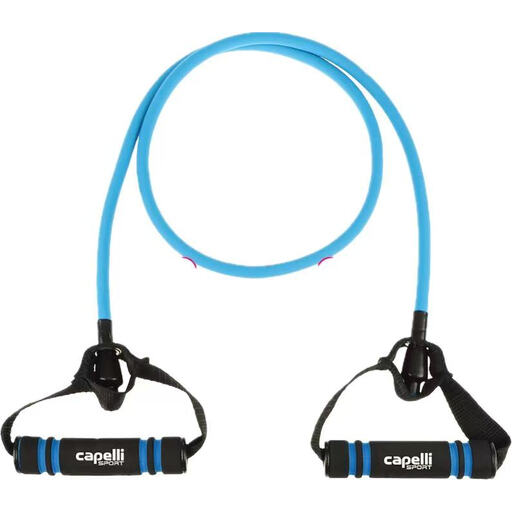
Why it suits this profile: This single TPE model is 120 cm long and designed for strength training, home workouts, Pilates and general fitness. It’s a straightforward choice if you want to get started without buying a large set.
The material composition and tube length are specified, so you don’t have to rely on a general claim about strength alone. Check that medium resistance is right for your level.
TPE material, foam handles, one band and a length of 120 cm. Suitable for exercises including arm curls, triceps kickbacks and front raises.
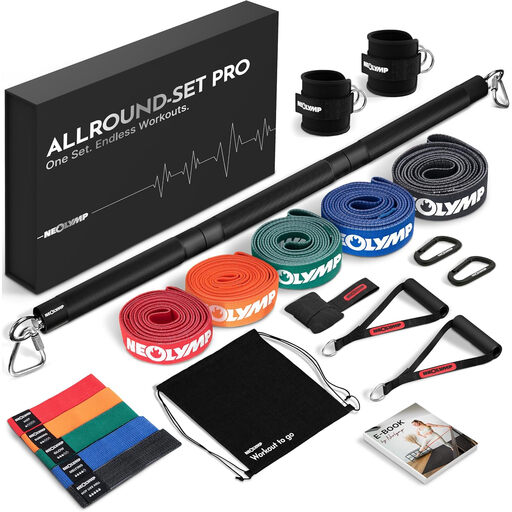
Why it suits this profile: The product name describes an all-round set with accessories and 400 exercises. It’s a good fit for users who want to explore different types of training rather than stick to one routine.
A set can help overcome the limitations of a single fixed resistance. Before buying, check which accessories and resistance levels are actually included in the box.
All-round positioning, accessories according to the product name and a claim of 400 exercises. Check the specifications for each item before ordering.
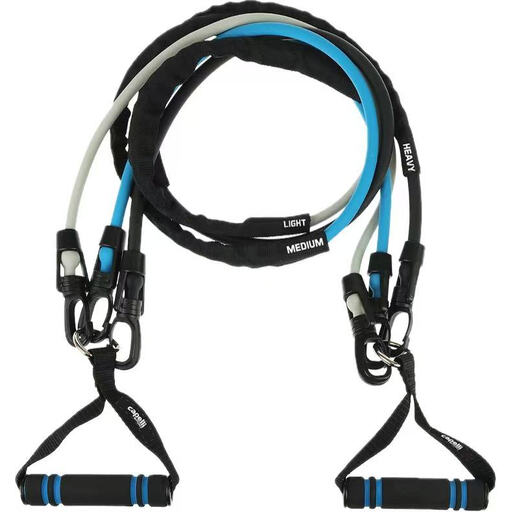
Why it suits this profile: Three interchangeable latex cords with light, medium and heavy resistance give you more ways to adjust the load for strength training and different users.
You’re not limited to one resistance level: add or remove bands using the clips. Before each session, check the clips, bands and foam handles for signs of wear.
Three resistance levels, easy-adjust clips, foam sure-grip handles and a length of 120 cm per band. Please note: the material contains natural latex.
A fitness resistance band can be used for controlled movements, light strength training and toning. With Pilates, it’s especially important to move slowly and avoid letting the band snap back uncontrollably.
For resistance bands for physiotherapy, resistance bands for rehabilitation or exercises after an injury, personal advice is important. A doctor or physiotherapist can advise you on the resistance, range of movement and number of repetitions that suit your situation. Product information alone is no substitute for treatment advice.
Start with minimal tension and keep the band away from your face and other people. Don’t stretch it further than the manufacturer recommends, and don’t use a band with visible damage.
We’ve put together a complete, up-to-date list of products that meet these strict selection criteria and the applicable European safety regulations.
First, check the handles, bands and clips for cracks or loose parts. Stand firmly when using the band with your feet. If you’re using a door anchor or another attachment point, make sure it’s suitable for the band and securely fastened. Leave plenty of space around you and don’t let the band snap back uncontrollably.
Its lifespan depends on how often you use it, how far you stretch it, how you store it and what it’s made from. Direct sunlight, heat, sharp edges and overstretching can speed up wear. There’s no set lifespan that applies to every band. Replace it as soon as you notice cracks, thin patches or damaged attachments.
It can be, but “medium” doesn’t have a universal meaning. The right choice depends on the exercise, your technique and how much tension you can control comfortably. For beginners, a light resistance band or a model with several levels is often more practical. Start slowly and only increase the resistance once you’ve mastered the movement.
