
Vandaag of morgen in huis

Kwaliteit gegarandeerd

Welkomstaanbiedingen ontgrendelen: GRATIS bezorging | Tot 80% korting | Gratis 30 dagen JoyPlus-proefperiode
Download de app
A resistance band with handles is compact, relatively easy to store and suitable for exercising at home, at the gym or while travelling. However, resistance bands vary considerably in their material, attachment points and ease of use. A low price doesn’t automatically mean a band is right for your training, while you may not always need an extensive set.
Look out for these common pitfalls:
A single band with a fixed resistance level can be practical if you already know what resistance you need. For beginners, a light or medium level is often easier to manage than a set with lots of separate components. If you want to build up gradually, consider an adjustable resistance band or a resistance band set with multiple bands.
When comparing products, check:
A fitness band with handles doesn’t work in the same way as a dumbbell. Tension usually increases as you stretch the band further. Move in a controlled way and don’t let the band snap back.
The products featured here are made from TPE or natural latex. TPE can be a practical choice if you’re looking for a latex-free elastic resistance band. If you choose natural latex, read the warning about possible allergic reactions.
The material alone doesn’t determine how long an exercise band will last. Storage, stretch range and frequency of use also play a part. Store your band somewhere cool and dry, away from direct sunlight. Don’t use it if you notice any cracks, fraying or deformities.
A tube length of 120 cm features across several of the products available. The right length depends on your height, the exercise and the range of movement you want. A comfortable grip is important for arm curls, front raises and triceps kickbacks. If you’re placing the band under your feet for an exercise, the connection needs to stay secure.
Before buying, check:
Handles are often more convenient than a simple loop for strength training with resistance bands. A basic model may be enough for Pilates or gentle mobility exercises. If you’re looking for a resistance band for physiotherapy, it’s best to choose a resistance level that matches your practitioner’s instructions. A band is no substitute for personalised exercise advice.
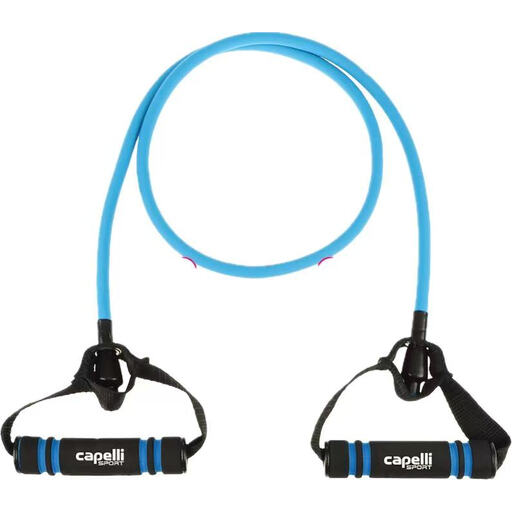
Why it suits this profile: This is a single medium-resistance TPE band with foam handles and a length of 120 cm. It’s a straightforward choice if you want to get started at home without buying several bands straight away.
The material, resistance level and tube length are specified, so you don’t have to rely solely on a vague description such as “strong”.
TPE material, foam handles, safety strap and a 120 cm tube, according to the product description.
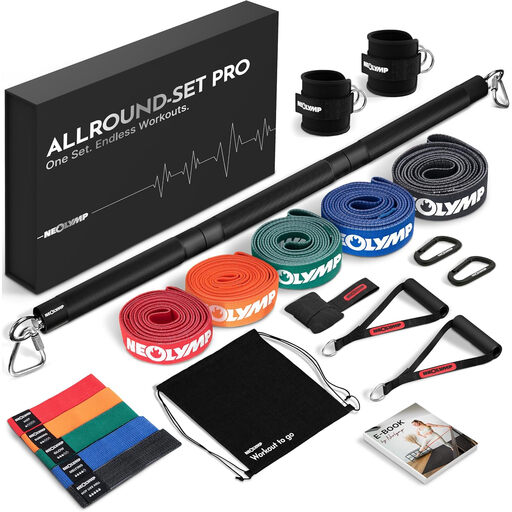
Why it suits this profile: The product name describes this as an all-round set with accessories and a range of training options. It’s a good fit if you want to try different exercises rather than sticking to just one type of training.
A set with accessories may save you having to look for separate components later. Before buying, check exactly which accessories are included.
An all-round set, accessories and a product listing that mentions 400 exercises; check the product page for the exact contents of the set.
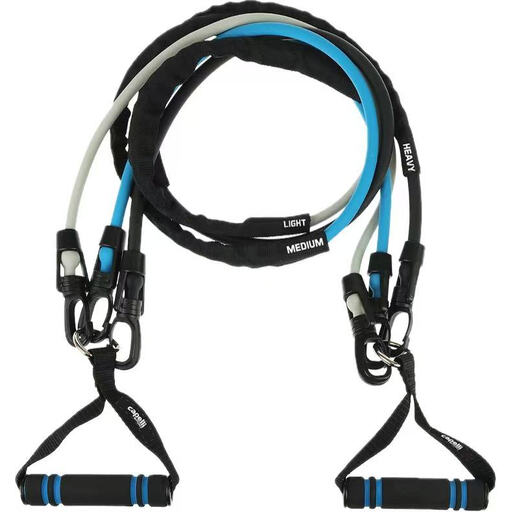
Why it suits this profile: According to the product description, this set includes three interchangeable latex cords with light, medium and heavy resistance. It’s practical if you want to adjust the load for each exercise.
The easy-adjust clips let you add or remove bands, so you’re less likely to be stuck with just one resistance level. Check the clips before each use.
Three resistance levels, 120 cm per band, foam handles and adjustable clips, according to the product information. Please note: it’s made from natural latex.
Inspect your resistance band for home use before every session. Look for small cracks, thin patches, loose clips and damaged handles. Don’t stretch the band beyond its natural elasticity, and never point it at your face or someone else’s.
After use, wipe the surface with a slightly damp cloth. Let the band dry completely before putting it away. Keep it away from direct sunlight, radiators and sharp edges. Take extra care if you have a known latex allergy and are using a latex resistance band.
We’ve put together a complete, up-to-date list of products that meet these strict selection criteria and the applicable European safety regulations.
Yes, as long as you start with an appropriate resistance level and move in a controlled way. A medium band may suit some beginners, but the tension you need varies depending on the exercise and the person. Start with a small range of movement and only increase the load once your technique is consistent.
Its lifespan depends on the material, how often you use it, how far you stretch it, and how you store and care for it. There’s no set lifespan that applies to every band. Replace it as soon as you notice cracks, wear or lasting deformities, even if it still seems usable.
You can use one for certain exercises, but choose the resistance carefully. For Pilates, a light band that’s easy to control is often more practical. For physiotherapy or rehabilitation, follow your practitioner’s instructions and don’t use a damaged band.
