
Vandaag of morgen in huis

Kwaliteit gegarandeerd

Welkomstaanbiedingen ontgrendelen: GRATIS bezorging | Tot 80% korting | Gratis 30 dagen JoyPlus-proefperiode
Download de app
A resistance band with handles may seem simple, but a few small details can make the difference between a comfortable training aid and a purchase you regret. A band may look sturdy in the product photo, yet its resistance might not be clearly explained, the handles may be uncomfortable or it may not be the right length for your exercises.
This is especially important if you work out at home, are looking for a fitness band for strength training or want a resistance band for physiotherapy and mobility exercises. So don’t base your choice on colour or the number of exercises mentioned in the description alone.
Terms such as ‘medium’, ‘heavy’ or ‘extra strong’ don’t mean the same thing across all brands. A medium resistance band from one brand may feel different from a medium band from another. Check whether the seller provides further details about:
For beginners, a medium-resistance band is often a practical choice for arm, shoulder and back exercises. More experienced users may find that a single medium band doesn’t offer enough of a challenge for leg or back training.
With an exercise band with handles, the grips are more important than many product photos suggest. Check whether the band has:
Comfortable handles are particularly helpful for repeated movements such as bicep curls, triceps extensions and front raises. Before every workout, check the band, seams and attachment points for tears or signs of wear.
Not every resistance band is suitable for every type of training. A long band with handles works differently from a short loop band. A stretch band with loops, on the other hand, is mainly designed for controlled stretching and mobility exercises.
Use a resistance band for strength training according to the product instructions. For rehabilitation or physiotherapy, it’s a good idea to agree on the movements and resistance with your healthcare professional. A product description isn’t personal training advice and doesn’t replace professional guidance.
TPE, or thermoplastic elastomer, is often used in fitness bands. It generally feels smooth and may be suitable for general exercises. If you’re sensitive to certain materials, check the material specifications and any allergen information.
Polyester is more commonly used for stretching and flexibility bands. A stretch band with loops, for example, serves a different purpose from an elastic fitness band with handles. So check what the band is designed for before considering its appearance.
A 120 cm band offers different training options from a 68-inch band, which is approximately 173 cm long. A shorter model is useful for exercises where you hold the band with both hands. A longer band gives you more room for overhead movements or stretching.
Also check whether you want to attach the band to a door, pole or another fixed point. Only do so if the manufacturer specifies a suitable attachment or method of use. Never pull on a band that’s rubbing against a sharp edge.
Decide in advance what you want to use the band for:
Higher resistance isn’t automatically better. A band that’s too strong can disrupt your movement pattern.
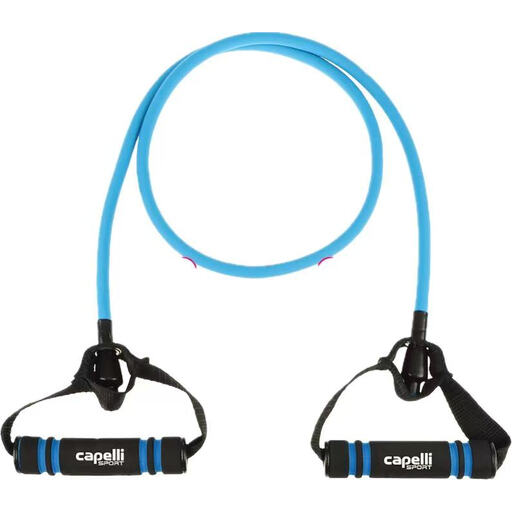
Why it suits this profile: This single medium band is a straightforward option for home use, without a complicated set of multiple resistance levels. It’s 120 cm long and has foam handles.
The product information specifies the TPE material, length and resistance level. That means you don’t have to rely on a colour code or vague marketing term alone.
TPE material, a 120 cm tube and foam handles. Suitable for curls, triceps exercises and front raises, among other movements.
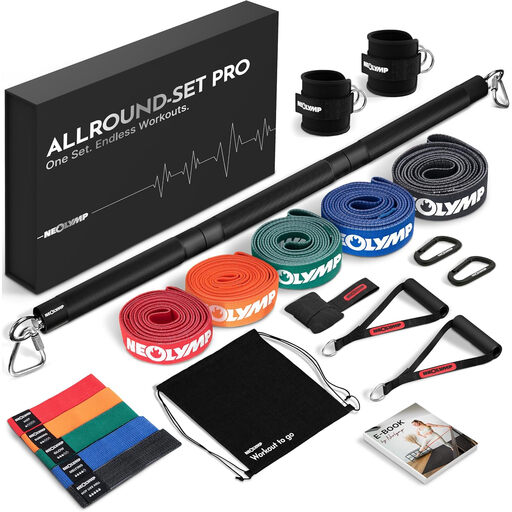
Why it suits this profile: The product name describes an all-round set with accessories and 400 exercises. It may suit users looking for variety, but check the full contents, resistance levels and dimensions before buying.
A set may offer multiple resistance levels, but the available product specifications here aren’t complete. Check what’s included before you order.
Described as an all-round set in the product name, with accessories and a stated selection of 400 exercises. Check the specifications first.
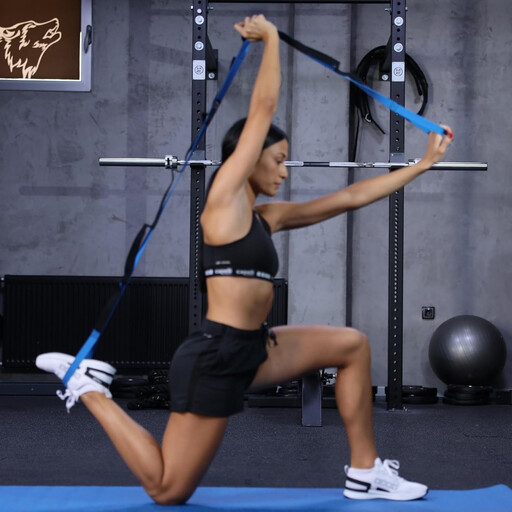
Why it suits this profile: This isn’t a traditional resistance band with handles, but an aid for flexibility, balance and leg stretching. The eight loops offer different hand and foot positions.
The eight loops make positioning clearer than with a smooth, unmarked band. This lets you adjust the stretch gradually.
Eight loops, polyester material and a length of 68 inches. Designed for yoga, ballet, stretching and mobility.
We’ve put together a complete, up-to-date list of products that meet these strict selection criteria and the applicable European safety regulations.
Start with a gentle movement and check that the band isn’t twisted. Keep the tension under control throughout each exercise and don’t let the band snap back suddenly. Don’t use the band if you notice any tears, thin patches or damaged handles.
Store your fitness band somewhere dry and out of direct sunlight. Heat, sharp objects and poor storage over a long period can affect how long it lasts. A band’s lifespan depends on its material, how often you use it, how far it’s stretched and how well it’s maintained. There’s no set lifespan that applies to every model.
Yes, as long as you choose a resistance that lets you perform the movement with control. A medium model can be a practical option for general exercises, but its suitability depends on your fitness level and the type of exercise.
Sometimes, but choose the resistance and exercises in consultation with your physiotherapist. A band is a tool; using the right technique and applying the right level of resistance are more important than choosing a high resistance.
Use the band on a smooth surface, keep it away from sharp edges and check it regularly. Store it clean and dry, and stop using it straight away if you notice any visible damage.
