For patch photos, a remote shutter release is especially useful if you want to choose when to take the shot without touching the camera. If the camera is stable and a timer is all you need, you may not need to buy anything extra. Canon Netherlands lists the self-timer and a remote control as options when using a stable camera. If you do choose a separate shutter release, check that the cable or wireless control is compatible with your exact camera model. None of these options can, on its own, correct incorrect focus or moving fabric.
Who is this relevant to?
Photographer with an existing camera
You want to check before buying whether a shutter release or the camera’s built-in controls work with your exact camera model. Canon Netherlands and Nikon Netherlands explain compatibility by camera and accessory.
Photographer capturing fine patch details
You photograph small embroidery details with a stable setup and want to avoid touching the camera when taking the shot. Canon Netherlands describes remote control and the self-timer as options when using a stable camera.
Photographer taking product photos in batches
You photograph several patches in a row and want to choose when to take each shot without reaching for the camera. Canon and Nikon product information describes both wired and wireless controls for specific models.
What should you look for when choosing?
Self-timer or camera app
Choose this when: the camera is stable and you don’t need to take the shot at a precise moment of your choosing.
Bear in mind: the timer delays the shot, while app control depends on the camera. Canon Netherlands describes Camera Connect for compatible cameras.
Wired shutter release
Choose this when: you’re staying by the setup and want to take the shot without a wireless connection.
Bear in mind: the cable limits where you can stand. Check the connection and camera model compatibility of the specific accessory.
Wireless shutter release
Choose this when: you want to move around the setup without a cable.
Bear in mind: the camera must support that specific remote control. Also check the pairing requirements and power supply.
If you’re buying a separate shutter release, always check your camera’s full model name and the connection or wireless support listed by the manufacturer for that accessory.
| What to consider |
What should you check? |
Who should prioritise this? |
| Compatibility |
Check your camera’s full model name, the port type and the compatibility list for the specific shutter release. Bluetooth on the camera does not, by itself, prove that a particular remote control will work. |
I want to make sure the control works with my camera first; the right connection or supported wireless feature is essential. Around 36% of consumers prioritise compatibility. |
| Taking photos without touching the camera |
Compare a separate shutter release with the self-timer you may already have. Assess focus and patch movement separately. |
For small details, I don’t want to touch the camera when taking a shot, and I want to keep the setup stable. Around 29% of consumers prioritise reducing camera shake when taking photos. |
| Taking multiple shots |
Compare the freedom of movement offered by a cable with that of a compatible wireless control; consider whether pairing fits your workflow. |
When photographing several patches, I want to choose when to take each shot without reaching for the camera every time. Around 21% of consumers prioritise flexible, repeated shooting. |
| Avoiding extra accessories |
Test the features you already have and check which cable, plug or adapter, if any, is needed for your camera model. |
I want to find out whether a timer or supported app will do the job before buying a separate accessory. Around 14% of consumers want to avoid unnecessary purchases and extra accessories. |
Common buying mistakes
-
Assuming a matching camera name means it’s compatible
Manufacturers list compatible camera models and connections for each accessory. The wrong connection may mean the shutter release won’t work, or that you’ll need to buy a suitable adapter.
Before buying, compare your camera’s full model name and required port type with the information for the specific shutter release.
-
Expecting a shutter release to prevent all blur
Taking a shot remotely means you don’t touch the camera when releasing the shutter, but it won’t correct incorrect focus or movement of the patch.
Take a test shot with a stable setup, and assess focus and movement separately.
-
Buying a separate shutter release before trying the timer
If the self-timer already suits your workflow, an extra accessory may be unnecessary.
Try the existing timer first, and only buy a separate control if the delay or the way it works is a problem for you.
Brands to consider
Canon
Canon offers the wired RS-80E3 for cameras with a compatible E3 connection, as well as the wireless BR-E1 for the compatible models listed.
- Canon describes remote control and a lock function for the RS-80E3; for the BR-E1, it lists Bluetooth control.
- Features and compatibility lists apply to each accessory, not to every Canon camera.
Nikon
Nikon offers the MC-dc2 cable for certain cameras with a compatible accessory connection, and the ML-L7 as a Bluetooth option for specific cameras.
- Nikon describes operation without touching the camera body for the MC-dc2, and a separate photo button for the ML-L7.
- The product information does not say that these accessories are compatible with all Nikon cameras.
Sony
The RMT-P1BT is a wireless option for supported Sony cameras with the appropriate Bluetooth remote control function.
- Sony lists a status LED and operation without a clear optical line of sight for the RMT-P1BT.
- These features apply to this accessory and do not confirm compatibility with every Sony camera.
Fujifilm
The RR-100 is a wired shutter release for the X and GFX models listed on the Dutch product page.
- Fujifilm lists an L-shaped extension cable for a 2.5mm connection as included.
- For some models, Fujifilm specifies an adapter from another manufacturer; check what your camera requires.
JJC
JJC makes the wired MA-R, among other products, and describes it as a replacement for the Fujifilm RR-90.
- For the MA-R, JJC lists a half-press for autofocus, a lock function and operation without its own battery.
- The product information does not confirm that this specific MA-R is universally compatible; check the connection and camera support.
Products on Joybuy
This selection is suited to compact setups with a tripod and remote control. Check that the controls on your chosen product work with your camera.
 No image available
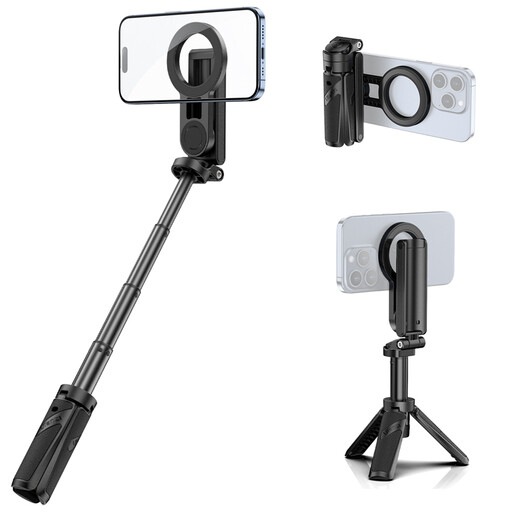
Ulanzi JJ03 3-in-1 magnetic tripod/selfie stick with 10 m remote control
For a compact setup, the product name lists a 3-in-1 tripod/selfie stick with magnetic attachment, 360° rotation and a remote control with a range of up to 10 m. Check that the controls are compatible with your camera.
Keep the strong magnets at least 15 cm away from pacemakers, defibrillators and other medical implants. Test the magnetic attachment before letting go of the setup.
View on Joybuy
Frequently asked questions
Do I need to buy a remote shutter release for patch photos taken with a tripod?
No, not always. Try the self-timer first; with compatible cameras, a supported app may also let you release the shutter remotely. A separate shutter release is most useful if you want to choose when to take the shot without touching the camera.
How can I tell whether a shutter release is compatible with my camera?
Check your camera model’s manual and the compatibility information for the specific accessory. A wired shutter release needs the right connection; a wireless model needs support for that particular remote control and may need to be paired. Take a test shot after connecting it.
What can I do if the patch is still out of focus when using remote control?
Remote control only prevents you from touching the camera when taking the shot. Also check the focus, camera stability and whether the fabric is moving.
What are my rights when buying online in the Netherlands?
For an eligible distance purchase from a business, the Dutch government generally provides a 14-day cooling-off period. You are also entitled to a product that is fit for purpose; if there is a fault, the seller is your point of contact for the legal guarantee. The Netherlands does not have a fixed, general statutory guarantee period of two years.


