First, check which controls are supported by your exact camera model. A compatible remote shutter release lets you trigger the shutter without touching the camera body, but it won’t automatically adjust focus or lighting. For a fixed tripod setup, a compatible cable may be all you need. If you move around your figures and lights, consider a supported wireless remote or camera app.
Who can benefit from a remote shutter release?
Photographers with a fixed tripod setup
If you photograph figures from a fixed position, a compatible shutter release lets you trigger the shutter without touching the camera body. Your camera’s connection determines whether a cable will fit; Nikon lists the MC-DC2 for certain cameras.
Creators who rearrange their setup
If you move between the camera, figures and lights, wireless control can keep the area around your worktable clear. Your exact camera model must support the remote you choose; Nikon and Canon publish model-specific information about their wireless options.
Photographers who want to try an app first
Before choosing a separate accessory, check whether your existing camera and phone can take photos remotely. Canon UK describes control via Camera Connect for many Canon cameras and notes that not all app features are available on every camera.
What should you look for in a remote shutter release?
Wired remote shutter release
Choose this option if: you usually stand beside a fixed tripod setup and your camera supports the connection.
Bear in mind: the cable needs to reach your working area without getting in the way.
Wireless remote control
Choose this option if: you want to move around your figures or lights and your camera supports the specific remote.
Bear in mind: compatibility and available buttons vary between camera and remote combinations.
Control via a camera app
Choose this option if: your camera and phone support the remote shooting you need, and you want to see whether you need a separate accessory first.
Bear in mind: Canon warns that not all Camera Connect features are available on every camera.
| What to consider |
What to look for |
Who it matters to |
| Compatibility |
Check your exact camera model and the connection or wireless control it supports. Also check whether your setup needs an adapter. |
I want to make sure the shutter release works with my camera before choosing one. Around 36% of consumers put compatibility first. |
| Triggering the shutter without touching the camera |
Choose a supported way to trigger the shutter remotely. If you’re using a cable, check that it reaches your working area without disturbing your setup. |
If I don’t want to touch my camera on a tripod when taking a photo, remote control is my main priority. Around 29% of consumers say the same. |
| Space around your setup |
Check that your camera supports the specific wireless remote and find out which functions it offers. |
I don’t want to have a cable trailing across my worktable while moving figures or lights. This is the main concern for around 21% of consumers. |
| Avoiding a separate accessory |
First, try taking photos with your camera and phone. Check that the app offers the features you need. |
If I can already control my camera through an app, I’d rather not buy another shutter release unnecessarily. Around 14% of consumers put this first. |
Common mistakes when choosing
-
Choosing a shutter release based on the camera brand alone
A connection or wireless feature won’t necessarily work with every camera from the same brand. Some combinations also require a specific adapter.
Look up your exact camera model in the compatibility information, then check the connection and any adapter requirements before choosing.
An incompatible connection can make the shutter release unusable; some combinations may also need an adapter.
-
Expecting the shutter release to control focus and lighting too
A remote shutter release means you don’t need to touch the camera body to take a photo, but it won’t automatically ensure your figures are in focus or correctly lit.
Check focus and exposure separately. Only use remote focus-checking features if your camera model supports them.
-
Buying a separate remote without trying the camera app
For some cameras, a supported app may already offer the remote shooting you need.
First, try taking photos with your camera and phone, and check that the app features you want are available on your camera model.
Camera brands to consider
Canon
For specific EOS cameras, Canon offers wired and wireless remote controls, as well as control via Camera Connect.
- Canon lists an N3 connection and an 80 cm cable for the RS-80N3.
- The BR-E1 has its own compatibility list. Canon says that not all app features are available on every camera.
Nikon
Nikon describes the MC-DC2 as a wired option for certain cameras and the ML-L7 as a wireless option for specific models.
- Nikon says the MC-DC2 lets you trigger the shutter without touching the camera body and supports Bulb mode.
- The ML-L7 has separate photo and video buttons, but both remotes require compatibility with your exact camera model.
Sony
According to Sony, the RMT-P1BT is designed to control supported Sony cameras wirelessly.
- Sony describes a status indicator and control without a clear line of sight.
- Check whether your camera model is supported; the product description doesn’t demonstrate an advantage over other brands.
FUJIFILM
The wired RR-100 is an option for the X and GFX cameras listed on the Dutch accessories page.
- The product information lists an L-shaped extension cable for a 2.5 mm connection as included.
- For certain camera models, FUJIFILM lists a separate adapter; check the guidance for your model.
Joybuy products for remote control
These options include smartphone tripods with remote controls and a remote for the Osmo models listed. Check that your recording device is compatible: smartphone accessories are not the same as a remote shutter release for a dedicated camera.
 No image available
KINSI selfie stick with tripod, 170 cm
A good choice if you want to control a compatible smartphone camera remotely from a tripod setup.
Bluetooth remote control; for smartphones from 4.7 to 6.0 inches.
Joybuy
 No image available
Osmo Action GPS Bluetooth remote control
Designed for remote control of the listed Osmo cameras; check whether your model appears in the compatibility information.
Models listed: Osmo Action 4, Osmo Action 5 Pro, Osmo 360 and Osmo Action 6.
Joybuy
 No image available
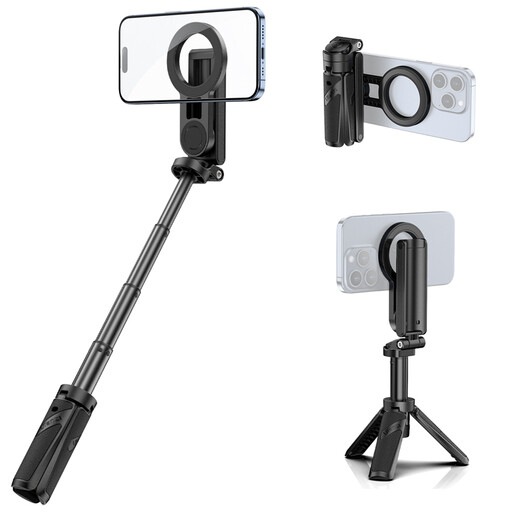
Ulanzi JJ03 magnetic 3-in-1 tripod with selfie stick
Ideal for a smartphone setup where you want to combine a tripod with remote control.
Remote control with a stated range of 10 m; 360° rotating phone holder; for iPhone and Android.
Joybuy
 No image available
Ulanzi JJ02 Bluetooth selfie stick with tripod
Suitable for a smartphone setup with a tripod and remote control; check that the holder suits your needs.
Extendable; with two cold shoe mounts and designed for iPhone and Android. Keep the strong magnets at least 15 cm away from pacemakers, defibrillators and medical implants; test the magnetic attachment before use.
Joybuy
Frequently asked questions
Do I always need a remote shutter release as well as a tripod?
No, you don’t always need a separate accessory. Canon UK describes remote shooting via Camera Connect for supported cameras; check whether your camera and phone offer the control you need. A tripod alone won’t prevent the setup from moving when you press the camera’s shutter button.
How do I check whether a wired shutter release will connect?
Look up your exact camera model in the compatibility information and check the connection. For example, the Canon RS-80N3 has an N3 connection; FUJIFILM’s Dutch product information says that some RR-100 combinations need an adapter.
What should I check when setting up and using a camera app?
First, check whether your camera supports remote shooting through the app, then try connecting and using the feature you want. Canon UK says that not all Camera Connect features are available on every camera.
Where can I recycle a flat battery from a wireless remote?
The Dutch government lists shops and supermarkets that sell batteries, among other places, as battery recycling points. So don’t put a flat battery in your household rubbish.


