
Photographer looking for the right fit
You want to avoid buying a remote shutter release with the wrong connector or wireless support. Start by checking your full camera model and the manufacturer’s compatibility information.


For close-ups of vintage badges, you may not need a separate remote shutter release. Set your camera up securely and try the self-timer or an app that supports your camera first. A separate release is useful if you want to take a shot straight away without touching the camera; just make sure you choose one that’s compatible with your exact camera model. With the Canon RC-6, you also need to operate it from the front of the camera, according to the Canon Netherlands Store.
You want to avoid buying a remote shutter release with the wrong connector or wireless support. Start by checking your full camera model and the manufacturer’s compatibility information.
You’re taking close-ups in window light and want to take a shot without touching the camera or disturbing the framing. A tripod and remote control can help.
You want to keep the space around your badges and the window light clear. So think about where the cable will run, where you’ll be operating the camera from and whether your camera already has a suitable app.
First, check that the remote is compatible with your exact camera model. Then make sure its method of operation suits your set-up.
| What to consider | What to check | Who is this important to? |
|---|---|---|
| Compatibility with your camera model | Check your full model number against the compatibility information, and look at the connector and any adapter requirements. | I want to be sure the remote shutter release will work with my camera before I buy it. Around 36% of consumers put compatibility first. |
| Taking a shot without touching the camera | Check whether the self-timer, camera app or remote shutter release is supported, and whether features such as half-press or a lock function are available for the way you work. | When taking close-ups with a tripod, I don’t want to touch the camera as I take a shot. Around 29% of consumers prioritise this. |
| Space around the badges and window | Check where a cable will run. With infrared, the direction you operate the remote from matters, while Bluetooth still requires camera compatibility. | I want to be able to move around a small table set-up without a cable getting in the way. Around 21% of consumers say having room to move is their main concern. |
| Avoiding unnecessary extra controls | Try the supported app or self-timer first. Choose a separate remote shutter release if direct control would be useful to you. | I want to find out whether an existing camera feature will do the job first. Around 14% of consumers prioritise simple operation without an extra purchase. |
A plug that fits doesn’t prove that the remote shutter release will work with your camera model. Some models may also need an adapter.
Before choosing, check your full camera model, the connector and the manufacturer’s compatibility information.
Bluetooth and infrared work differently. The Canon RC-6 uses infrared from the front of the camera, while the BR-E1 uses Bluetooth.
Choose based on where you’ll be standing as you take photos, and check which technology your camera supports.
For a stationary badge, the self-timer or a supported camera app may be all you need.
First, take a test shot with your camera on a tripod. Then decide whether you need direct control.
Canon offers wired, Bluetooth and infrared controls. For these product ranges, choose based on your EOS or PowerShot model, not just the brand.
The MC-DC3 is a wired remote shutter release for compatible Nikon Z cameras, while the ML-L7 is designed for specific Nikon cameras. Nikon also describes SnapBridge as a possible way to control the camera remotely for close-ups.
The RR-100 is a wired remote shutter release for specified X and GFX models. Some models need an adapter.
The RMT-P1BT is a Bluetooth remote control for compatible cameras.
These options combine a Bluetooth remote control with a phone holder or tripod and are designed for smartphone photography. They don’t confirm compatibility with a camera body; check this separately if you’re using a camera.
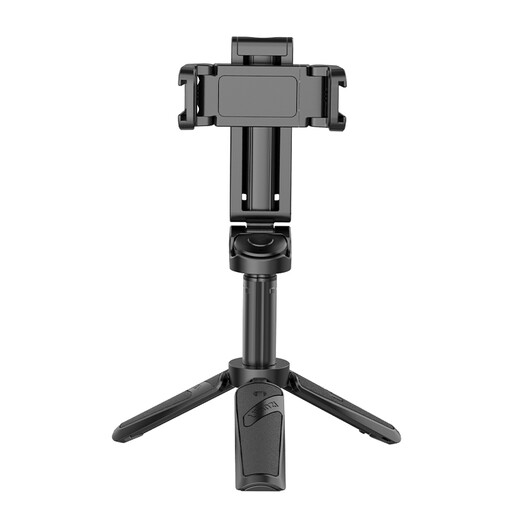 No image available
An option for smartphone photography if you want to mount your phone on a tripod and take shots remotely.
The product title lists compatibility with iPhone and Android, as well as two cold shoe mounts. According to the product information, the remote control is not waterproof.
Secure your phone in the clamp. In windy conditions or on uneven ground, use the tripod only at its lowest height.
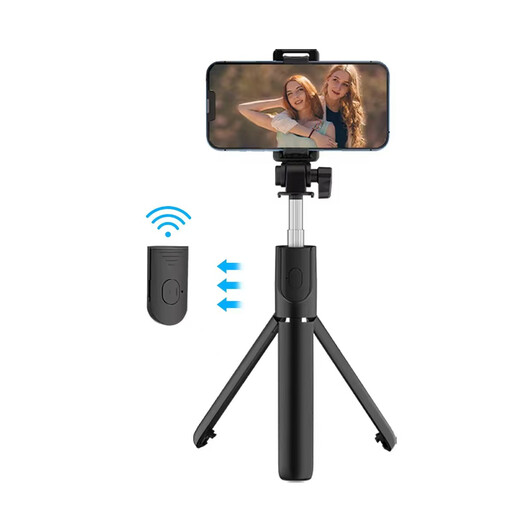 No image available
A phone holder with a Bluetooth remote control and tripod function for taking smartphone photos remotely.
The product title lists an extendable length of 1.9 m.
Secure your phone and make sure all three tripod legs are stable before taking photos. Don’t extend the telescopic pole beyond its maximum length.
No image available
A phone holder with a Bluetooth remote control and tripod function for taking smartphone photos remotely.
The product title lists two lights and an extendable length of 1.9 m.
Secure your phone and make sure all three tripod legs are stable before taking photos. Don’t extend the telescopic pole beyond its maximum length.
Not necessarily. Try the self-timer first or, if your camera supports it, control it through a camera app. A separate remote shutter release is most useful if you want to take shots straight away, repeatedly, without touching the camera.
First, check the information for your camera model and connector. Route the cable away from your subject and test that the camera stays steady. Some camera models need an adapter for the Fujifilm RR-100; check the latest manual for your model.
Before buying, check whether your camera needs an adapter or battery. For a consumer purchase in the Netherlands, contact the seller if a product is faulty; the Government of the Netherlands states that there is no fixed statutory guarantee period. Online purchases from a business usually come with a 14-day cooling-off period, with some exceptions.
The Dutch Authority for Digital Infrastructure outlines the requirements of the Radio Equipment Directive for radio equipment sold in the Netherlands. When a product complies, the manufacturer applies the CE marking; sellers also have duties to check compliance. This doesn’t confirm that any particular model meets the requirements.
Take small electrical appliances to a suitable collection point. Milieu Centraal recommends removing the battery from the appliance, if possible, and taking it to a collection point for used batteries.