
Vandaag of morgen in huis

Kwaliteit gegarandeerd

Welkomstaanbiedingen ontgrendelen: GRATIS bezorging | Tot 80% korting | Gratis 30 dagen JoyPlus-proefperiode
Download de app
A remote-controlled car for children may seem easy to choose at first glance. However, models vary considerably in terms of controls, batteries, terrain and recommended age. A low price can be tempting, but a car that only works on a smooth floor or whose battery runs out quickly often ends up back in the cupboard.
Pay particular attention to these common pitfalls:
For children aged 3 and over, a remote-controlled toy car with forward, reverse and left-right controls is usually easier to understand than an advanced stunt car with several modes. Always check the stated age range and warnings. Models with small parts are not suitable for children under 3 and require adult supervision.
A 2.4GHz remote control is practical when several children want to play at the same time. According to the product descriptions of the models mentioned, this technology allows multiple vehicles to operate alongside one another without their signals normally interfering. The actual range and performance depend on the environment and how the vehicle is used.
A 4WD RC car is powered by all four wheels and is generally designed to provide more grip and climbing ability than a 2WD model. Also look out for:
For indoor use on tiles, wood or short-pile carpet, a compact RC car may be perfectly adequate. For outdoor driving, a remote-controlled off-road vehicle with larger tyres makes more sense. A model described as “off-road” is not automatically suitable for deep puddles or mud.
A rechargeable RC car saves you from having to buy new vehicle batteries for every play session. Check the voltage, capacity and included charging cable. A higher capacity does not automatically mean that the car will run for longer; motor power, terrain and driving style also have an effect.
Pay attention to the difference between the vehicle battery and the remote control. Several models come with a rechargeable lithium battery, while the remote control still requires 2 AA batteries. Store batteries in a dry place, charge them according to the instructions and remove them from the toy when it will not be used for an extended period.
Water resistance deserves extra attention. “Waterproof” or “suitable for use in water” should be read in the context of the product description. Shallow water, a swimming pool and rain are not the same as submersion. Always check that the vehicle is dry after use before storing or charging it.
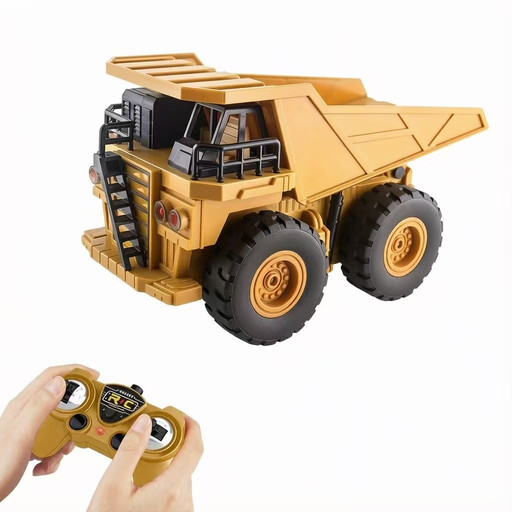
Why it suits this profile: This remote-controlled lorry has easy-to-understand controls for forward, reverse, left and right, as well as a moving tipper bed. That makes it suitable for short play sessions indoors or on a flat surface.
The key features are clearly described. According to the product information, the 3.7V 500mAh battery and USB cable are included; the 2 AA batteries for the remote control are not.
6-channel control, liftable tipper bed, rubber tyres, LED headlights and a sound effect.
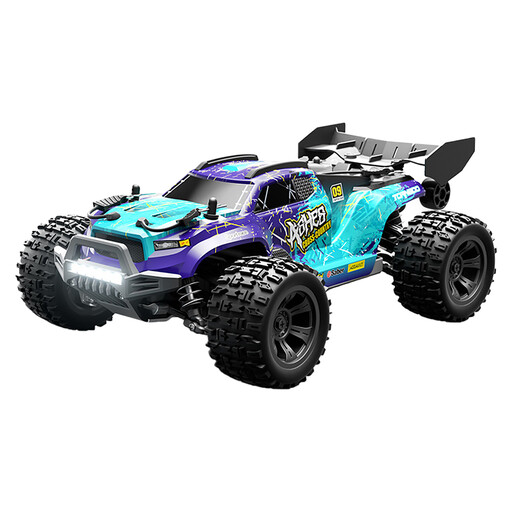
Why it suits this profile: For teenagers aged 14 and over and hobbyists looking for more control and speed than a basic children's car can offer. The transmitter provides several adjustment options.
The product information lists a 7.4V 1500mAh battery, 4WD drive and an aluminium chassis plate. The higher speed does require sufficient space and supervision.
4WD, adjustable steering, deep-tread tyres, LED lighting and included spare parts.
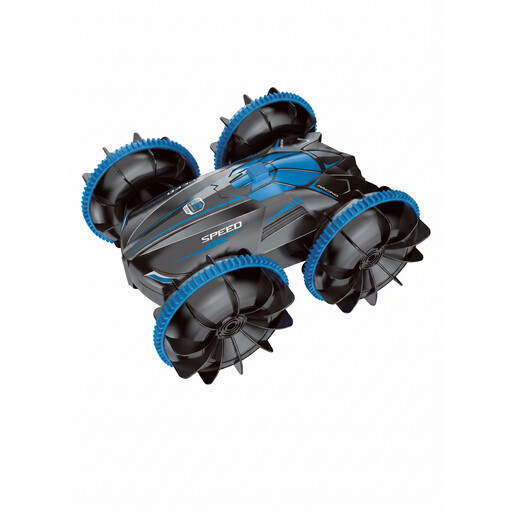
Why it suits this profile: This amphibious RC car is aimed at children who want to experiment with stunts, drive on both sides and play on land and in shallow water.
The description explicitly mentions 4WD, two control modes and a sealed housing. Only use it in water within the limits set out in the instructions, and dry the vehicle afterwards.
4WD, 360° turning, dual-sided driving, hand control and motion control via a wristband.
We have put together a complete, up-to-date list of products that fully meet these strict selection criteria and the applicable European safety regulations.
Before buying, check that the product page includes a clear age recommendation, warnings and information about the party responsible in the EU. A CE marking should be visible and verifiable on toys offered in the European Union. Do not rely solely on terms such as “safe” or “environmentally friendly” in marketing copy.
At home, pay attention to these points:
Choose a model with a simple remote control, limited speed and a clear warning stating that it is suitable from age 3. A remote-controlled lorry with basic functions is often easier to understand than an advanced RC stunt car. Supervision is still necessary because of small parts and batteries.
The running time per charge depends on battery capacity, motor, terrain and driving style. Check the stated voltage and capacity, but treat any quoted play time as an indication. Intensive driving on grass or gravel generally requires more power than gentle driving on a smooth floor.
Only when the product information expressly permits it. Water resistance varies from one model to another and does not always mean that submersion is safe. Follow the instructions, avoid deep puddles and never charge a vehicle when the battery or charging port is wet.
