
Vandaag of morgen in huis

Kwaliteit gegarandeerd

Welkomstaanbiedingen ontgrendelen: GRATIS bezorging | Tot 80% korting | Gratis 30 dagen JoyPlus-proefperiode
Download de app
A remote control car for children can provide hours of fun in just a few minutes. Yet not every remote-controlled car lives up to its product photo. A model might be fast, but handle poorly on carpet. Or the car may have LED lights, only for the battery to run out after a short time. If you pay attention to age, surface, controls and maintenance beforehand, you can avoid a bad purchase.
A fast RC race car sounds appealing, but young children often benefit more from a simple remote control with clear buttons. A model with only high speed can be difficult to manage indoors. So check whether there is a slow mode, proportional steering, or a simple forward and reverse function.
The term off-road says little without information about the tyres, drive system and suspension. A small toy car may run on tiles and grass, but get stuck in loose sand or on gravel. Look out for 4WD, tyre tread, ground clearance and shock absorption. Also check whether the manufacturer intends the model for indoor, outdoor or both settings.
A rechargeable RC car is practical, but check exactly what is rechargeable. On some models, the car runs on a lithium battery, while the remote control still needs AA batteries. Also see whether a USB cable, batteries, spare tyres or an extra charging plug are included. The stated playtime depends on speed, surface and use of lights.
Start with the age rating on the product page and packaging. A remote control car for children aged 3 and up is not automatically suitable for every toddler: speed, weight and small parts also play a role. Products with a warning about small parts must not be given to younger children. Use a fast or heavy model under adult supervision and read the included instructions.
Also look out for a CE mark and the European safety information stated with the product. A mark does not replace supervision or careful use. Check the car for loose parts, damaged cables and a battery compartment that closes properly before playing.
For smooth floors, 2WD is often sufficient. A 4WD RC car has drive to all four wheels and, according to the product specifications, can offer more grip on grass, uneven tiles or light terrain. That does not mean every 4WD model is suitable for mud or water.
An off-road RC car should have wide, treaded tyres and preferably suspension. For drifting, smooth drift tyres are usually more practical on a hard, flat surface. Models with two interchangeable tyre sets can switch between racing and drifting. Carpet, sand and wet surfaces affect handling and can accelerate wear.
A 2.4GHz remote control is commonly used with remote-controlled toy cars. According to the product descriptions of various models, multiple cars can run simultaneously without the signals normally interfering with each other. Always check the actual product specifications though.
For beginners, a steering wheel and trigger control, or a few clear buttons, are easy to understand. An RC stunt car with wrist control, automatic demo mode or one-button functions offers more play possibilities, but can be overwhelming for young children at first.
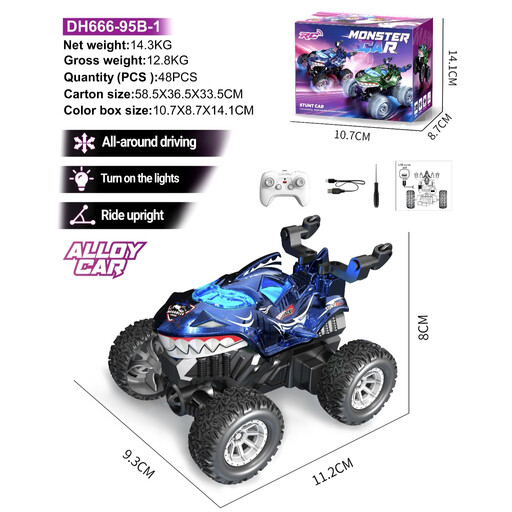
Why it fits the profile: The two speed settings and simple forward, reverse and steering functions make this model accessible for children trying their first remote-controlled stunt car.
The slow mode helps avoid driving at maximum speed straight away. The lights can be switched on or off separately.
2.4GHz remote control, two speeds, LED lights and a 360° rotating stunt function.
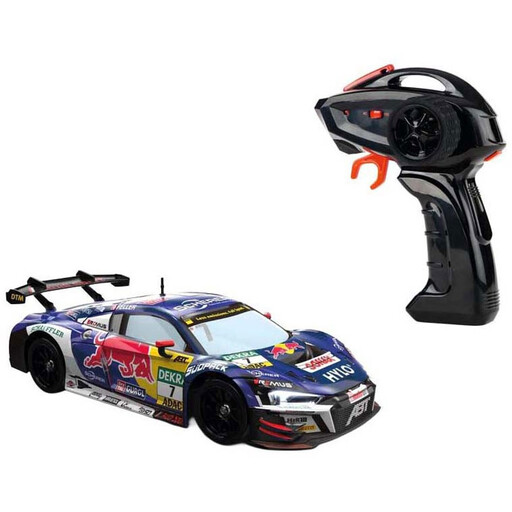
Why it fits the profile: This 1:16 model is designed for children aged 6 and over and combines racing with LED lights, a flexible body and a stated speed of up to 18 km/h.
The product information states both the maximum speed and a playtime of up to 30 minutes, so expectations are clearer from the start.
LED lights, smoke function, drift tyres and 2.4GHz technology according to the product description.
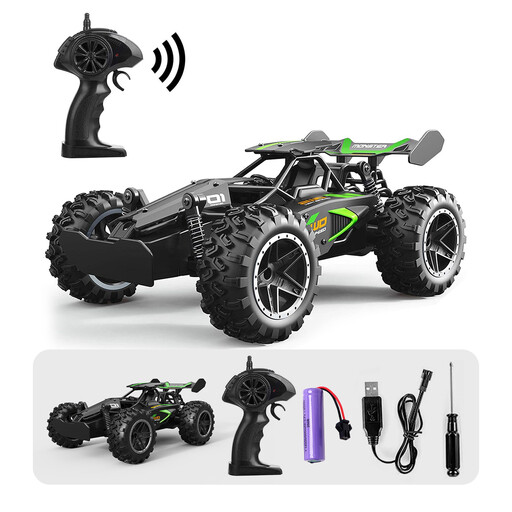
Why it fits the profile: For children aged 3 and over who mainly want to drive outdoors, this buggy offers a terrain tread with suspension, large tyres and a rechargeable battery.
The product description explicitly mentions large anti-slip tyres, a shock-absorbing construction and use on different surfaces.
Rechargeable 3.7V lithium battery, pistol-grip remote control and four-wheel suspension.
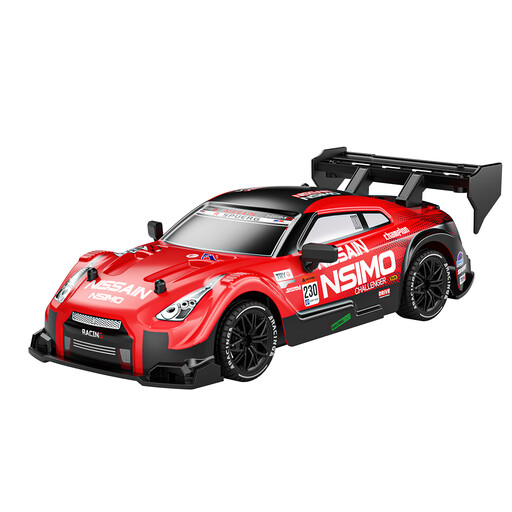
Why it fits the profile: According to the product information, this model is suitable from age 8 and focuses on controlled racing and drifting on flat surfaces.
The two tyre sets make a clear distinction between drift tyres and race tyres. This means the model isn't limited to just one style of play.
4WD drive, interchangeable tyres, LED lights and a stated playtime of 20 to 40 minutes per charge.
We've put together a full, up-to-date list of products that fully meet these strict selection criteria and current European safety regulations.
Choose a model with the correct age rating, simple controls and limited speed. Check the warning about small parts and use the car under supervision. A heavy or fast RC race car is usually less practical for a young beginner than a compact model with simple functions.
This varies by model. In the product information mentioned, some drift models state a playtime of 20 to 40 minutes and the Carrera car up to 30 minutes. Driving fast, drifting and using LED lights can shorten the usage time. So check both the playtime and the charging time before you order.
That depends on the tyres, ground clearance and construction. According to the product description, a stunt car with Mecanum wheels can drive on tiles, carpet, concrete and grass, among other surfaces. A drift RC car generally works better on a flat, hard floor. For gravel or uneven terrain, an off-road model with treaded tyres and suspension is more logical.
