
Cooking for lots of neighbours
You want to reheat chapatis in batches without the cooking station slowing down serving. The usable cooking surface matters more than a pan’s capacity in litres.


Looking to reheat chapatis in batches? First compare a flat cooking surface with the size of your bread, so you can turn it easily. A deep electric pan with a lid is more convenient if you also want to cook or keep other dishes warm, but its higher sides can make it harder to turn flatbreads. A thermostat setting alone does not prove that food will stay at a safe serving temperature.
You want to reheat chapatis in batches without the cooking station slowing down serving. The usable cooking surface matters more than a pan’s capacity in litres.
You want to serve chapatis alongside other hot dishes, so you’re considering a pan with a lid. Bear in mind that a lid or thermostat does not automatically prove that perishable sides will stay safely warm.
You need a stable, heat-resistant surface and a suitable power socket, away from where guests are walking. The cord, dimensions and accessibility all play a part in your choice.
Choose this style if: you mainly want to reheat chapatis one after another and turn them easily. Compare the usable width and depth with the size of your chapatis.
Bear in mind: an open griddle does not come with a lid to cover food.
Choose this style if: you also want to cook other dishes alongside chapatis or cover them with a lid.
Bear in mind: high sides can make it harder to slide a spatula under flatbread and turn it. Capacity in litres tells you less about usable cooking space than the internal dimensions.
Choose this style if: you have enough table space and mainly want a large pan base. HENDI lists an inner pan measuring Ø 550 mm for model 239605.
Bear in mind: this model measures Ø 620 mm across the outside, and its higher sides make it less accessible than a flat griddle.
| What to consider | What to look for when buying | Who this matters most to |
|---|---|---|
| Usable cooking surface | Compare the internal dimensions with your chapatis; also consider the height of the sides if you’ll be turning them often. | When I need to reheat several batches for guests, I want to know how many chapatis fit side by side. Around 36% of this group prioritise serving batches quickly. |
| Serving warm | Check whether you want a lid and what temperature range is specified for the exact model. | I want to serve chapatis warm and decide whether a lid would be useful for my buffet. Around 29% of this group are most concerned with serving food warm. |
| Positioning and power | Measure the available stable, heat-resistant space and check the cord and power connection. | When guests are walking past the table, I want to position the pan safely without the cord getting in the way. Around 21% of this group prioritise the set-up and power supply. |
| Cleaning and care | Check which parts are removable or dishwasher-safe, and follow the instructions for the temperature control. | After several rounds of reheating, I want to know how to clean the pan and get it ready for next time. Around 14% of this group prioritise cleaning and aftercare. |
The HENDI party pan 239605 measures Ø 620 mm across the outside; the inner pan measures Ø 550 mm. For chapatis, the usable internal space determines how many will fit side by side.
Measure your chapatis and compare them with the stated cooking surface or internal dimensions, rather than relying only on the capacity in litres or the largest diameter.
The manual for Nedis model FCSP110EBK40 lists settings of 150–230 °C. This range does not show that the pan can keep food warm at a low temperature for an extended period.
Check the setting range for the exact model, and keep an eye on the temperature and condition of the food while using it.
According to the manufacturer, the Tristar PZ-9145 has sides that are 9 cm high. These can make it harder to slide a spatula under flatbread.
Choose high sides if you also want to use the pan for other dishes. If you mainly want to cook chapatis, compare flat griddles first.
For Nedis model FCSP110EBK40, the manufacturer says the pan and lid are dishwasher-safe, but the temperature-control plug is not.
Unplug the appliance before cleaning, and follow the cleaning instructions for the pan, lid and temperature control separately.
Both the flat BP-2965 and the deeper PZ-9145 electric pan are relevant options for this choice.
The 239605 party pan is worth comparing if you’re looking for a large pan base and have enough space.
The 162367 Multi Wonder Chef Pro is an electric pan to consider if you also want to cook or keep other dishes warm alongside flatbread.
Model FCSP110EBK40 is a deep electric pan with a removable temperature control.
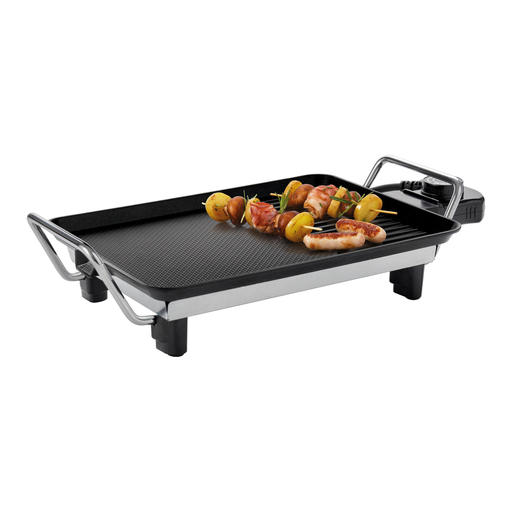
These product options are flat electric griddles and teppanyaki plates for reheating chapatis in batches. For plates with a ridged section, check how much of the surface is smooth.
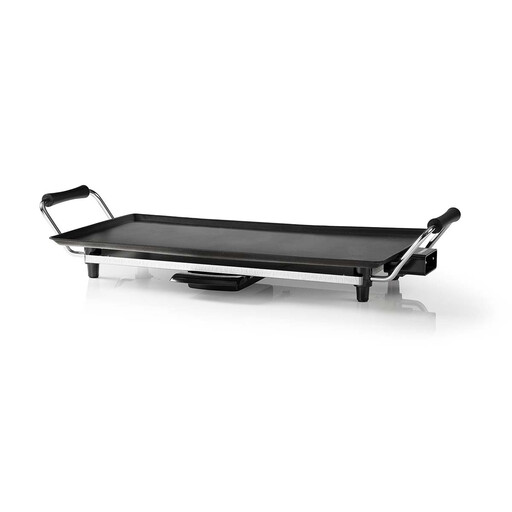 No image available
The stated dimensions give you a starting point for comparing the available cooking space with your chapatis.
47.5 × 26.5 cm; 2000 W; non-stick coating; infinitely adjustable thermostat. The description also mentions a removable drip tray.
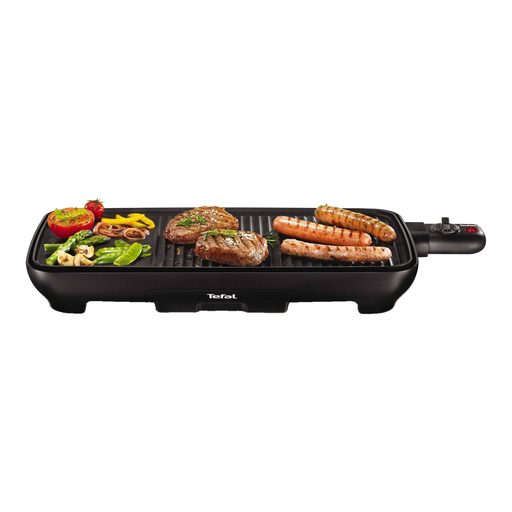 No image available
The description calls this model compact and suitable for smaller groups. Check whether the smooth section is large enough for your chapatis.
Stated surface: 19 × 23,5 cm, of which 1/3 is flat and 2/3 is ridged; removable thermostat with six settings. The description mentions a drip tray.
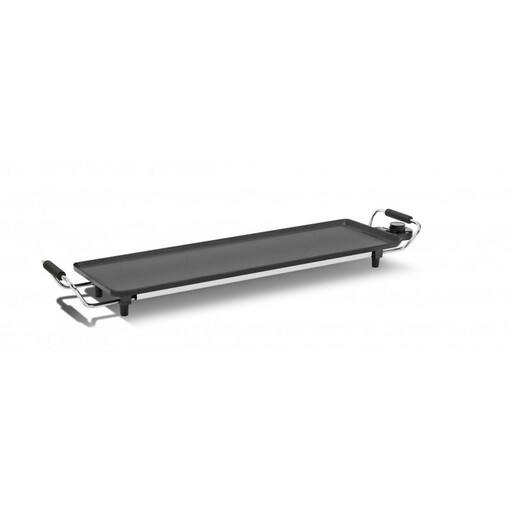 No image available
Compare the size of the smooth teppanyaki section with your chapatis, as part of the plate is ridged.
70 × 22 cm; 1800 W; five settings; 1/3 of the surface is ridged. The product name mentions a non-stick coating.
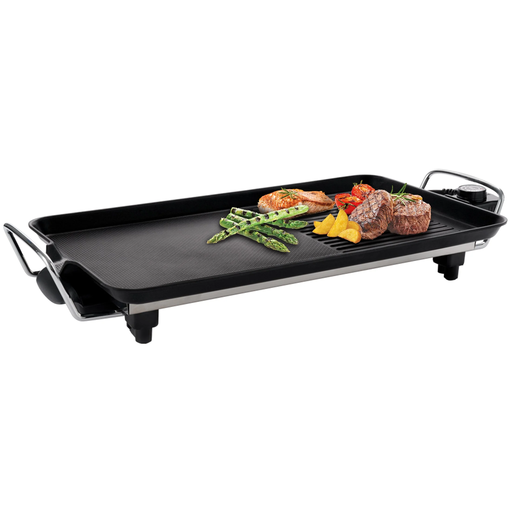 No image available
The smooth teppanyaki zone is useful for chapatis; bear in mind that a third of the plate is ridged.
48 × 20 cm; 1360 W; five settings; stated as suitable for 1–2 people. According to the description, 1/3 of the surface is ridged.
 No image available
Compare the smaller plate and its smooth section with the size and number of chapatis you want to reheat in each batch.
28 × 20 cm; 1000 W; five settings; stated as suitable for 1–2 people. According to the description, 1/3 of the surface is ridged.
A published recipe lists reheating in a dry frying pan as one method. Try a small batch on your electric appliance first and follow the instructions for the exact model; this method is not a test of these appliances.
The fire service advises fully unwinding a cable reel and, where possible, plugging high-power appliances directly into a wall socket. Place the pan on a stable surface and keep the cord out of walkways.
It depends on the model. Nedis states that the pan and lid for FCSP110EBK40 are dishwasher-safe, but the temperature-control plug is not. For other models, follow their own instructions.
CE marking is required for electric pans covered by the Dutch Commodities Act Decree on Electrical Equipment. The Netherlands Food and Consumer Product Safety Authority explains that the Low Voltage Directive covers, among other things, electrical equipment with a rated AC voltage of 50–1000 V. Check the product identification and marking on the item you intend to buy; CE is not a cooking-performance label.
No. Don’t assume that the chapati pan’s setting proves that side dishes are being stored safely. The Netherlands Nutrition Centre advises not leaving food that spoils quickly out of the fridge for more than 2 hours and recommends a fridge setting of 4 °C.