
Watching in a small room
You want to project a performance onto a wall, but have limited space between the projector and the screen. BenQ Netherlands recommends considering your desired image size alongside the distance to the projection surface.


First, measure the distance to the projection wall and decide how much you can darken the room. Then choose a projector with a throw ratio, image size and connections suited to your recording. Built-in playback features and speakers can save you from needing separate equipment, but check that you can access your specific recording and that the sound is good enough for you. A compact design alone doesn’t guarantee the right image size or clearly readable subtitles.
You want to project a performance onto a wall, but have limited space between the projector and the screen. BenQ Netherlands recommends considering your desired image size alongside the distance to the projection surface.
You want to put the projector away easily after watching, ideally without setting up a separate player or speakers. Models vary in their built-in playback features, sound and battery life.
You already have a playback source and want to know whether you can connect it for both picture and sound. ViewSonic lists an HDMI input for the M1X; check the connections on the exact model you’re considering.
| What to consider | What should you check? | Who is this important for? |
|---|---|---|
| Image size and distance | Measure the distance to the wall and the available width. Compare these with the throw ratio or the distance specifications for the exact model. | I want an image that fits the space where the projector can actually go; around 27% of consumers put available placement space first. |
| Picture in ambient light | Check the stated brightness and its unit, and take account of how dark the room will be and your desired image size. | If I want to follow dark scenes in the lighting I’ll have during the performance, I focus on the combination of brightness and room lighting; around 27% of consumers have this as their main concern. |
| Playback and connections | Check whether your recording works with the built-in software or whether the projector has the right input for your media player. | I want to start my recording with as little extra equipment as possible; around 26% of consumers give easy playback their top priority. |
| Dialogue and sound | Check which speakers and audio outputs the model has, and whether you can use them with your own audio equipment. | For a theatre performance, I want to be able to follow the spoken words and music clearly; around 20% of consumers choose primarily based on the sound solution. |
According to its specifications, the ViewSonic M1X accepts a Full HD input signal, but has a native resolution of 854 × 480. This difference matters if you want to read subtitles or see fine details.
Compare the native resolution of the exact model, not just the input signals it can process.
Product specifications may use different units, such as lumens, ISO lumens and ANSI lumens. Unless they use the same measurement basis, the figures aren’t directly comparable for your room.
Check the unit and assess brightness alongside how dark the room will be and your intended image size.
XGIMI states that the MoGo 4 can play video for up to 2.5 hours in power-saving mode. Built-in software also doesn’t automatically mean that your specific recording will be available.
Check the playback time, whether you can access your recording, and whether you’ll need a power supply while watching.
In the Netherlands, Epson’s EF-61W is listed as a portable Full HD projector with Google TV and built-in sound. It’s worth considering if you’re looking for playback features and picture in one device.
XGIMI positions the MoGo 4 as a portable model with Google TV, built-in speakers and a battery.
According to ViewSonic, the M1X is a small projector with a rotating stand and connections for an external source.
Nebula offers several small projectors in its Capsule range.
The TK705STi offers a different approach for a small room: its placement is designed for short throw, rather than simply having a compact body.
These Joybuy products are portable projectors with built-in playback features or connections for an external source. For your room, check the projection distance; for your recording, check compatibility; and for a long performance, check whether you’ll need a power supply.
 No image available
Suitable for a portable setup with built-in playback features and connections for an external source.
The product listing specifies native 1080p, Google TV, 800 ANSI lumens, HDMI 2.1, USB-C and a built-in battery. Battery life is stated as up to 2 hours; longer use may require a power supply.
 No image available
This bundle is a good fit if you want to put away or move a portable projector together with its screen and stand.
The product listing specifies Full HD 1080p, Google TV, 250 ISO lumens, JBL audio and a built-in battery. The description gives a throw ratio of 1.3:1; measure the available distance for your intended image size.
 No image available
Its built-in playback features and speakers may suit a setup with minimal extra equipment.
The product listing specifies native 1080p, Google TV, 520 ISO lumens and two 5 W speakers. The description gives a throw ratio of 1.17:1 and an image size of 40–150 inches; check the distance you’ll need in your setup.
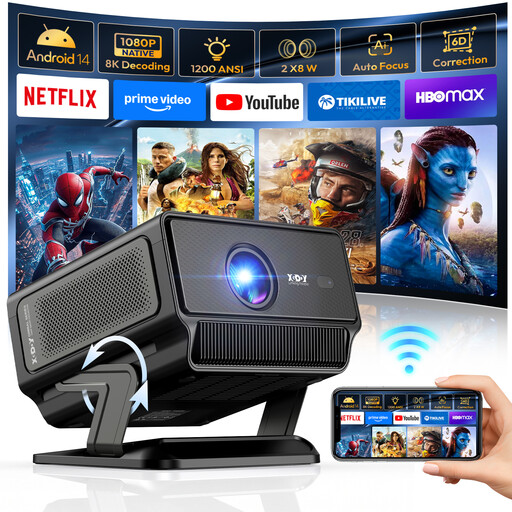 No image available
Could suit a compact setup with built-in software and speakers; check that the controls and connections work with your source.
The product listing specifies native 1080p, Android 14, 1200 ANSI lumens, 2 GB RAM and 16 GB ROM. The description gives a throw ratio of 1.08:1, HDMI and dual 8 W speakers.
 No image available
Built-in apps and HDMI and USB connections give you different ways to use a compatible playback source.
The product listing specifies native 1080p, 700 ANSI lumens, WhaleOS 3.0 and Netflix apps. The description mentions automatic focus and keystone correction; check beforehand that your specific recording is available through your chosen app or source.
Measure the available distance between the lens and the projection surface, as well as the clear width of the wall. Compare these with the throw ratio or the manufacturer’s stated image-size and distance combination for the exact model.
It depends on where your recording is available. Built-in software can save you from needing a separate player if it supports the recording or service. Alternatively, you can connect a compatible external source through the right HDMI input. Check the app, file or source for the exact model.
Follow the chosen model’s instructions for placement, power and maintenance, and check that its location and connections meet the specifications. For the M1X, ViewSonic recommends using a ViewSonic power adaptor or one from an authorised source.
According to the Dutch government, when you buy online from a business you’re often entitled to a 14-day cooling-off period, although there are exceptions. You’re also entitled to a product that works properly, and you can contact the seller if there’s a problem. The Dutch government states that there is no fixed statutory guarantee period for all products in the Netherlands.
Don’t assume that permission to watch a recording at home also allows you to show it publicly. The Dutch government states that copyrighted material may not be made available to the public without permission; check the rights and terms of use for the specific recording.