For spoken-word listening in a large living room, a record player with speakers you can position separately gives you more flexibility than a model with built-in speakers. Start with the records and audio equipment you already own: check the speed, the right stylus for any 78 rpm records and the amplification you’ll need before choosing between a standalone player, a complete set or an all-in-one model.
Who is this for?
Listeners in a large living room
If you want to follow spoken-word audio from more than one seat, it’s worth considering speaker placement and your existing audio equipment when choosing a player. The Consumentenbond notes that a standard record player is usually connected to separate speakers and an amplifier.
Owners of older 78 rpm records
Check the speed your records need and which stylus suits the record material. Audio-Technica lists the AT-VM95SP separately for 78 rpm mono records; it is not the AT-VM95E cartridge supplied with the AT-LP120XUSB.
Listeners who want a straightforward set-up
If you want to use an existing system or would rather choose a set with speakers, check which inputs and amplification you’ll need. The PHONO or LINE/AUX connection must match the record player’s output and the connected equipment.
What should you consider when choosing?
First, consider where you can put the speakers in your living room and what equipment you already own. Then check your records and connections, and choose the controls based on how much you want to do yourself.
Standalone record player with your own equipment
Best if: you already have suitable equipment or want the freedom to position the speakers around the room.
Trade-off: you may also need a phono preamp, amplifier or speakers.
Complete set with separate speakers
Best if: you don’t yet have an audio system and want to place the supplied speakers separately.
Trade-off: check that the supplied speakers suit the space where you want to listen.
All-in-one with built-in speakers
Best if: a simple, integrated set-up matters more than being able to position the speakers freely.
Trade-off: you can’t position built-in speakers separately from the player around the room.
| What to consider |
What should you check? |
Who should pay extra attention? |
| Speech from your listening position |
Check whether you have active speakers or an amplifier with speakers, and where separate speakers can be placed. |
I want to follow spoken-word audio from my seat and position the speakers to suit; around 36% of consumers prioritise speaker set-up. |
| Playing your own records |
Check the speed of your records and, for older records, whether the stylus is suitable for the record material. |
If I own 78 rpm records, I want to know which speed and stylus are right for them. Around 29% of consumers give record compatibility top priority. |
| Connections and equipment |
Check what you have in terms of PHONO or AUX/LINE input, preamplification, power amplification and active speakers. |
I want to know in advance whether my existing system is compatible and which audio components I still need; around 21% of consumers prioritise connections and system costs. |
| Ease of use |
Check whether starting, stopping and returning the tonearm happen automatically on each model. |
For longer listening sessions, I want as few steps as possible when starting and finishing; around 14% of consumers prioritise ease of use. |
Avoid common buying mistakes
-
Budgeting for the record player alone
A standalone record player isn’t automatically ready to use with passive speakers. The rest of the audio chain also needs the right preamplification and power amplification.
Before you buy, check the inputs, amplification and speakers in your current system. Then see which components a standalone player or complete set will add.
-
Assuming a 78 rpm setting means the stylus is suitable
Speed and stylus are separate features. The Audio-Technica AT-LP120XUSB comes with an AT-VM95E cartridge; this is not the same as the separately listed AT-VM95SP for 78 rpm mono records.
Check the material and speed of your records, then check which stylus is suitable for the exact model you’re considering.
-
Assuming built-in speakers can be positioned freely
Speakers built into the casing can’t be placed separately from the record player. The Consumentenbond also notes in its general buying advice that suitcase record players often have lower sound quality than standard record players; this is not a model-specific test of every player.
Weigh the convenience of the set-up against your preferred speaker placement, and assess the arrangement where you intend to listen.
Brands to consider
Audio-Technica
Worth considering if you’re looking for a standalone player and may own 78 rpm records.
- The manufacturer lists three speeds, a USB output and a replaceable cartridge for the AT-LP120XUSB.
- This model is manual and comes with an AT-VM95E. The separately listed AT-VM95SP is designed for 78 rpm mono records.
Lenco
Worth considering if you’re looking for a set with speakers that can be positioned separately.
- Lenco says the LS-200WD has a built-in amplifier and two external speakers that can be placed separately.
- The stated 2 × 10 W RMS is a product specification, not a measure of how clear speech will sound in a large living room. The LS-200WD does not support 78 rpm.
Denon
Worth considering if you’re looking for automatic operation and a PHONO or AUX/LINE connection.
- Denon describes the DP-300F as automatically starting and returning the tonearm, with a switchable phono preamp.
- The listed speeds are 33⅓ and 45 rpm, not 78 rpm.
Sony
Worth considering if you want automatic operation with Bluetooth and a switchable phono/line output.
- Sony specifies automatic start, stop and tonearm return for the PS-LX310BT.
- The listed speeds are 33⅓ and 45 rpm. Bluetooth and automatic operation alone don’t tell you whether the speakers will suit your living room.
Denver
Worth considering if you’re thinking of a compact all-in-one player with a 78 rpm setting.
- The VPB-262 and MRD-180 manuals list a 78 rpm setting; Denver says the VPB-262 has built-in speakers.
- The speed setting doesn’t confirm that the supplied stylus is suitable for every older 78 rpm record. Built-in speakers can’t be positioned separately.
Record players at Joybuy
These record players may suit an existing audio set-up or anyone looking for an integrated player with built-in speakers.
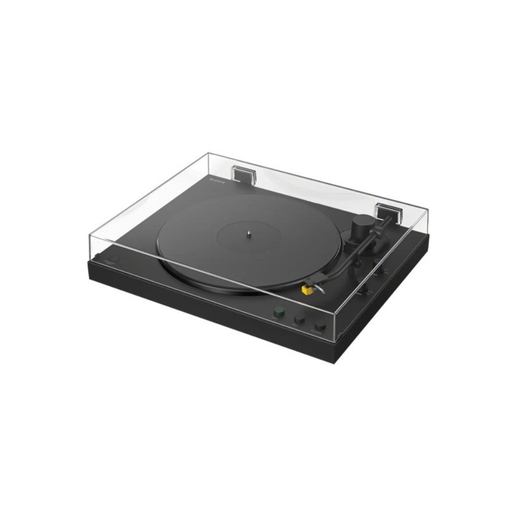 No image available
Sony PS-LX5BT Bluetooth record player
Suited to anyone who wants to use an existing audio set-up and is looking for automatic operation.
The product details list fully automatic operation, Bluetooth, a PHONO/LINE switch and playback at 33⅓ and 45 rpm.
View at Joybuy
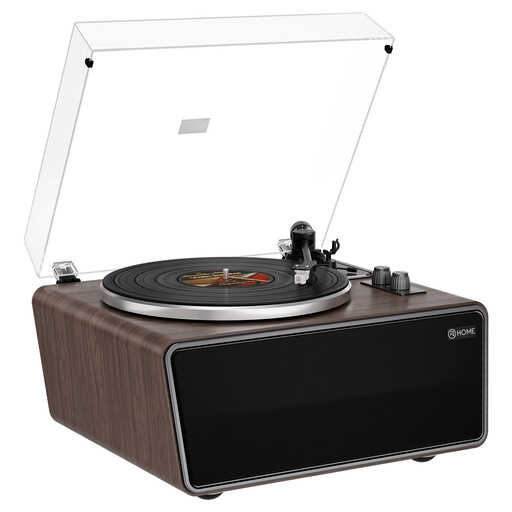 No image available
XJ-HOME XJ-H01 Vintage All-in-One Record Player
Suited to anyone looking for an integrated player with built-in speakers; these speakers can’t be positioned separately.
The product details list four built-in speakers, an AT-3600L (MM) cartridge, a phono preamp, Bluetooth, AUX and RCA outputs for external speakers.
View at Joybuy
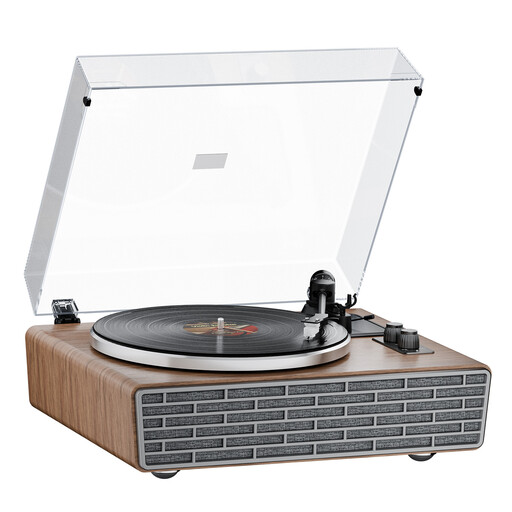 No image available
XJ-HOME XJ-H02 Retro Walnut Bluetooth Record Player
Suited to anyone looking for an integrated set-up who also wants the option to connect external speakers.
The product details list four built-in speakers, playback at 33⅓ and 45 rpm, an AT-3600L cartridge, Bluetooth, AUX and dual RCA outputs.
View at Joybuy
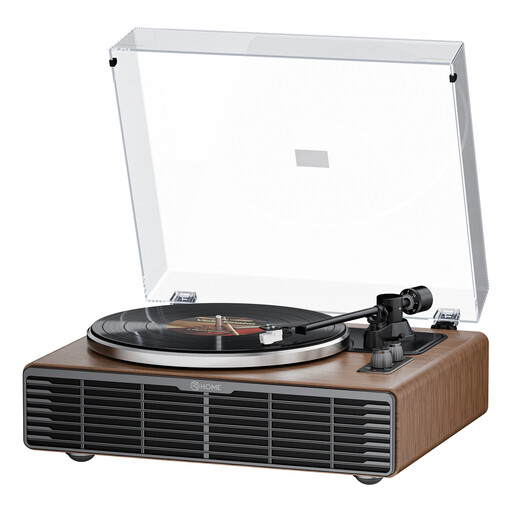 No image available
XJ-HOME XJ-H03 Walnut Bluetooth Record Player
Suited to anyone looking for an integrated player with the option to connect external speakers.
The product details list four speakers, playback at 33⅓ and 45 rpm, an AT3600L cartridge, Bluetooth, AUX and RCA Phono/Line outputs.
View at Joybuy
Frequently asked questions
Can I connect a record player directly to my speakers?
Only if the connections and amplification throughout the audio chain are compatible. Lenco says that connecting directly to active speakers requires a record player with a phono preamp and speakers with power amplification. If your player has a switch, select PHONO or LINE to match the input on the connected equipment.
Will a player with a 78 rpm setting play every old spoken-word record properly straight away?
No, you should also check the record and the stylus. For example, the Audio-Technica AT-LP120XUSB comes with an AT-VM95E cartridge, while Audio-Technica describes the separate AT-VM95SP, with its 3.0 mil stylus, as suitable for 78 rpm mono records.
What are my rights when I buy online in the Netherlands?
According to the Dutch Government, for many eligible distance purchases you have a 14-day cooling-off period, although there are exceptions; its guidance says that an online purchase from a private individual is not classed as a distance purchase. There is no fixed two-year period for statutory guarantees in the Netherlands: if a product is faulty, you may be entitled to an appropriate remedy, depending on the circumstances.


