
Second-hand vinyl listener
You buy used records and want to work out whether crackling or skipping is caused by the record, the stylus or your set-up. Bear in mind the condition of each record, along with cleaning and stylus maintenance.


For regular listening to second-hand records, a separate turntable is a good choice if you already have suitable speakers or an amplifier. An all-in-one player may be more convenient if you want to get started without separate audio equipment. According to the Consumers' Association, suitcase record players often sound worse than standard turntables. None of these types can repair dirty or damaged records or solve the problem of a surface that vibrates.
You buy used records and want to work out whether crackling or skipping is caused by the record, the stylus or your set-up. Bear in mind the condition of each record, along with cleaning and stylus maintenance.
You want to connect your turntable to your current audio set-up and find a spot where floor movement or speaker vibrations won't interfere with playback.
You want to play records without lots of set-up and are choosing between automatic operation, a wired connection and Bluetooth streaming.
A good fit if: you want to get started without separate speakers or an amplifier, and convenience is your priority.
The trade-off: according to the Consumers' Association, suitcase record players often sound worse than standard turntables.
A good fit if: you have suitable speakers or an existing system and don't want to position the tonearm yourself every time.
The trade-off: you still need a suitable audio connection and compatible speakers; Bluetooth is only relevant if you want to listen wirelessly.
A good fit if: you want to operate the tonearm yourself and choose your turntable with the stylus, cartridge and connections in mind.
The trade-off: starting and finishing a record involves more steps; features such as automatic tonearm return vary by model.
| What to consider | What should you check? | Who should pay particular attention? |
|---|---|---|
| Condition of the record and stylus | Check which stylus is compatible with the model and assess each record individually; clean it according to the instructions for the product you use. | If I play used records, I want to find out first whether the problem is caused by the record, stylus or set-up. Around 36% of consumers put record care first. |
| Connecting to your system | Check whether your equipment has a phono or line input, and whether you need Bluetooth streaming for wireless listening. | If I want to use my existing amplifier or active speakers, I want to know in advance which connection is suitable. For around 29% of consumers, connecting their equipment is their main concern. |
| Where to put it in your loft | Choose a flat, sturdy surface away from speakers; check the wall type and load-bearing capacity before considering a wall shelf. | If my floor or furniture vibrates, I want to find a spot that has as little effect on the stylus as possible. Around 21% of consumers make placement their top priority. |
| Operation | Check separately whether the player starts and stops automatically and returns the tonearm, and whether it supports the speeds needed for your records. | If I want to keep the number of steps to a minimum, I look for automatic operation; if I want to operate the tonearm myself, manual operation is the right choice. Ease of use is the main priority for around 14% of consumers. |
Built-in components are convenient, but the Consumers' Association reports that suitcase record players often sound worse and that their tonearms and tonearm lifts are often less robust.
Choose this style if it suits the way you plan to use it. Before buying, compare how the stylus is lowered and what components you would need for a separate set-up.
The right connection depends on the inputs on your speakers or amplifier and on whether the player has a phono or line output.
First, note which inputs your equipment has and whether you use passive speakers. Then check whether the player has a suitable phono preamp or whether you'll need one separately.
Manufacturer instructions warn against vibrations and placing a turntable close to speakers. A wall shelf is only suitable if the wall type and load-bearing capacity are right.
Start by trying a flat, sturdy surface. If the floor moves noticeably, try another spot; check the wall type and load-bearing capacity before choosing a shelf.
Used records may be dirty or damaged, and dirt can also build up on the stylus. Cleaning won't repair a persistent scratch.
Check the record, stylus and set-up before replacing the player. Follow the cleaning instructions provided by the manufacturer of the product you use.
Audio-Technica describes the AT-LP70XBT as a fully automatic turntable with Bluetooth streaming and a switchable phono preamp.
Sony describes the PS-LX3BT as an automatic turntable with Bluetooth and a built-in phono equaliser with a PHONO/LINE switch.
According to Lenco, the LBT-188PI combines manual operation with Bluetooth streaming, USB conversion to a computer and a switchable preamp.
Denon lists automatic operation and a switchable phono preamp for the DP-300F.
Pro-Ject describes the E1 Phono as a manual turntable with a built-in phono preamp.
This selection includes separate automatic turntables and all-in-one models with built-in speakers.
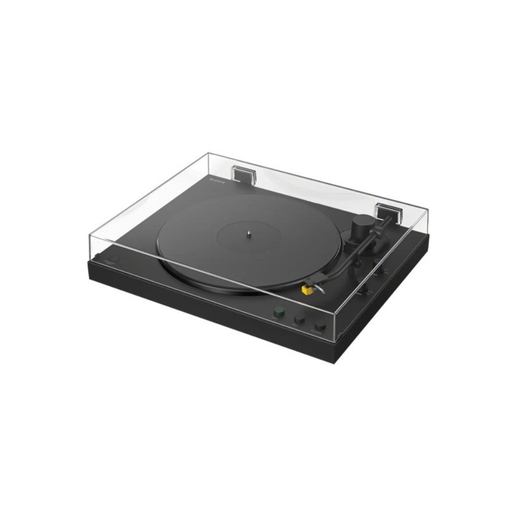 Image unavailable
A separate automatic turntable for anyone who doesn't want to position the tonearm themselves and wants the option of wired or wireless listening.
Fully automatic operation; 33⅓ and 45 rpm; MM cartridge; PHONO/LINE switch; Bluetooth streaming; dust cover.
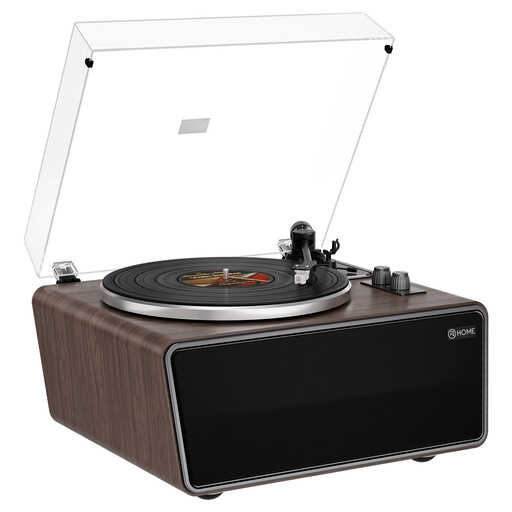 Image unavailable
An all-in-one model for anyone who wants to play records through built-in speakers and use USB conversion too.
AT-3600L cartridge; four built-in speakers; 33⅓ and 45 rpm; USB; Phono/Line RCA outputs; removable dust cover; replaceable cartridge on a universal headshell.
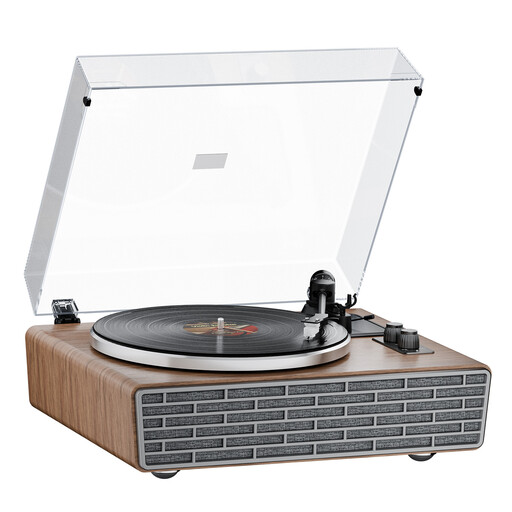 Image unavailable
A model with built-in speakers for anyone who wants to get started without separate speakers but still have the option to connect external audio equipment.
33⅓ and 45 rpm; AT3600L cartridge; four built-in speakers; RCA Phono/Line outputs; transparent dust cover.
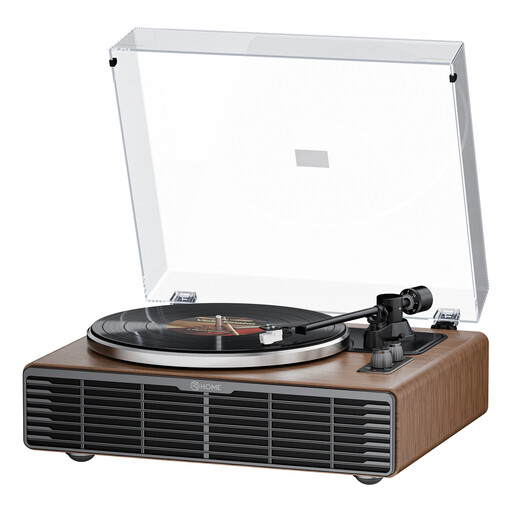 Image unavailable
An all-in-one model for anyone looking for built-in speakers and connections for external audio equipment.
AT-3600L cartridge; four built-in speakers; 33⅓ and 45 rpm; USB recording; RCA Phono/Line outputs; AUX input; removable dust cover.
That depends on the inputs on your speakers or amplifier and the output on the record player. A standard line input needs a phono preamp, either built into the player or as a separate component; if you're using a phono input, check the position of any PHONO/LINE switch. Passive speakers also need an amplifier.
First, check the condition of the record and whether it's dirty, then check the stylus and the position of the player. Discogs uses separate grading scales for vinyl and sleeves; follow the instructions from the manufacturer of the product you use to clean the record and stylus. Cleaning won't fix a permanent scratch.
Not necessarily. According to the Dutch government, the seller must offer a solution if a product is faulty, and there is no fixed statutory warranty period in the Netherlands. Compare any paid extension with your existing rights and check exactly what additional cover it provides.
CE marking is required for products covered by harmonised EU rules that specifically require it. According to the European Union, the marking is a declaration by the manufacturer, not a quality certificate from a central EU body. Check the product and seller information for the specific version; this general rule does not confirm that an individual model complies.