
Listener with second-hand LPs
If you play second-hand records, consider their condition, how to clean them and whether you can replace the stylus. Audio-Technica stresses that cleaning will not repair damaged grooves.


First decide whether you want separate speakers or would prefer an all-in-one player. Then check the connections you need and how much you want to do yourself. With second-hand records, the condition of the discs, stylus maintenance and the correct speed all matter too. For 78 rpm shellac records, both the speed and the cartridge need to be suitable.
If you play second-hand records, consider their condition, how to clean them and whether you can replace the stylus. Audio-Technica stresses that cleaning will not repair damaged grooves.
If you want to listen through separate speakers, you’ll need space for them and should also consider possible vibrations if they’re placed too close to the record player. Audio-Technica advises against placing speakers too near the player.
If you’d rather not place the tonearm on the record yourself, compare automatic operation and the connections with your existing setup. Audio-Technica and Sony describe automatic models with phono or line connection options.
Best for: anyone who wants to play LPs and singles with ease and has room to position the speakers separately.
Things to consider: check that the player and speakers connect to your amplifier or existing setup. For the automatic models discussed, Audio-Technica and Sony list speeds of 33⅓ and 45 rpm.
Best for: anyone who wants to operate the tonearm themselves or values adjustable settings and cartridge choice.
Things to consider: manual operation requires more attention. Audio-Technica lists 78 rpm for the AT-LP120XBT-USB, but the cartridge must also be suitable for the shellac records you want to play.
Best for: anyone who wants to connect as little separate equipment as possible.
Things to consider: the Consumentenbond reports that suitcase record players often offer mediocre sound, and some are less gentle on delicate records. So assess the specific model and where you plan to use it.
| What to consider | What should you check? | Who should pay particular attention? |
|---|---|---|
| Record and stylus | Check the condition of the record, that the stylus is suitable and that a replacement stylus is available for the exact model. | If I buy second-hand records, I want to tell dirt apart from groove damage and maintain the stylus properly. Around 36% of consumers in this decision-making context prioritise record care. |
| Speakers and positioning | Check what amplification and connections you need; don’t place the speakers right next to the record player. Audio-Technica points out that vibrations may be an issue. | In a spacious living room, I want to position the speakers appropriately and listen to music in the setup I prefer. Around 29% of consumers in this decision-making context prioritise room layout. |
| Connections and operation | Match the phono or line output to the available input, and decide whether you want the player to start automatically or prefer to operate the tonearm yourself. | If I want to listen without extra connection work, I check the inputs on my setup and how easy the player is to use. Around 21% of consumers in this decision-making context prioritise straightforward connections and operation. |
| Speed and record type | Check the speed marked on the record; for 78 rpm shellac records, the cartridge must also be suitable. | If my collection includes less common record formats, I want to know whether both the speed and cartridge are suitable. Around 14% of consumers in this decision-making context prioritise this compatibility. |
A standard record player does not make a complete listening setup by itself. The Consumentenbond points out that you may also need speakers and an amplifier.
Before buying, make a note of the inputs, amplification and speakers you already have, then compare them with the player’s connections.
According to the Consumentenbond, suitcase record players often offer mediocre sound, and some are less gentle on delicate records.
Weigh the convenience of having fewer connections against your preferred speaker setup and the care your second-hand records need. Check the specifications of the model you’re considering.
A player may run at 78 rpm even if the supplied cartridge isn’t designed for shellac records.
First check whether you own any 78 rpm records, then make sure both the player and a suitable cartridge or stylus can handle them.
Dirt can affect playback, but cleaning will not repair damaged grooves, according to Audio-Technica.
Inspect and clean the record carefully, and check the stylus too, before deciding that the record player is to blame.
The AT-LP3XBT is an automatic player; the AT-LP120XBT-USB is manual and offers more adjustment options.
According to Sony Netherlands, the PS-LX3BT is an automatic record player with Bluetooth and a phono/line switch.
The SL-1500C is a direct-drive model supplied with a cartridge and a built-in phono equaliser.
Denon describes the DP-300F as a fully automatic belt-drive record player.
The Debut EVO 2 is designed for a separately assembled hi-fi setup.
This selection features all-in-one record players with built-in speakers, for anyone who wants to listen without separate speakers. Check that the connections and listed speeds suit your records and setup.
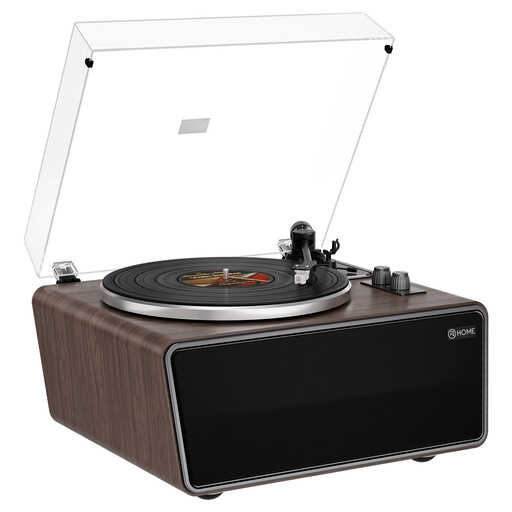 No image available
The built-in speakers suit anyone who wants to listen without a separate speaker setup.
The product description lists four built-in speakers, 33⅓ and 45 rpm, and an AT-3600L cartridge with a diamond stylus.
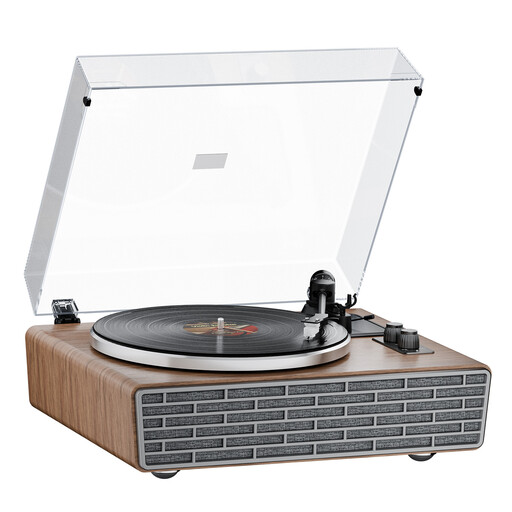 No image available
The four built-in speakers are worth considering if you don’t want to set up separate speakers.
The product description lists Bluetooth, AUX, dual RCA outputs, 33⅓ and 45 rpm, and an AT-3600L cartridge.
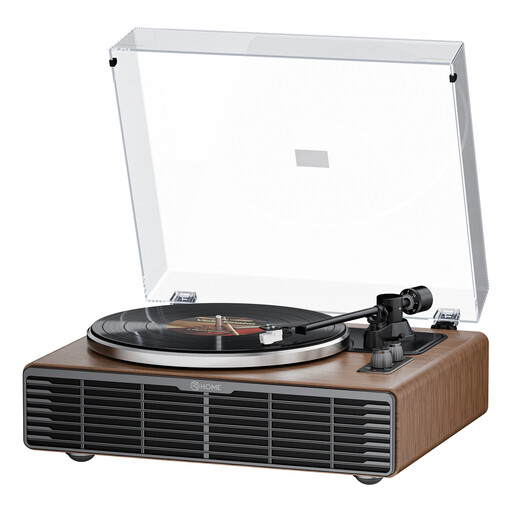 No image available
This model could suit you if you want built-in speakers and would also like to compare the listed connection options.
The product description lists four built-in speakers, Bluetooth, USB recording, RCA outputs, 33⅓ and 45 rpm, and an AT3600L cartridge.
A standard record player needs a suitable powered speaker setup. The phono preamp may be built into the player or amplifier, or be a separate device; check the inputs available before choosing your equipment.
Check the record for damage and carefully clean off any dirt before playing it. Audio-Technica advises cleaning the stylus from back to front; cleaning will not repair damaged grooves.
No. Check whether you can use a suitable cartridge and stylus profile too. Ortofon describes a stylus profile designed for shellac records; speed alone does not confirm that the complete setup is suitable.
When you buy from a business at a distance, you usually have a 14-day cooling-off period, including for second-hand or vintage products. According to the Dutch government, online purchases from a private seller are not covered by these distance-selling rules.
In the Netherlands, statutory consumer protection requires a product to be of satisfactory quality, but there is no single fixed statutory warranty period. The Dutch government says to contact the seller if the product does not meet your expectations.