
Housemates who play records together
If several people will use the turntable, look for simple start and stop controls so nobody has to operate the tonearm manually.


Start by checking the speeds and types of records in your collection, as well as the connections on the speakers or amplifier you already own. A standard turntable generally offers more connection and maintenance options than a suitcase record player, but you’ll often need separate speakers. For 78 rpm records, you need both the right speed and a suitable stylus.
If several people will use the turntable, look for simple start and stop controls so nobody has to operate the tonearm manually.
If you play pre-owned records, consider how easy they are to clean, their condition and whether you can replace a worn or damaged stylus.
If you already have an amplifier, active speakers or a Bluetooth device, check in advance that the turntable can connect to it.
First, check your records and existing audio equipment. Then decide how important automatic controls and easy maintenance are for everyone who’ll use the turntable.
| Consideration | What should you check? | Who is this important for? |
|---|---|---|
| Record care and maintenance | Check whether the stylus is replaceable and which stylus is compatible with the exact cartridge. Remove any visible dirt from a record before playing it. | If I play pre-owned records, I want to remove dirt and replace a worn stylus without mixing up parts unnecessarily. Around 36% of consumers say record care is their top priority. |
| Controls for housemates | Check whether both starting the turntable and returning the tonearm are automatic. Also make sure the speeds suit your records. | If different housemates use the turntable, being able to start it without placing the stylus by hand is important to me. Around 29% of consumers prioritise easy operation. |
| Connection to existing audio equipment | Check the inputs on your amplifier or active speakers, and whether the turntable has a phono/line setting. For Bluetooth, check whether the turntable transmits and the other device receives. | If I want to keep using my current audio system, I want to know in advance which connection I need. Around 28% of consumers say reusing their existing audio equipment is their top priority. |
| 78 rpm records | For 78 rpm records, check both that the turntable supports the speed and that the stylus and cartridge are suitable. | If my collection includes 78 rpm records, the stylus needs to be suitable as well as the speed. Around 7% of consumers prioritise 78 rpm support. |
Consumentenbond describes the sound quality of suitcase record players as often mediocre and warns that they may be less gentle on delicate records.
Weigh the convenience of a compact design against record care and sound quality. With a standard turntable, you’ll generally also need to arrange suitable speakers.
Audio-Technica says vibrations from external speakers can affect the stylus and cause it to skip.
Place the turntable on a stable surface and keep external speakers away from it.
The AT-LP70XBT is an automatic option for 33⅓ and 45 rpm records. According to Audio-Technica, the manual AT-LP120XBT-USB also supports 78 rpm.
The PS-LX3BT is an automatic turntable with Bluetooth and a wired phono/line output, designed for straightforward shared use.
The DP-29F is a fully automatic, wired option for use with an existing audio system.
The manual LBT-188PI is an option if you’re looking for Bluetooth transmission and adjustable stylus pressure.
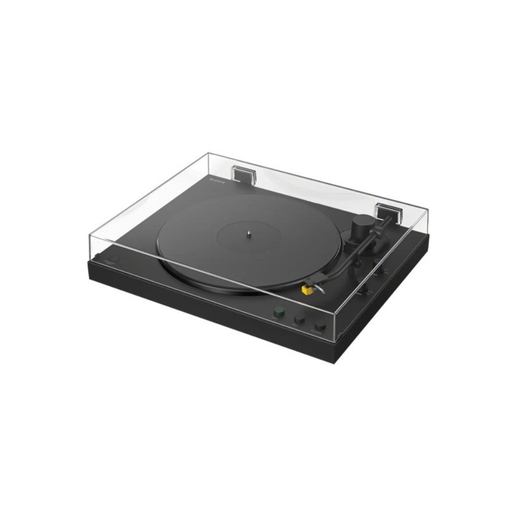
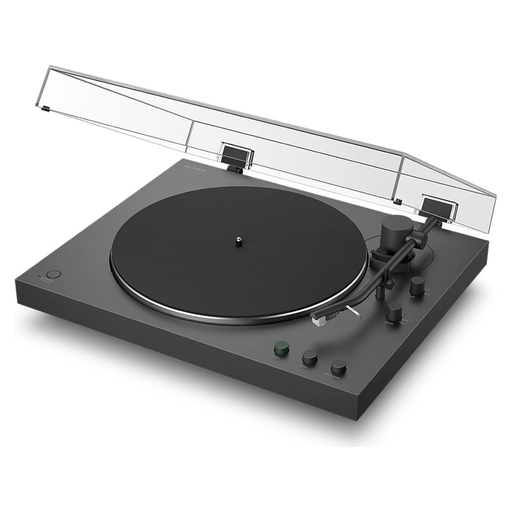
The Joybuy options shown are automatic Sony turntables with Bluetooth and wired connection options. Check each model’s supported speeds and connections to make sure they suit your records and audio system.
 No image available
Automatic operation and Bluetooth may suit housemates who want to play records easily and use a compatible wireless or wired audio system.
The description lists a built-in phono preamplifier with a PHONO/LINE switch and Bluetooth. The stated speeds are 33 and 45 rpm.
 No image available
Automatic operation and tonearm return may suit shared use, especially if housemates would rather not operate the tonearm manually.
The description lists Bluetooth, a built-in phono equaliser with a PHONO/LINE switch, and speeds of 33⅓ and 45 rpm.
A standard turntable needs a suitable amplification and speaker set-up. If your amplifier doesn’t have a phono input, choose a turntable with a built-in phono preamplifier or add a suitable external one. Also check whether your speakers are active or passive.
Use a suitable record brush to remove dust before playing, and clean the stylus according to its care instructions. Audio-Technica describes a more thorough cleaning method for heavily soiled records. Cleaning won’t necessarily restore a damaged record to good condition.
Don’t place external speakers right next to the turntable. Audio-Technica warns that vibrations can affect the stylus and cause it to skip. Choose a stable spot where housemates are unlikely to knock the turntable.
When you buy from a business online, you usually have a 14-day cooling-off period. According to the Dutch Government, this also applies to second-hand and vintage products. An online purchase from a private seller isn’t covered by distance-selling rules, according to that guidance. Check who the seller is and whether any exceptions apply.
No. A manufacturer’s or seller’s warranty is in addition to your statutory rights; if a product is faulty, the seller is your point of contact. The Dutch Government states that there is no fixed, general statutory warranty period of two years.