
Listener with existing speakers
You want to listen to folk LPs through your existing active speakers or amplifier. First, check that the player’s connection is compatible with the input on your audio set-up.


Start with your speakers: a standard record player needs a suitable phono or line connection, while a model with built-in speakers can work without a separate audio set-up. Then consider the space needed for the complete set-up, how easy it is to use and whether you can replace the stylus. An all-in-one model isn’t automatically the best choice if you might want to expand your set-up later.
You want to listen to folk LPs through your existing active speakers or amplifier. First, check that the player’s connection is compatible with the input on your audio set-up.
You want to put on a record without positioning the tonearm yourself, perhaps using a Bluetooth speaker you already own. Check that the speaker can receive a Bluetooth signal.
You don’t have much room for a player and separate audio components, so you’re weighing up an all-in-one set-up against separate speakers.
First, find out how the record player sends sound to your speakers and whether you already have the right connection. Then measure the space available for the complete set-up and decide how much manual control you’re comfortable with.
| What to consider | What to look for when buying | Who is this important for? |
|---|---|---|
| Connection to your audio set-up | Check for a PHONO or LINE input, whether the preamp can be switched and whether a Bluetooth speaker can receive a signal. | If you want to use your existing active speakers or amplifier, you’ll need a compatible signal path to play your LPs. Around 33% of consumers prioritise connectivity. |
| Ease of use | Check whether the tonearm starts and returns automatically; pre-adjusted doesn’t necessarily mean automatic. | If you don’t want to position the tonearm yourself, automatic operation may matter more than manual adjustment. Around 25% of consumers put ease of use first. |
| Space for your set-up | Measure the space for the player, dust cover, cables and any separate speakers. The stated dimensions of the device don’t show how much clearance you’ll need. | If your living room is short on space, you’ll want to know whether the speakers and the room needed to use the player will fit too. For around 25% of consumers, the space needed for the set-up is the biggest consideration. |
| Stylus and maintenance | Check which replacement stylus is compatible with the exact model, and place the player on a level surface away from speakers that cause vibrations. | If you might replace the stylus later or need to place the player close to speakers, compatibility and a suitable set-up matter. Around 17% of consumers prioritise ease of maintenance. |
A standard record player needs a suitable connection and speakers. Not every amplifier has a phono input.
Check the inputs on your speakers or amplifier, and see whether the player has a built-in, switchable phono preamp.
A Bluetooth transmitter that sends audio to a speaker is different from Bluetooth reception. For example, Lenco doesn’t list Bluetooth reception for the LS-50GY.
Check the direction of the Bluetooth connection and whether your existing speaker can pair as a receiver.
The Consumentenbond generally describes the sound quality of all-in-one record players as lower than that of standard record players. The Lenco LS-50GY does have an RCA line output for external speakers.
Choose built-in speakers if a simple set-up without separate speakers matters more to you. Also check whether you can connect external speakers if you want to expand your set-up later.
The device’s dimensions don’t tell you how much space the dust cover, connection cables and any separate speakers will take up.
Measure the complete set-up and place the player on a level surface, not right next to a speaker that causes vibrations. Audio-Technica gives this advice for the AT-LP70XBT.
The AT-LP70XBT is designed for listeners who want automatic operation and both wired and wireless connectivity options for use with existing speakers.
Sony says the PS-LX3BT combines automatic operation with Bluetooth and a phono/line output.
The E1 Phono is a manually operated, pre-adjusted player designed for use with a separate audio set-up.
The LS-50GY is aimed at listeners who want to get started without separate speakers.
The DP-29F is a wired, fully automatic record player with a built-in phono equaliser.
These record players are designed for automatic playback, with Bluetooth and a wired connection option.
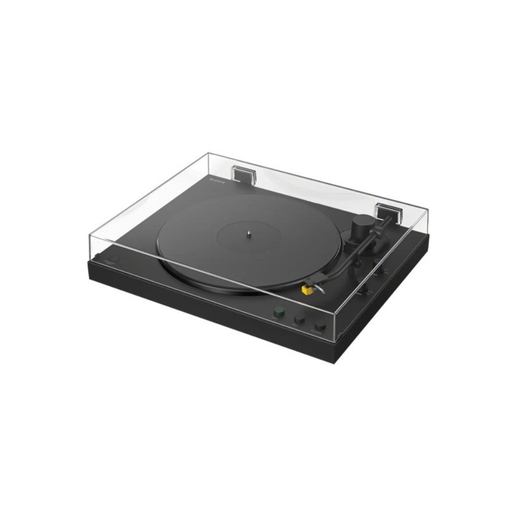 Image unavailable
Ideal if you want to play folk LPs automatically and use a Bluetooth speaker or wired audio set-up.
The product description lists Bluetooth, an MM cartridge and a dust cover. The player supports 33⅓ and 45 rpm, automatic operation and PHONO/LINE connections.
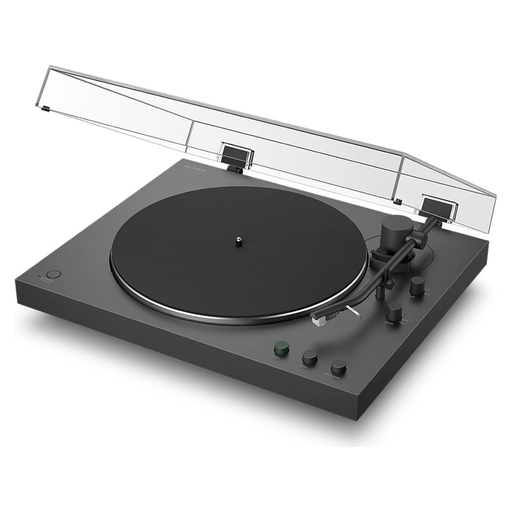 Image unavailable
Ideal if you want to play folk LPs automatically and choose between Bluetooth playback and a wired connection.
The product description lists Bluetooth, an MM cartridge and a dust cover. The player supports 33⅓ and 45 rpm, automatic operation with automatic tonearm return, and PHONO/LINE connections.
Yes, if the player and speakers have compatible connections. Audio-Technica explains that you can connect the AT-LP70XBT to active speakers using its built-in preamp; for a line input, its set-up instructions say to use LINE mode.
Place the player on a level, horizontal surface away from speakers that cause vibrations. Audio-Technica gives this advice for the AT-LP70XBT. Remember to allow space for the dust cover and cables too.
No. Pre-adjusted and fully automatic describe different features. Check separately whether the tonearm starts, stops and returns automatically if you don’t want to operate it yourself.
It depends on the model and how you use it. Pro-Ject describes wear to the belt and stylus; follow the manual and check the part number for your specific record player when inspecting or replacing them.
No. A record player with a Bluetooth transmitter can send audio to a compatible Bluetooth receiver, so check that your speaker can receive the signal. Bluetooth reception on a record player is a different feature.