
Folk listener with a dedicated spot in the lounge
You want to listen to LPs through suitable speakers and need a stable place for the turntable. Audio-Technica recommends placing a turntable on a level surface and keeping it away from speakers.


Start by checking how the player will connect to the speakers already in the lounge. Choose one that suits the available amplifier, input or Bluetooth speaker. A fully automatic model makes it easier for everyone to use, but a standalone turntable still needs a suitable sound system and a stable spot.
You want to listen to LPs through suitable speakers and need a stable place for the turntable. Audio-Technica recommends placing a turntable on a level surface and keeping it away from speakers.
Several people put records on and would rather start and stop playback easily than position the tonearm themselves each time.
Your choice depends mainly on the active or passive speakers, amplifier, inputs and any Bluetooth connection you already have.
First, check where the player can go and what sound equipment is available. Then choose the controls and connections that suit the people who use the lounge.
| What to consider | What should you check? | Who is this important for? |
|---|---|---|
| Placement and LPs | Check for a level spot, away from speakers and furniture that vibrates, and find out how the stylus is positioned. | If you want to play folk LPs in a shared space, you’ll need a stable spot and careful handling. Around 37% of consumers prioritise placement and handling records. |
| Sharing the controls | Check whether the model is fully automatic and how starting, stopping and, if applicable, manually selecting a track work. | If different people will use the player, you’ll want starting and stopping to be straightforward. Around 27% of consumers give shared use the highest priority. |
| Connections | Check what active or passive speakers and amplifier you have, as well as the phono or line input. Also check whether Bluetooth is available and wanted. | If you want to keep using the lounge’s speakers and amplifier, the player’s output must match their inputs. Around 18% of consumers prioritise this compatibility. |
| Complete set-up and maintenance | Check whether you need a phono preamp and whether a suitable replacement stylus is available for your chosen model. | If you want to know what else you’ll need alongside the player, including any care and maintenance, check these points in advance. Around 18% of consumers make the complete set-up and maintenance their top priority. |
A standalone record player needs a suitable connection to your speakers. Passive speakers require an amplifier, and the phono preamp must also be compatible with the input you’re using.
First, make a note of the speakers and inputs you already have. Then compare models with and without a built-in phono preamp.
The Consumers’ Association (Consumentenbond) says suitcase record players often sound less good and are generally less gentle on records than standard turntables.
Weigh up the convenience of a simple set-up against these points, and assess the specific model you’re considering.
Vibrations and sound pressure can affect the turntable.
In the set-up instructions for one of its turntables, Audio-Technica recommends a level surface and keeping the turntable away from speakers. Check the manual for the model you choose, too.
The AT-LP70XBT is a fully automatic standalone turntable with Bluetooth, support for 33⅓ and 45 rpm, and a switchable phono preamp.
The Sony PS-LX3BT is an automatic record player with Bluetooth and a phono/line switch.
The DP-300F is a fully automatic belt-drive record player with a switchable phono preamp.
The E1 Phono and the fully automatic Automat A1 are separate models with different controls and features.
The L-3810GY is a direct-drive record player with a built-in preamp and a USB connection for recording via a PC.
The Planar 1 is a standalone turntable for anyone planning to use their existing hi-fi system.
This selection focuses on a standalone Bluetooth record player for use with a suitable Bluetooth speaker or a wired audio system.
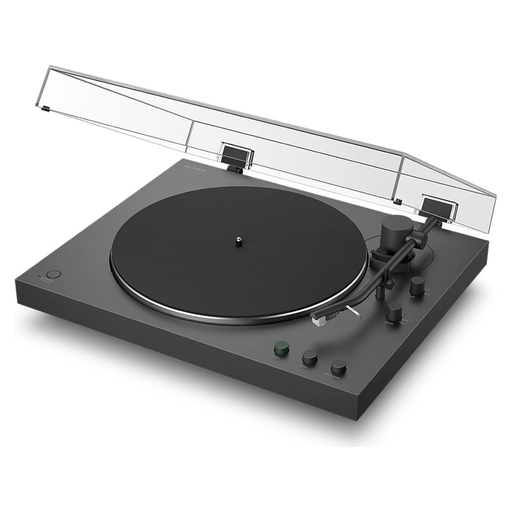 No image available
The automatic controls can be handy when several people use the player.
The product description lists belt drive, an MM cartridge, an aluminium platter and a dust cover. The player supports 33⅓ and 45 rpm records and has Bluetooth and a PHONO/LINE switch. You’ll need a Bluetooth receiver for wireless listening. For a wired connection, check that the switch setting is suitable for your system’s input.
You can with active speakers that have a suitable input, as long as the necessary phono preamp is present and correctly set up. Passive speakers also need an amplifier. Before buying, check which inputs your system has.
Choose a level, stable surface and don’t place the player right next to speakers. Audio-Technica gives this placement advice for one of its turntables; also check the manual for the model you’re buying.
Clean the stylus carefully, following the instructions for your player and stylus. For its recommended cleaning method, Audio-Technica advises brushing from back to front, not from side to side, and not moving the platter while cleaning.
It depends on whether the lounge is used for business. The Dutch Ondernemersplein explains that businesses need a music licence, for example when playing background music for customers or employees. BumaStemra says that, in these kinds of business settings, a combined licence from BumaStemra and Sena is required. First establish who operates the space: the term ‘shared lounge’ alone doesn’t mean it’s being used for business.
In the Netherlands, the retailer is your first point of contact. According to the Dutch Government, if a product is faulty, the retailer must offer a solution, such as repairing or replacing it free of charge; they can’t simply refer you to the manufacturer.