
Listeners who prefer a low volume
You want to hear vocals and acoustic instruments at a comfortable volume. So consider your entire listening setup and keep the stylus clean; Audio-Technica warns that dirt on the stylus can affect playback.


Start by deciding how you want to listen: through your existing system, active speakers or headphones. Then check that the phono stage, volume control and connections suit your chosen setup. Bluetooth and automatic operation are handy features, but on their own they don’t prove that folk music will sound better at low volume.
You want to hear vocals and acoustic instruments at a comfortable volume. So consider your entire listening setup and keep the stylus clean; Audio-Technica warns that dirt on the stylus can affect playback.
You already have speakers or an amplifier and want to know whether the PHONO or LINE connection will work with your equipment. Audio-Technica points out that passive speakers need a separate speaker amplifier.
You want to listen to folk LPs without room speakers. For wired listening, your setup needs a suitable headphone amplifier and volume control; for Bluetooth, the record player needs to be compatible with your headphones.
First, work out the complete route from record player to speakers or headphones. Then choose features such as Bluetooth or automatic operation.
| What to consider | What should you check? | Who is this important for? |
|---|---|---|
| Playback at low volume | Check the condition of the stylus and whether it can be replaced, and follow the manufacturer’s cleaning instructions. | If I want to listen to vocals and acoustic instruments at a relaxed volume, I look at the whole setup and make sure the stylus is clean. Around 36% of consumers prioritise relaxed listening. |
| Connecting to your audio system | Match PHONO or LINE to the input; also check whether your speakers are active or passive. | If I already have an amplifier or speakers, I want the output to work with my existing equipment. Around 29% of consumers put connection compatibility first. |
| Listening with headphones | For wired use, check the headphone amplifier and volume control; for Bluetooth, check that both devices support it. | If I want to listen to folk without sound coming from room speakers, the headphone setup needs to be complete. Around 21% of consumers prioritise listening with headphones. |
| Ease of use | Check whether the exact model starts and returns automatically, or needs to be operated manually. | If I want to play an LP without having to operate the tonearm myself each time, I check how the model works. Around 14% of consumers prioritise convenience. |
A built-in phono preamp doesn’t mean a record player can drive passive speakers directly, nor does it automatically control the volume of wired headphones. Audio-Technica recommends a separate stereo amplifier for passive speakers and a suitable headphone amplifier for headphones.
Before you buy, map out the entire signal path, including the amplification and volume control between the record player and your speakers or headphones.
Depending on your existing equipment, you may still need a stereo or headphone amplifier for your chosen setup.
A PHONO signal connected to a standard line input may sound too quiet; a LINE signal connected to a PHONO input may distort.
Check the name and function of the input on your amplifier, then set the record player’s PHONO/LINE switch accordingly.
The Sony PS-LX3BT and PS-LX310BT are separate models. For Pro-Ject, the built-in phono stage is a feature of the T1 Phono SB, and shouldn’t be assumed to come with every T1 version.
Check the full model name and the connections on the version you’re considering.
A version without a suitable built-in phono stage may need extra equipment to connect to your existing system.
According to Audio-Technica, the AT-LP70XBT offers automatic operation, Bluetooth and a switchable phono preamp.
According to Sony, the PS-LX3BT and PS-LX310BT combine automatic operation with wired connection options; the PS-LX3BT also offers Bluetooth.
According to Denon, the DP-300F is an automatic, wired record player with a switchable phono preamp.
According to Pro-Ject, the T1 Phono SB has a built-in, switchable MM phono stage and electronic speed selection between 33 and 45 rpm.
According to Rega, the Planar 1 is a manually operated record player with a pre-fitted Carbon cartridge and preset bias.
These models are suited to listening via Bluetooth, a wired audio system or built-in speakers. Check the connections and amplification required for each model to make sure it suits your setup.
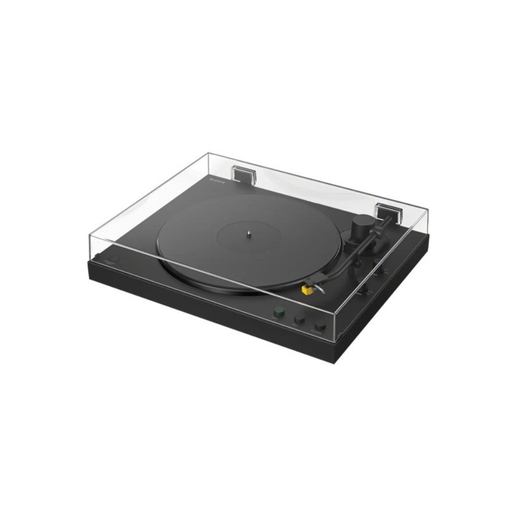 No image available
May suit you if you want to listen wirelessly but also want the option of a wired connection.
The product description lists automatic operation, Bluetooth, a PHONO/LINE switch and playback at 33⅓ and 45 RPM.
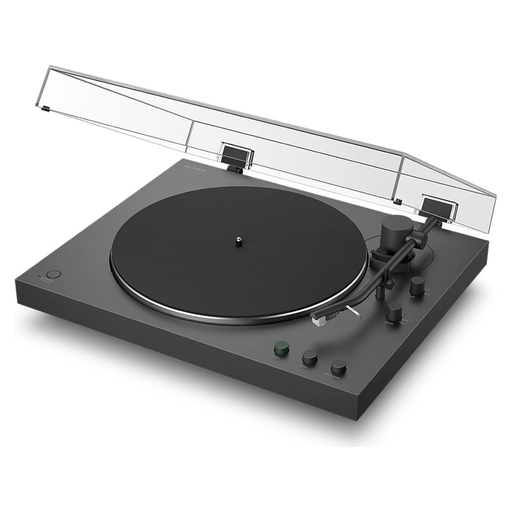 No image available
May suit you if you want automatic playback and the choice of Bluetooth or a wired connection.
The product description lists fully automatic operation, a built-in phono equaliser, a PHONO/LINE switch and playback at 33⅓ and 45 RPM.
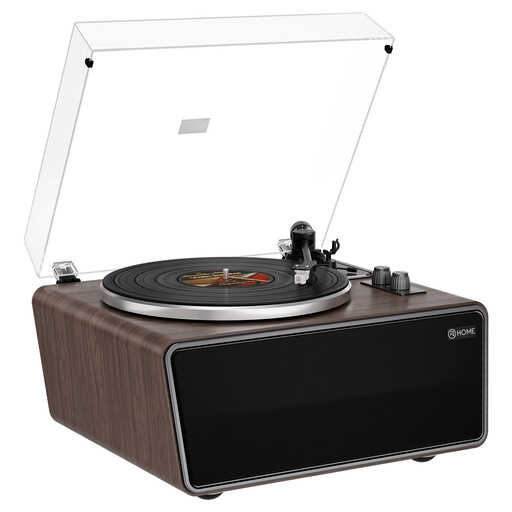 No image available
May suit you if you want to use built-in speakers or connect an external system.
The product description lists four built-in speakers, RCA PHONO/LINE outputs, an AT-3600L cartridge and belt drive.
The description lists playback at 33⅓ and 45 RPM.
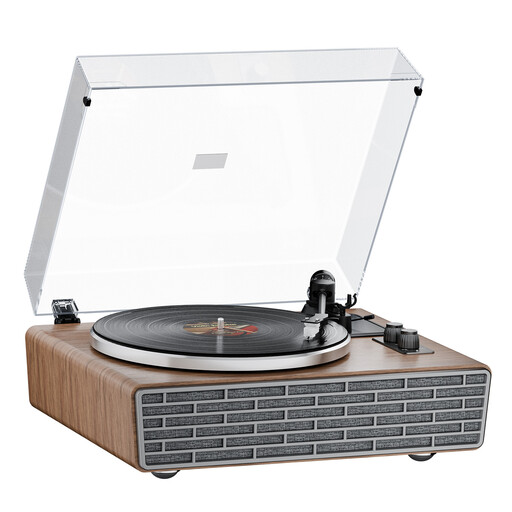 No image available
May suit you if you want built-in speakers and the option to connect external equipment.
The product description lists four built-in speakers, RCA PHONO/LINE outputs, an AT-3600L cartridge and belt drive.
The description lists playback at 33⅓ and 45 RPM.
No, passive speakers also need a speaker amplifier. With active speakers, check that the signal and PHONO/LINE setting are compatible with their input.
No, a standard line output isn’t the same as a headphone output. Audio-Technica explains that a line signal needs a headphone amplifier; check whether your chosen model has a suitable output with volume control.
First, check that PHONO or LINE matches the input on your system. A PHONO signal connected to a line input may sound too quiet; LINE connected to a phono input may distort.
Follow the cleaning instructions for your model’s stylus and avoid putting sideways pressure on this delicate part. Audio-Technica notes that dirt on a stylus can affect playback.