Start with where you’ll put it: place the record player on a stable surface, separate from the speakers, so vibrations aren’t transmitted directly to the stylus. Then choose between automatic operation and more scope to adjust the settings yourself, and check that the phono connection is compatible with your amplifier or active speakers. A damped turntable is no substitute for a suitable setup.
Who is this buying guide for?
Listener with a tight setup against the wall
You want to stop speakers, furniture or the floor from transmitting vibrations to the stylus, and may be able to adjust your setup. Audio-Technica explains how vibrations from speakers can affect the stylus.
Dedicated listener of classical LPs
You want to pay attention to tonearm and stylus setup, and are happy to spend time on it. Audio-Technica recommends rechecking the balance and tracking force during maintenance and after replacing the stylus or cartridge.
Listener who wants a simple connection
You want to know in advance whether the record player will work with your amplifier or active speakers, and how much you’ll need to do yourself.
What should you look for when buying?
First assess your setup and the connections you need; then choose the controls and adjustment options that suit your listening habits.
| What to consider |
What should you check? |
Who is this important to? |
| Vibrations and positioning |
Check whether the record player and speakers can be placed separately on stable surfaces. Also check the recommended distance between the speakers and the wall in the speaker manual. |
If space is tight, I want to know whether the record player can have its own stable spot; around 40% of consumers prioritise positioning and vibrations above all else. |
| Tracking and setup |
Check which cartridge and replacement stylus are compatible with the exact model, and which settings are specified in the manual. |
If you’re mainly concerned with the stylus and setup when playing classical LPs, you may be happy to check the settings yourself; around 30% of consumers put this concern first. |
| Connecting to your system |
Check whether your amplifier has a PHONO or line input, and whether the record player has a built-in, possibly switchable, phono preamp. |
If I want to connect my existing amplifier or active speakers without extra equipment, the right output matters; around 20% of consumers start by checking the connections. |
| Operation and maintenance |
Check whether the tonearm starts and returns automatically, and which replacement stylus is specified for the model. |
If I’d rather not operate the tonearm myself, I look at the automatic features and what maintenance will involve later; around 10% of consumers prioritise ease of use above all else. |
Common buying mistakes
-
Assuming damping makes careful positioning unnecessary
Damping components won’t necessarily eliminate vibrations transmitted from speakers to the record player through the same piece of furniture.
First plan separate, stable spots for the record player and speakers. Only then decide whether you need additional isolation.
A separate spot may require an extra piece of furniture or a suitable wall shelf; check that the fixings are right for your type of wall.
-
Confusing a PHONO output with a standard line input
The right connection depends on the input on your audio system and whether the record player has a phono preamp, as well as its setting.
Check the connections on both devices and the PHONO/LINE setting in the manual before ordering.
If the record player and audio system aren’t a suitable match, you may need a separate phono preamp.
-
Assuming automatic operation means maintenance-free playback
Even on an automatic record player, the stylus and cartridge still need to be checked and replaced when necessary.
Find the replacement stylus for the exact model and follow the setup instructions after replacing it.
You may need a replacement stylus or help with setup when it’s time for maintenance.
Brands to compare
Audio-Technica
The AT-LP70XBT is a fully automatic record player with Bluetooth and a switchable phono preamp.
- Audio-Technica says that a replacement stylus from the VM95 series is compatible.
- The stated damping in the chassis doesn’t prove that the record player can sit next to speakers without problems.
Pro-Ject
The manual Debut EVO 2 is an option for anyone who wants to compare settings and separate hi-fi components. The A1.2 is another model with automatic operation.
- For the Debut EVO 2, Pro-Ject lists electronic speed selection, anti-skating and RCA connections.
- The Debut EVO 2 and A1.2 are different models with different controls; they aren’t interchangeable versions.
Sony
The PS-LX5BT combines automatic operation with Bluetooth and a PHONO/LINE selector switch.
- Sony lists support for 33⅓ and 45 rpm, as well as a built-in phono preamp.
- Sony’s description of the sound is a manufacturer claim, not an independent comparison for classical music.
Technics
The SL-40CBT combines direct drive with Bluetooth, a built-in phono preamp and a supplied cartridge.
- Technics describes isolators and digital speed control for this model.
- These specifications don’t prove that speakers close to the wall won’t cause feedback in every room.
Denon
The DP-300F is a fully automatic, belt-drive record player with a switchable phono preamp.
- Denon lists automatic tonearm return and playback at 33⅓ and 45 rpm.
- These features don’t provide a comparative measure of performance when vibrations from speakers are present.
Record players at Joybuy
These product picks are record players for vinyl, with models offering automatic operation, built-in speakers or connections for external equipment. Check that each model’s connections and placement suit your audio system and room.
 No image available
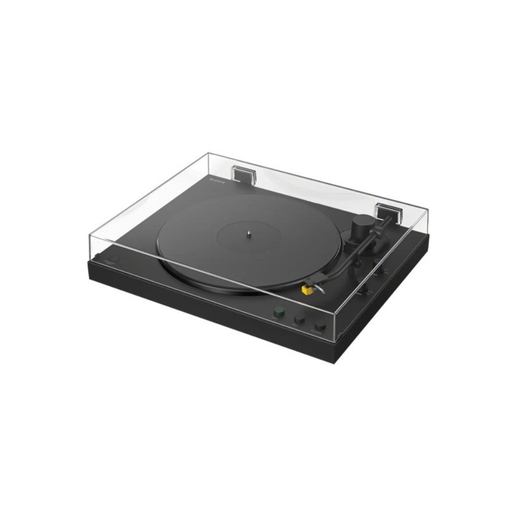
Sony PS-LX5BT
Suited to anyone who values automatic operation and the choice between PHONO and LINE.
Bluetooth; fully automatic operation; PHONO/LINE selector switch; 33⅓ and 45 rpm.
View at Joybuy
 No image available
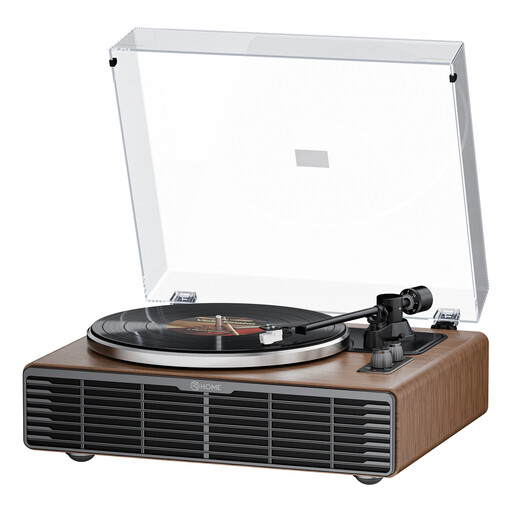
XJ-HOME XJ-H03 Walnut
Suited to anyone who wants built-in speakers and also needs connections for external equipment.
Belt drive; four built-in speakers; Bluetooth; 33⅓ and 45 rpm; AT3600L cartridge; RCA Phono/Line outputs.
View at Joybuy
 No image available
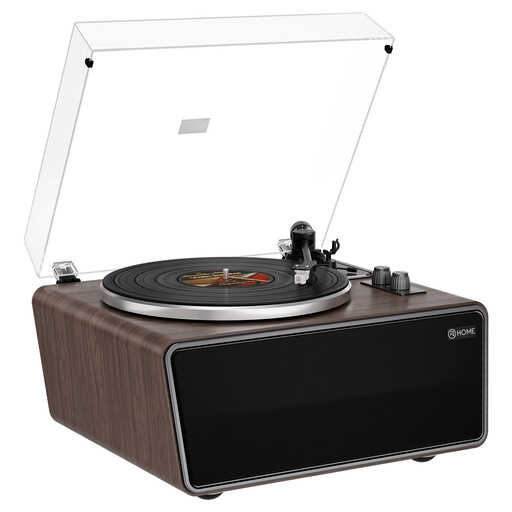
XJ-HOME XJ-H01 Vintage All-in-One
Suited to anyone looking for a record player with built-in speakers and connections for external equipment.
Four built-in speakers; 33⅓ and 45 rpm; AT-3600L cartridge; AUX/RCA outputs; Bluetooth and USB function.
View at Joybuy
 No image available
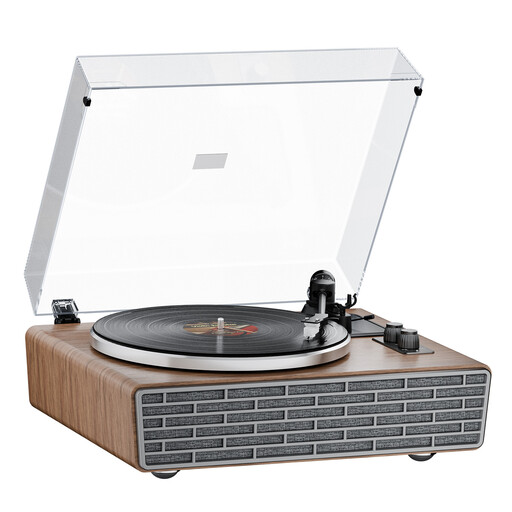
XJ-HOME XJ-H02 Retro Walnut
Suited to anyone who wants built-in speakers as well as the option to connect external amplifiers or active speakers.
Belt drive; four built-in speakers; Bluetooth; 33⅓ and 45 rpm; AT-3600L cartridge; dual RCA outputs.
View at Joybuy
Frequently asked questions
Does a record player need to sit next to the speakers if they’re close to the wall?
No. Ideally, give the record player its own stable spot, separate from the speakers. Audio-Technica warns that vibrations from speakers can affect the stylus. Check the speaker manual for the recommended distance between the speakers and the wall.
When might a wall shelf for a record player be useful?
A wall shelf may be an option if you need a separate spot for the record player. For its Wallmount it 1, Pro-Ject recommends a solid wall, such as brick, and suggests a different model with integrated vibration damping for less substantial walls. Check that the shelf, wall, fixings and load capacity are suitable for your setup.
How do I connect a record player to my existing audio system?
First, compare the input on your amplifier or active speakers with the output on the record player. Denon says the DP-300F’s phono preamp can be switched on to connect to a standard AUX input, or switched off for a compatible PHONO input. Always check the manual for the model you choose.
What should I check after setting up or replacing a stylus?
For a model with an adjustable tonearm, follow the instructions for tracking force and anti-skating. Audio-Technica recommends rechecking the balance and tracking force during maintenance and after replacing the stylus or cartridge.
What rights apply to online purchases in the Netherlands?
For online purchases from a business, you’ll generally have 14 days to change your mind, although exceptions may apply. You’re also covered by the legal guarantee: the Dutch Government states that there is no fixed statutory time limit for this in the Netherlands. If a product is faulty, contact the seller; this is separate from any manufacturer’s warranty.


