
For listeners who want an easy start
You play spoken-word records at 33⅓ or 45 rpm and want the tonearm to start and return automatically. Models such as the Audio-Technica AT-LP70XBT and Sony PS-LX3BT offer automatic operation at these speeds.


Choose a record player based on the speeds of your records and the inputs on your speakers or amplifier. For standard 33⅓ and 45 rpm records, automatic operation can be handy. For 78 rpm records, you’ll also need a suitable cartridge. If you want to digitise recordings, check that the player has a suitable recording output: Bluetooth doesn’t provide USB recording.
You play spoken-word records at 33⅓ or 45 rpm and want the tonearm to start and return automatically. Models such as the Audio-Technica AT-LP70XBT and Sony PS-LX3BT offer automatic operation at these speeds.
Your choice mainly depends on how the player connects to your active speakers, amplifier or Bluetooth headphones. The Consumers' Association points out that a record player needs phono amplification, so check whether this is built into the player or your existing equipment.
You want to digitise spoken-word records or you have 78 rpm shellac records. Audio-Technica lists both a USB output and 78 rpm playback for the AT-LP120XUSB; shellac records also require a suitable cartridge.
Start with the speed and material of your records. Then consider which connections and level of automatic operation suit your home office and listening habits.
| What to consider | What should you check? | Who is this important for? |
|---|---|---|
| Operation | Check whether the exact model is fully automatic and supports the speeds of your records. | If I don’t want to keep operating the tonearm while working or reading, ease of use comes first. Around 40% of consumers put automatic operation at the top of their list. |
| Connections | Check which inputs your speakers or amplifier have and whether the player has a phono preamp. | If I want to use my existing desk setup, the player’s output needs to match it. Around 30% of consumers prioritise connecting to their existing audio equipment. |
| Digitising | Check whether the exact model has a USB output suitable for recording to a computer. | If I want to preserve spoken-word recordings digitally, I look for a suitable recording output and consider the recording process. Around 20% of consumers put digitising at the top of their list. |
| 78 rpm shellac records | Check for both a 78 rpm setting and a cartridge that is suitable and compatible. | If I want to play 78 rpm shellac records, the speed and the stylus both need to be suitable for the record. Around 10% of consumers put playing 78 rpm records at the top of their list. |
A record player isn’t automatically a complete listening setup. Without suitable speakers or amplification, you may not be able to connect it to your existing equipment.
Make a note of the inputs on your speakers or amplifier and check whether the player has a built-in phono preamp.
A player may run at 78 rpm without the supplied cartridge being suitable for shellac records. Audio-Technica specifies a separate suitable cartridge for the AT-LP120XUSB.
Check the record material, speed and cartridge compatibility before playing the record.
Bluetooth output doesn’t mean a player can record over USB or play sound through built-in speakers. Sony lists no USB connection for the PS-LX3BT.
Check what each connection is for on the specific model, and which receiver, speaker or computer you’ll need.
The PS-LX3BT is an automatic option for 33⅓ and 45 rpm records, with Bluetooth and a wired connection.
The AT-LP70XBT is an automatic option for 33⅓ and 45 rpm records; the manual AT-LP120XUSB also offers 78 rpm playback and USB.
The DP-300F is a wired, fully automatic option for an existing audio setup.
The E1.2 is a manual option for anyone who already has a hi-fi setup.
The Joybuy products below are automatic Sony turntables for 33⅓ and 45 rpm records, with Bluetooth and a wired connection option. Check which connection on each model works with your speakers, amplifier or headphones.
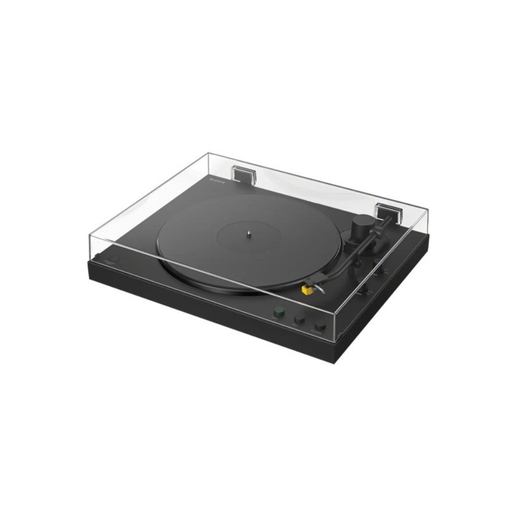 No image available
A good match for spoken-word records if you’re looking for automatic operation and a choice between Bluetooth and a wired connection.
The product information lists automatic operation, tonearm return and a PHONO/LINE switch. You’ll need a compatible Bluetooth receiver or wired audio setup; Bluetooth doesn’t mean there’s a built-in speaker.
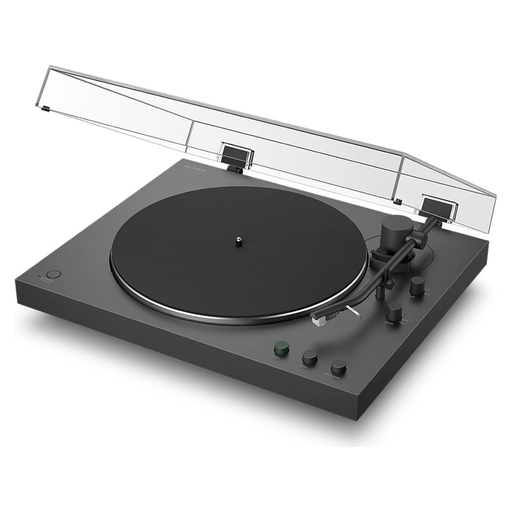 No image available
A good match if you want to play spoken-word records at 33⅓ or 45 rpm automatically and listen via Bluetooth or a cable.
Sony specifies 33⅓ and 45 rpm playback and a switchable phono/line connection. According to Sony, this model has no USB connection, so check this if you want to digitise your records.
It depends on the inputs on your speakers and the phono amplification. Check whether the player has a line output or your speakers or amplifier have a suitable phono input. If not, you’ll need a separate phono preamp.
No, you should also check whether the cartridge is suitable for shellac. Audio-Technica lists an optional suitable cartridge for the AT-LP120XUSB; check its compatibility and setup too.
For online purchases by consumers, there is generally a statutory 14-day cooling-off period. The ACM outlines some exceptions, so check which terms apply to your purchase.
According to the Dutch Government, the seller must offer a solution if a product you’ve bought is faulty. The Netherlands doesn’t have a fixed statutory warranty period for all products; what you can expect depends, among other things, on the product and what you were told about it.