
LP and single listeners who like to cook
If you want to put on a soundtrack while cooking, look for automatic operation and support for 33⅓ and 45 rpm records. Audio-Technica, Sony and Denon list these speeds for the models discussed here.


Start with the speed and material of the records you actually own. Many record players handle 33⅓ and 45 rpm records, but not 78 rpm records. Then choose between automatic and manual operation, check that the connections work with your speakers and amplifier, and set aside a sturdy, level spot. Shellac records also need a suitable stylus, as well as 78 rpm playback.
If you want to put on a soundtrack while cooking, look for automatic operation and support for 33⅓ and 45 rpm records. Audio-Technica, Sony and Denon list these speeds for the models discussed here.
If you want to connect your record player to active speakers, an amplifier or a wireless speaker, check the PHONO and LINE connections, as well as the direction of Bluetooth transmission. The model specifications from Audio-Technica, Sony and Denon show that connectivity varies between models.
Check whether your collection consists of standard LPs and singles, or includes 78 rpm shellac records too. Dual lists 78 rpm playback for the CS 529; for shellac, you should also check that the stylus and cartridge are suitable.
A good fit if: you mainly play LPs and singles and would rather not handle the tonearm while cooking.
Bear in mind: check that Bluetooth transmits audio to your speaker and that they’re compatible. A transmitter doesn’t automatically receive music from your phone too.
A good fit if: your amplifier or active speakers have a suitable input, and you value automatic start and return.
Bear in mind: Bluetooth isn’t listed as a feature for the Denon DP-300F. Check the PHONO or LINE setting for the input you’re using.
A good fit if: you want to operate the tonearm yourself and choose the components in your setup.
Bear in mind: according to the manufacturer, only the Phono version of the Pro-Ject E1.2 has a switchable built-in preamp.
A good fit if: your collection includes 78 rpm records, such as shellac records.
Bear in mind: Dual lists 78 rpm playback for the CS 529, but for shellac you’ll also need to check that the stylus and cartridge combination is suitable.
| What to consider | What to check before buying | Who should pay particular attention? |
|---|---|---|
| Record material and speed | Check the speed printed on your records. For 78 rpm records, also check the material and, for shellac, that you have a suitable stylus. | If I want to make sure my LPs, singles or any 78 rpm records can be played, I start with my collection. Around 33% of consumers say that making sure the right record format is covered is their top priority. |
| Operation | Check separately whether starting, stopping and returning are automatic, and what setup is required before use. | If you’d rather not keep handling the tonearm while cooking, pay particular attention to the automatic features. Around 25% of consumers put ease of use first. |
| Connection to your audio equipment | Note the input on your amplifier or active speakers. For Bluetooth, check that the record player transmits audio to the playback device. | If I want to use my existing speakers, I check that their input matches the record player’s output. For around 25% of consumers, connecting to their current audio equipment is the top priority. |
| Space in your kitchen-diner | Measure the available space, including room for the dust cover. Choose a sturdy, level spot away from anything that might spill. | If the available space determines whether the player will be practical to use, I measure the area first. Around 17% of consumers put their setup at the top of their list when choosing. |
Vintage describes the music, not necessarily the record format. A player that only supports 33⅓ and 45 rpm won’t play a 78 rpm record at the correct speed. Shellac records also need a suitable stylus.
Before comparing players, check the speed and, for 78 rpm records, the material of your own records.
If you have a shellac collection, you may need a suitable stylus or cartridge combination as well as a compatible record player.
Pro-Ject specifically lists a switchable built-in phono preamp for the E1.2 Phono. The name E1.2 alone doesn’t confirm that it’s this version.
Check the full version name and compare the PHONO or LINE connection with the input on your audio system.
If your chosen version doesn’t have a suitable preamp, you may need to add a separate phono preamp to your setup.
According to the Dutch government, an extended warranty offered to you is in addition to your statutory right to a product that works properly. If there’s a problem, contact the seller.
Before paying for extra cover, compare exactly what it adds to your existing statutory rights.
An extended warranty may be an additional expense, so consider whether the cover offers anything extra for your situation.
According to Audio-Technica Netherlands, the AT-LP70XBT is an automatic player for 33⅓ and 45 rpm records, with a Bluetooth transmitter and switchable phono preamp.
The PS-LX3BT is designed for anyone who wants to play 33⅓ and 45 rpm records automatically through a wired output or a compatible Bluetooth playback device.
According to Denon, the DP-300F offers a wired, fully automatic option for 33⅓ and 45 rpm records, with a switchable phono preamp.
The CS 529 is worth considering if your collection includes 78 rpm records and you want automatic operation.
The E1.2 is a manual option for anyone who wants to operate the player themselves. Check which version you’re choosing.
This Joybuy selection includes automatic Sony record players and models with built-in speakers for listening in your kitchen-diner. Check each model’s features and connections to make sure they suit your records and audio equipment.
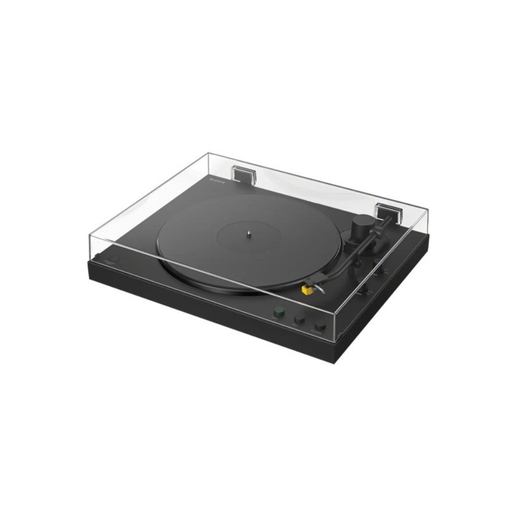 No image available
Worth considering if you’re looking for a Sony record player with Bluetooth for your listening setup.
Bluetooth is listed in the product name. Check compatibility and the direction of the audio connection with your playback device.
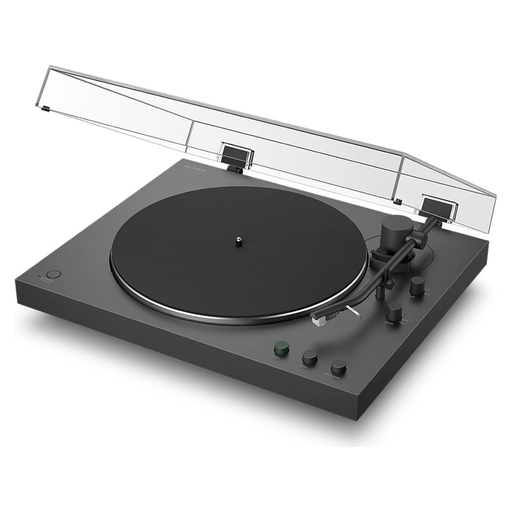 No image available
This Sony is worth considering if you’re looking for a Bluetooth record player. Check that it works with your speaker.
Bluetooth is listed in the product name. Also check which PHONO or LINE connection your audio equipment needs.
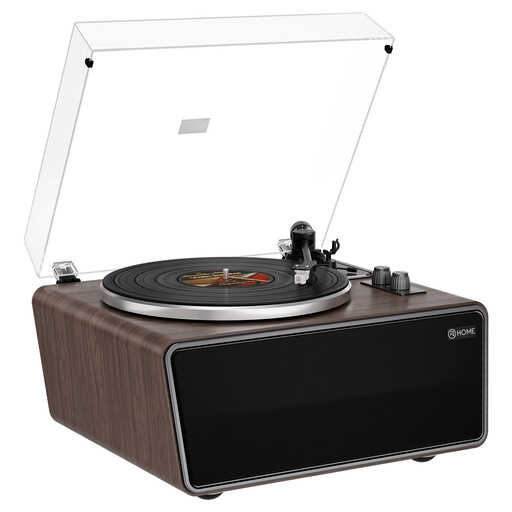 No image available
Worth considering if you want to listen through built-in speakers.
The product name lists four built-in speakers, a phono preamp and an AT-3600L (MM) cartridge.
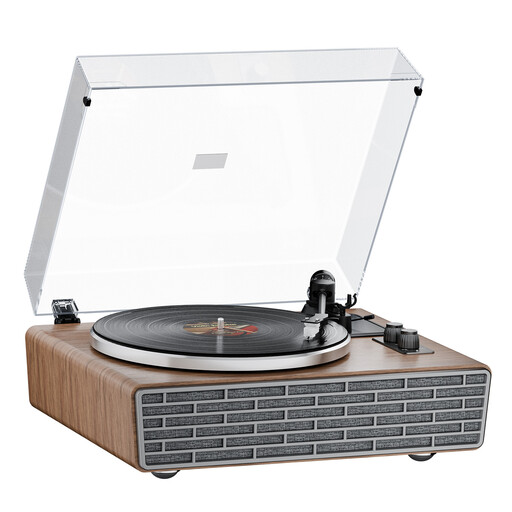 No image available
An option if you’re looking for a record player with built-in speakers and Bluetooth.
The product name lists four built-in speakers, a dust cover, belt drive and an AT cartridge.
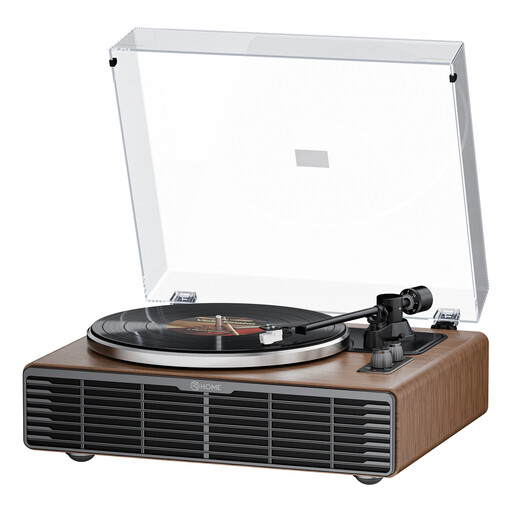 No image available
Worth considering if you want a record player with built-in speakers and Bluetooth.
The product name lists four speakers, belt drive, an AT3600L cartridge, an RCA PHONO/LINE output and a dust cover.
No, not necessarily. Check the record speed and, for older 78 rpm records, the material too. The Sony PS-LX3BT and Audio-Technica AT-LP70XBT are specified for 33⅓ and 45 rpm; Dual lists 78 rpm for the CS 529. Shellac records also need a suitable stylus.
It depends on the record player’s output and the input on your speakers or amplifier. Denon lists a switchable phono preamp for the DP-300F, which allows you to connect it to a standard AUX input. If you have a suitable PHONO input, use the corresponding switch setting. Check the manuals for both devices.
Not necessarily; check whether the model transmits or receives Bluetooth audio. Sony describes the PS-LX310BT as transmitting to playback devices, not receiving music from a phone.
Place the record player on a sturdy, level surface and follow the model-specific instructions for fitting or replacing the cartridge. Audio-Technica’s setup instructions point out that correct adjustment of the tonearm and stylus, among other things, is important, so check the instructions for your exact model.
The Dutch government states that distance purchases usually come with a 14-day cooling-off period, although exceptions apply. You’re also entitled to a product that works properly. There’s no fixed statutory warranty period in the Netherlands, and the seller is your point of contact if there’s a problem. Any extended warranty offered is in addition to these statutory rights.