
Vandaag of morgen in huis

Kwaliteit gegarandeerd

Welkomstaanbiedingen ontgrendelen: GRATIS bezorging | Tot 80% korting | Gratis 30 dagen JoyPlus-proefperiode
Download de app
A rechargeable LED night light with motion sensor can be a handy addition to a dark hallway, wardrobe, kitchen or nursery. The light turns on when movement is detected and doesn't need to be permanently plugged into a socket. However, models vary significantly in terms of mounting, brightness, battery life and operation.
If you only focus on the number of LEDs or a low price, you could run into practical problems. For example, the light might be too bright for a bedroom, the sensor may not respond well in your chosen spot, or the adhesive strip could come loose over time. The points below will help you compare more effectively.
A PIR sensor reacts to movement and temperature changes within its detection zone. The distance, viewing angle and lighting conditions determine how reliably the light switches on. In the available models, the stated range is typically around 3 to 5 metres. That doesn't automatically mean the light will activate in every direction or with every movement.
So, check the following:
A rechargeable night light uses less energy on a low brightness setting than at maximum brightness. The number of times it switches on each night also affects how long it lasts. A stated maximum battery life is therefore a product specification under certain conditions, not a fixed expectation for every household.
Pay attention to the battery capacity in mAh, the charging voltage and any usage time per mode. A 500mAh battery and a 2000mAh battery cannot be directly compared without information about brightness and power consumption.
A cupboard light without drilling is often attached using adhesive tape, magnets or hooks. A smooth, clean surface generally provides a better base than a dusty, porous or damp one. With a metal cupboard, a magnetic fixing can be practical; with a wooden shelf, a self-adhesive strip may be more convenient.
Clean the surface, don't place the light directly above a heat source, and check regularly that the fixing is still secure.
For a kitchen or wardrobe, cool white light can be practical, while warm LED lighting may feel more pleasant in a bedroom or on a bedside table. Versatile models offer multiple colour temperatures, such as:
A light with adjustable brightness is useful if you want to use one model in different places. For a baby night light or children's room lighting, a low, dimmable setting is particularly practical. Also check the light output in lumens. A model with 30 lumens is intended for orientation, whereas 400 lumens is more suitable as functional lighting in a cupboard or hallway.
A wireless LED light with a USB connection can be charged via a laptop, power bank or suitable USB charger. Always check the stated charging voltage, for example 5V, and the recommended charging current. Don't use just any power source if the product information specifies a particular connection.
A built-in lithium battery is practical, but it's usually not user-replaceable. So, look out for:
An ultra-thin LED cupboard light around 1 cm thick fits under a kitchen cabinet or in a narrow wardrobe. A freestanding LED night light offers more flexibility on a bedside table, shelf or changing unit. Measure the available space before you order.
Also consider moisture. Models for indoor use are not automatically suitable for a bathroom, balcony or other damp areas. The included safety information and protection rating are key here.

Why this fits the profile: Two lights offer a practical starting point for, say, a bedroom and hallway. This model features motion detection, three colour temperatures and five brightness levels.
The stated sensor works within 3 to 5 metres and at a maximum of 20 lux. This makes it clearer when automatic activation is intended.
500mAh battery, USB charging, three colour temperatures, five dimming levels and a set of two lights.
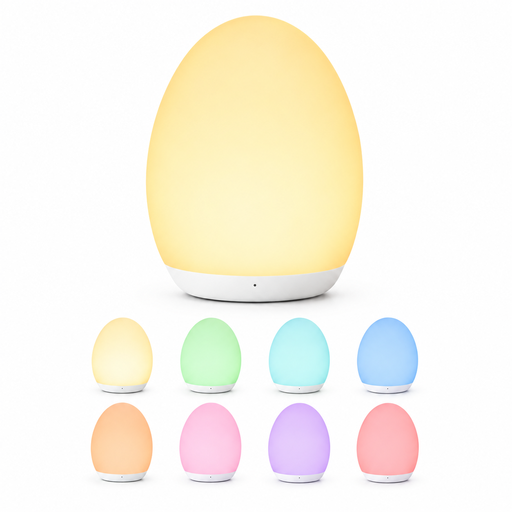
Why this fits the profile: This freestanding rechargeable night light is designed for night feeds, nappy changes, bedtime and travel. Touch control and a timer are handy when you don't have many free hands.
The product information states the usage time per brightness level. According to the description, the maximum of 100 hours only applies at the lowest setting and not for every night light mode.
2000mAh battery, dimmable warm light, eight colours, memory function and a one-hour timer.

Why this fits the profile: The long, slim shape is designed for kitchen cabinets, wardrobes and shelves where a freestanding light doesn't fit well.
The dimensions of 400 × 38 × 10 mm can be checked in advance. According to the product description, mounting is done with adhesive tape, without drilling.
61 LEDs, PIR detection at 3 to 5 metres, three colour temperatures, 1100mAh and two lights per set.
We've put together a full, up-to-date list of products that fully meet these strict selection criteria and comply with current European safety regulations.
Place the light in a spot where the sensor can detect the direction of movement, for example on a cupboard wall or in a hallway. Clean the surface first and test the detection before pressing the adhesive strip down permanently. Take the stated distance into account and avoid placing it behind doors, curtains or other obstacles.
This varies depending on battery capacity, brightness level and number of activations. A light with 500mAh may have a different usage time than a model with 1100mAh or 2000mAh. Always check the product specification for each mode. The maximum usage time usually applies to the lowest brightness setting.
An RGB night light can provide coloured light for atmosphere or a child's room, but warm white light is generally more practical when you need to see something without turning on the main light. Choose a model with a dimming function, memory setting or timer if you want simple operation. Only use a light according to the stated safety and usage instructions.
