
Vandaag of morgen in huis

Kwaliteit gegarandeerd

Welkomstaanbiedingen ontgrendelen: GRATIS bezorging | Tot 80% korting | Gratis 30 dagen JoyPlus-proefperiode
Download de app
A rechargeable LED night light is useful beside your bed, in a nursery, hallway or wardrobe. You don’t need a socket right next to the lamp, and you can move it whenever it suits you. However, models can vary considerably in how they work. A lamp that’s great for mood lighting isn’t necessarily suitable as a sensor-activated wardrobe light.
So don’t focus only on appearance or claims such as ‘long battery life’. Check the battery capacity, controls, brightness and mounting options. Below, you’ll find the key points to consider, along with a selection of products with clearly listed specifications.
Battery capacity, measured in mAh, tells you how much energy is stored, but it doesn’t show exactly how long a lamp will stay lit. Runtime also depends on power consumption, brightness, sensor settings and the colour selected. A lamp on maximum brightness uses more energy than a soft night light.
So look at the combination of battery capacity, power consumption and stated operating mode. If you’re choosing a model with a motion sensor, it’s also worth checking whether the sensor only works in the dark.
Some lamps have three preset settings, while others offer continuous dimming. A three-step dimmer is easy to use, but gives you fewer options in between. A continuously dimmable LED lamp gives you more control if, for example, you want a soft light beside your bed.
Check the colour temperature, too. Warm white at around 2700 to 3200K generally feels softer than cool white at around 5000 to 7000K. Bright white can be useful for a worktop or wardrobe, while warm white is often a better choice for mood lighting in the bedroom.
A night light with a motion sensor can switch on automatically, but its performance depends on distance, direction and ambient light. Check the stated detection range. For the sensor models featured here, it’s around 3 to 5 metres. Some models only switch on below a certain light level, such as a maximum of 20 or 40 lux.
A sensor can be useful in a wardrobe, on the stairs or in a hallway. For a bedside light, a touch control or standard switch may be more predictable.
A USB-rechargeable lamp is handy if you already use a USB charger, laptop or power bank. Check:
According to the product information, a lamp with an integrated lithium battery should be charged using a suitable USB power source. Don’t use a damaged cable, and keep the connection dry.
Lumens indicate how much light a lamp produces. A compact lamp with 30 or 40 lumens is mainly intended as a soft light to help you find your way. A 210-lumen table lamp can provide more general lighting, but still won’t replace a full ceiling light.
A low dimmer setting is often useful for lighting in a child’s bedroom or nursery. However, don’t leave a lamp within reach of a young child. Always check the manufacturer’s warnings and place table lamps on a stable surface.
Measure the space beforehand. A 40-centimetre wardrobe light won’t fit every narrow compartment; a 30-centimetre version may be a better fit. Also consider:
According to the product information, an IP20 lamp is intended for dry indoor spaces. Don’t use it in a damp environment.
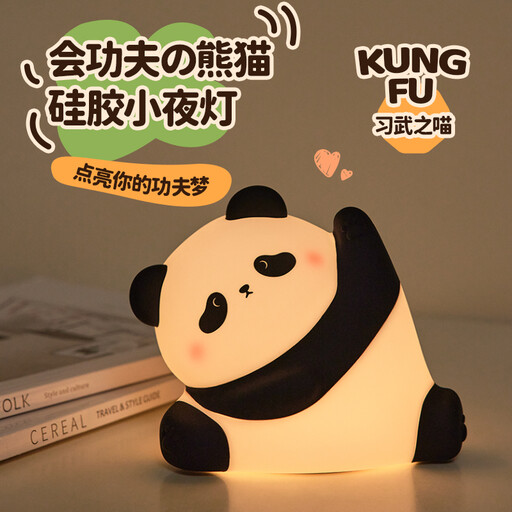
Why it suits this type of user: This compact lamp has touch controls and three dimmer settings. That makes it easy to use beside the bed or as soft lighting in a child’s bedroom.
The product information clearly states that it has a 1200mAh rechargeable battery and three light settings. So you don’t have to rely on the panda design or general advertising claims alone.
1200mAh battery, USB charging, silicone exterior and three dimmer settings with touch control.
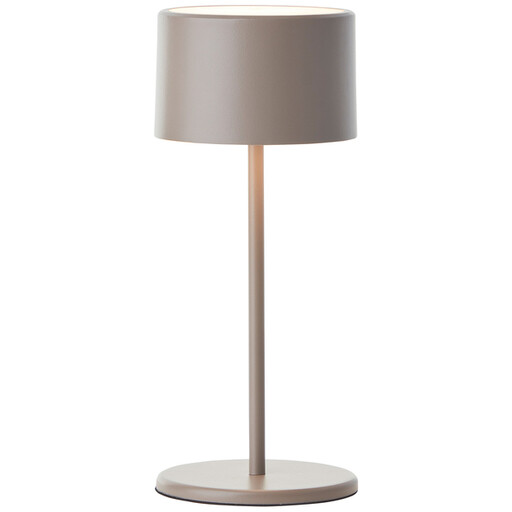
Why it suits this type of user: This metal table lamp is designed to sit on a stable surface. It’s well suited to a living room, bedroom or sideboard where design and simple controls go hand in hand.
The product specifications list 210 lumens, 3000K, 2W power and three dimmer settings. This means you can compare the lamp using verifiable details, rather than judging it on appearance alone.
210 lumens, warm white light at 3000K, integrated battery and three-step touch dimming.

Why it suits this type of user: This set is designed for kitchens, wardrobes, shelves or hallways. According to the product description, the PIR sensor switches the lights on automatically within a range of 3 to 5 metres.
The sensor range, three colour temperatures, USB charging and dimensions of 400 x 38 x 10 mm are all clearly listed. Check beforehand that a 40 cm light will fit your wardrobe.
Two-pack, 61 LEDs per light, PIR detection, three colour temperatures and a 1100mAh battery per light.
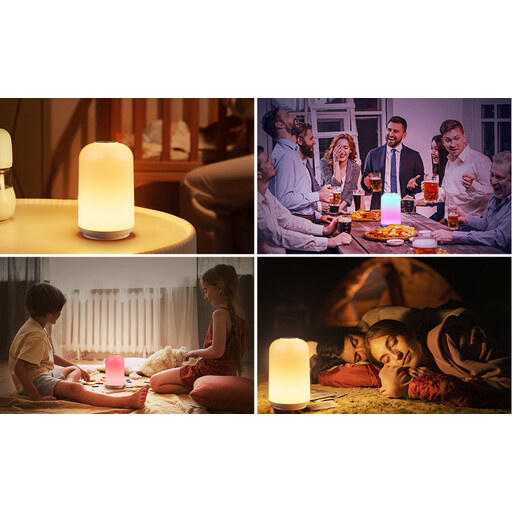
Why it suits this type of user: This RGB night light combines warm white light with seven RGB colours. Its compact size of 13 x 8 x 8 cm makes it a good fit for a bedside table, shelf or child’s furniture.
The light settings and dimming function are clearly specified: warm white is continuously dimmable, while RGB offers fixed colours or automatic colour changes.
40 lumens, 1W power, USB charging, warm white at 2600–2800K and seven RGB colours.
We’ve put together a complete, up-to-date list of products that meet these strict selection criteria and the applicable European safety requirements.
That depends on battery capacity, brightness, power consumption and operating mode. A motion-sensor light usually stays on for less time per activation than a light that remains on continuously. Check the stated runtime for each setting; without that information, you can’t reliably predict how long it will last.
A rechargeable model saves you from having to replace disposable batteries regularly. The cost per charge depends on the battery capacity and your electricity tariff. For a fair comparison, consider the battery capacity, charging frequency and lifespan of the integrated battery.
Place the light where you’ll pass within its stated detection range, for example by a wardrobe, in a hallway or beside your bed. Avoid obstacles that could limit the sensor’s range. After installation, test that the light only switches on when needed, and securely attach any wall-mounted model according to the product instructions.
