
Vandaag of morgen in huis

Kwaliteit gegarandeerd

Welkomstaanbiedingen ontgrendelen: GRATIS bezorging | Tot 80% korting | Gratis 30 dagen JoyPlus-proefperiode
Download de app
A rechargeable LED lamp is handy when you don’t want to run a cable or need a light you can move around flexibly. Think of an LED night light beside the bed, cupboard lighting in the kitchen, a wireless lamp in the hall, or an ambient light on the balcony. However, not all models are suitable for every use.
Many poor purchases come down to three recurring pitfalls:
If you look at light output, battery, controls and protection rating in advance, you’ll compare products on verifiable features rather than just marketing claims.
Light output is given in lumens (lm). A low lumen count usually suits an LED night light or ambient lighting. For cupboard lighting, a staircase or a worktop, more light is practical.
The colour temperature in kelvin (K) also determines the feel:
A dimmable LED lamp offers extra flexibility. Do check how the lamp dims: some models have fixed settings, while others use touch or gesture controls.
With a USB-rechargeable lamp, the battery capacity, charging port and run time are particularly relevant. A battery of 1,100 mAh can be suitable for regular use in a cupboard, while a smaller model may be intended for shorter nighttime moments.
Also check:
A solar table lamp works without a fixed power supply, but needs enough daylight to charge via the solar panel. A USB connection is therefore useful in cloudy weather or for indoor use.
A lamp with a motion sensor is especially practical in places where you don’t want to keep searching for a switch. The models mentioned have a detection range of 3 to 5 metres, for example. The operation can also depend on the amount of ambient light.
For mounting, magnets, hooks or self-adhesive strips are handy. Pay attention to the surface and the weight: a poorly fixed lamp can fall. For a wireless outdoor lamp, check the IP rating. IP44 protects against splashes from any direction, but not against submersion. So don’t place an IP44 outdoor lamp in a puddle, under an open sprinkler, or where rainwater can run directly inside.

Why this fits the profile: Two compact lamps offer a practical starting point for the bedroom, nursery, hallway or stairs. The sensor switches the light on automatically when it detects movement and low ambient light.
The specifications state a detection range of 3–5 metres, five dimming levels and two operating modes. So you don’t have to rely solely on a general claim about motion detection.
USB-rechargeable 500 mAh battery, three colour temperatures, five brightness levels and a compact size.
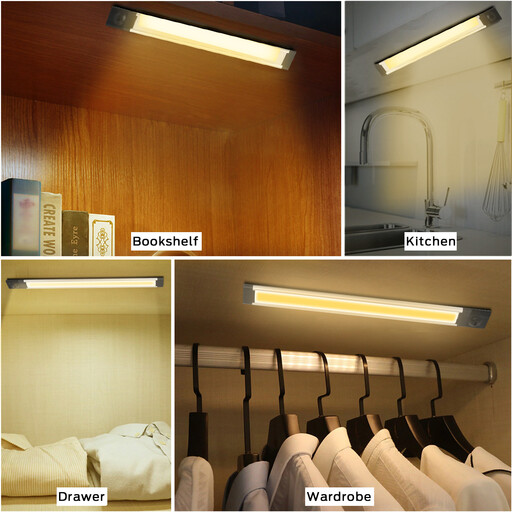
Why this fits the profile: This model is aimed at users who want more control over brightness and colour in, for example, a wardrobe, garage, hallway or bedroom.
The technical description mentions 400 lumens, a range of 2,800–6,500 K and operation with a dimming function. So the choice can be better tailored to task lighting or softer light.
36 SMD LEDs, aluminium and ABS, PMMA light guide, magnetic mounting and hooks without drilling.

Why this fits the profile: The long, slim shape is designed for kitchen cupboards, wardrobes, shelves and worktops where an even line of light is desired.
The lamp is 40 cm long and 1 cm thick. With PIR detection, self-adhesive mounting and three colour temperatures, the application is clearly described.
61 LEDs, 1,100 mAh battery, detection range of 3–5 metres and a set of two lamps.
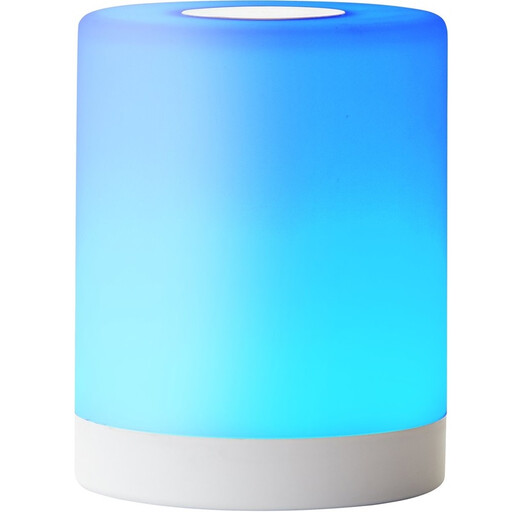
Why this fits the profile: This portable lamp suits anyone looking for a compact ambient light for the living room, balcony, patio or garden, and who wants to change the colour regularly.
The product information explicitly mentions an integrated RGB function, touch dimmer, USB charging and IP44 splash protection. When using the lamp outdoors, do place it in a sheltered spot and not in direct running water.
1 W integrated LED, 140 lumens, RGB light, touch control, dimming function and a built-in 18650 lithium-ion battery.
We’ve put together a full, up-to-date list of products that fully meet these strict selection criteria and comply with current European safety regulations.
The run time depends on the battery capacity, light output, sensor mode and the age of the battery. A lamp that runs on the lowest dim setting or only when motion is detected uses less energy than one that runs continuously at maximum brightness. So don’t just look at the battery capacity, but also at the stated run time and charging method.
It can be, depending on the brightness, colour temperature and placement. A warm white setting with low light output is often more practical for nighttime moments than cool, bright light. Also check that the lamp is securely fixed, keep cables out of reach, and follow the manufacturer’s safety instructions. Don’t use a sensor lamp as a replacement for general room lighting when sufficient visibility is needed.
An LED lamp typically uses very little electricity while charging, but the exact consumption depends on the wattage, the battery and how often you charge the lamp. A model with USB charging can also be charged via an existing adapter, laptop or power bank. When buying, compare the wattage, the battery and how you intend to use the lamp. That gives a more realistic picture than just the term ‘energy-efficient’.
