
Vandaag of morgen in huis

Kwaliteit gegarandeerd

Welkomstaanbiedingen ontgrendelen: GRATIS bezorging | Tot 80% korting | Gratis 30 dagen JoyPlus-proefperiode
Download de app
Cycling in the dark requires more than a light that simply switches on. You need to see clearly, remain visible to others and recharge the lights with ease. A rechargeable bike light set with a front and rear light may seem like a straightforward purchase, but product pages do not always explain what a specification means in practice.
For commuters, recreational cyclists and performance riders, three pitfalls are particularly important: a stated brightness level that says little without beam data, a battery that lasts mainly on the lowest setting and a mounting system that does not fit every handlebar. Below, you will find what to look for in 2026 before ordering a front and rear bike light.
Lux describes how much light reaches a surface. Lumens indicate the total amount of light emitted. As a result, two lights with the same lumen rating can still distribute their light very differently.
A 100-lux bike light may sound appealing, but also check the stated range and how the beam has been shaped. For urban rides, an even beam is usually sufficient. On unlit cycle paths, gravel routes or MTB trails, a focused beam with adequate reach is more practical.
Manufacturers generally specify battery life for each light mode. The longest runtime usually applies to eco mode or the lowest setting—not maximum brightness. Pay attention to:
According to OSRAM’s product information, the COMPACT 100 Set offers up to 12 hours of use for the front light and up to 13 hours for the rear light. The stated charging time is up to 3 hours. In practice, runtime depends on the selected mode and the conditions.
“Universal” does not mean that every handlebar will fit automatically. Check your handlebar diameter, especially on a road bike, gravel bike or e-bike with an unusual cockpit. An aerodynamic or non-round handlebar may also require an adapter.
The OSRAM set uses a Garmin-compatible mount for handlebar diameters of 22.2, 25.4, 31.8 and 35 mm. The specifications state that the mount is not suitable for non-round handlebars without an adapter. The rear light attaches to a standard round seatpost with a flexible strap.
For urban commuting, multiple modes are useful: a lower setting for lit streets and a higher setting for dark roads. The COMPACT 100 Set lists three fixed modes and an automatic mode for the front light: high, low, eco and automatic. The stated range is up to 95 metres.
Angle the front light slightly downwards. This illuminates the road surface without unnecessarily dazzling oncoming cyclists or motorists. A powerful light is not automatically suitable for every traffic situation; correct adjustment remains essential.
A bike light with brake light uses a motion or acceleration sensor to detect deceleration. According to OSRAM’s product information, the rear light automatically activates a brake light when speed decreases. This is a technical product feature, not a guarantee that other road users will always react.
Mount the rear light so that it points straight backwards and check that the sensor is correctly aligned. Mounting may need to be adjusted when using a pannier rack, suspension seatpost or non-standard seatpost.
The product specifications for the OSRAM COMPACT 100 Set state that it has StVZO approval with K-marking for road use in Germany, as well as CE certification. StVZO is a German standard. This does not automatically mean that every Dutch traffic situation or mounting arrangement is fully covered.
Before use, check the current Dutch regulations for bicycle lighting. In all cases, ensure that the white or yellow front light and red rear light are clearly visible, correctly mounted and not obstructed by clothing, a bag or a child seat.
The selection below is based on verifiable product information. As the available range contains one directly suitable bike light set, the same model is matched to three different usage profiles. This shows which features matter for your situation without recommending unsuitable products from other categories.
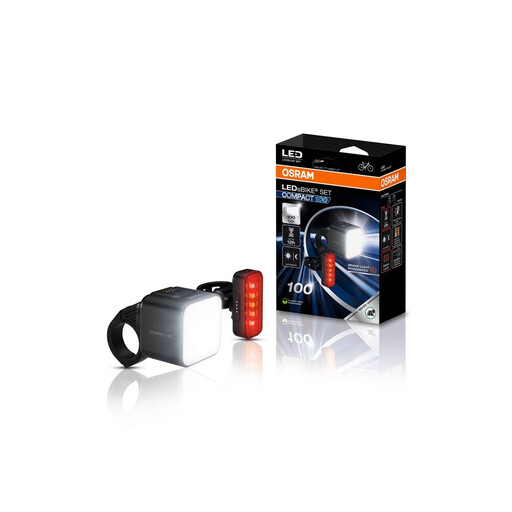
Why it fits: For anyone looking for one complete set for everyday rides on a city bike, trekking bike or e-bike, without having to combine separate lights and mounts.
The set specifies separate battery life for the front and rear lights, includes a USB-C connection and offers five light settings in total.
Complete set with front and rear lights, USB-C cable included and tool-free installation.
Why it fits: Suitable for road and gravel riders who want to check their handlebar diameter in advance and prefer a quarter-turn mounting system.
Compatibility is clearly specified for 22.2 to 35 mm. Non-round handlebars without an adapter fall outside the stated fit.
Garmin-compatible mounting and a stated beam range of up to 95 metres.
Why it fits: For cyclists who also ride on dark routes and want to combine a higher light setting, brake light function and water-resistant housing.
The product information identifies the highest front-light setting, automatic deceleration detection and separate charging indicators.
Front light rated at up to 100 lux according to the product specifications, automatic brake light and suitability for MTB, gravel and e-bike use.
Browse a current selection of compact kits and compare the specifications before making a purchase.
Yes, provided the set operates independently on its own battery. The OSRAM COMPACT 100 Set uses a rechargeable lithium-ion battery and does not connect directly to the e-bike. This also makes it suitable for use on a conventional bike, trekking bike or road bike.
According to the product information, the front light provides up to 12 hours of use and the rear light up to 13 hours. These are maximum figures that depend on the selected light mode. The high setting generally uses more energy than eco mode.
Not automatically. StVZO is a German approval standard. The product information states that this set has a German K-marking and CE certification. You should also check the current Dutch regulations and ensure that the light is mounted correctly and remains clearly visible.
