
Vandaag of morgen in huis

Kwaliteit gegarandeerd

Welkomstaanbiedingen ontgrendelen: GRATIS bezorging | Tot 80% korting | Gratis 30 dagen JoyPlus-proefperiode
Download de app
A children’s RC stunt car may seem straightforward to choose at first glance. However, models vary considerably in terms of drive system, controls, battery and suitability for indoor or outdoor use. A car with lots of LED lighting is not automatically suitable for grass. And a model with 4WD is not necessarily intended for young children.
Joybuy Product Recommendation Officer selects products based on verifiable specifications. So, before buying a remote-controlled stunt car, pay particular attention to these common pitfalls.
A product may list features such as drifting, 360-degree rotation, driving on both sides and transformation. That tells you nothing about how easy it is to control. For a child aged 3 and over, a simple remote control is often more practical than a model with several joysticks and lots of buttons.
A 2.4GHz remote control is useful when several children are driving at the same time. This technology is designed to reduce interference between cars on various models. However, always check which batteries the remote control requires.
A remote-controlled off-road vehicle needs to handle more than a smooth floor. Look at the combination of:
An 4WD RC car can offer more grip on grass, gravel or sand, but it often also requires more motor power and a sturdier construction. A smaller stunt car with omnidirectional wheels is mainly suitable for short stunts on flat surfaces.
“Long playtime” is not a fixed technical standard. Actual playtime depends on speed, terrain, stunt use and breaks between drives. So check whether the battery is included, what capacity is specified and how long charging takes.
With a rechargeable RC car, it is also important to check whether only the car has a rechargeable battery. Some models also use AA or AAA batteries in the remote control. These are not always included.
Mecanum wheels are interesting for stunts. These wheels can move sideways and support features such as diagonal drifting and an RC car with 360-degree rotation. A standard remote-controlled car with LED lighting will usually drive forwards and backwards and make normal turns.
For outdoor use, large tyres with a deep tread are more useful. If you mainly drive on tiles, carpet or a flat driveway, you do not necessarily need a heavy off-road vehicle.
A classic handheld remote control gives you direct control over speed and direction. A transformable RC car with wrist control adds an interactive way to operate it, but the child must first learn how hand movements affect the car.
Pay attention to the range, battery type and age warning. A model with lots of stunt functions can be an exciting gift for boys, but not every young user will be able to operate the functions properly straight away.
Check the CE marking, warnings about small parts and the recommended age in the product information. A CE marking is not a quality ranking, but indicates that the manufacturer declares compliance with applicable EU requirements. The product listing should also provide information about the manufacturer, importer or EU responsible person.
Only use an RC car with a water function as described in the instructions. “Waterproof” does not automatically mean that every model is suitable for deep water, seawater or prolonged submersion. Remove sand, mud and moisture after use, and charge a lithium battery according to the instructions.
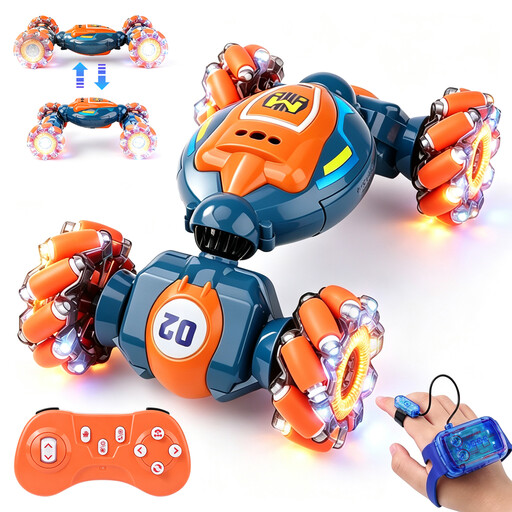
Why it suits this profile: This model offers both a handheld remote control and a wrist controller. This allows a child to start with traditional button controls and try gesture control later.
The product information clearly states that it includes a rechargeable 3.7V battery, USB cable, two-sided driving and a road or off-road mode. The AAA batteries for the controllers are not included.
Transformable body, LED-lit wheels and 360° rotation. The stated minimum age is 3 years; adult supervision is still recommended.
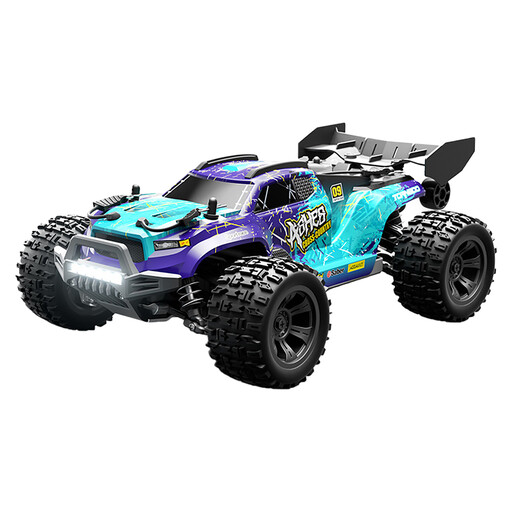
Why it suits this profile: This is a more powerful hobby-focused choice for teenagers aged 14 and over, and adults who value speed, off-road driving and precise adjustments.
The specifications list 4WD, a 7.4V 1500mAh lithium battery, reinforced metal chassis and adjustable controls. This makes the technical foundation clearer than a general claim about off-road performance alone.
Stated speed of up to 40 km/h, independent suspension, USB charging cable and a 2.4GHz transmitter with speed and steering settings. The transmitter uses three AA batteries, which are not included.

Why it suits this profile: This model is intended for users who want to use it on water as well as on land. Check the instructions beforehand and only use the vehicle in permitted water conditions.
The product details specify IPX7, 4WD, a range of approximately 80 metres and a runtime of around 50 minutes. These figures make it easier to compare with standard RC cars.
360° rotation, 3.7V 1200mAh battery, 2 to 3 hours’ charging time and dimensions of 27 × 20 × 16 cm. Cleaning the vehicle and checking the connectors after use is important.
We have put together a complete, up-to-date list of products that fully meet these strict selection criteria and the applicable European safety regulations.
Choose a model with a clear age recommendation, rounded casing and simple controls. Take small parts into account and use the car under adult supervision. A spectacular stunt function is less important than a remote control the child can understand.
This varies depending on the model and how it is used. Check the stated battery capacity, charging time and playtime. Intensive drifting, driving on grass and frequent spinning generally use more energy than calm driving on a flat floor.
Many models are designed for grass, sand, gravel or concrete, but not every model is suitable for wet conditions. Check the product information for water resistance, ground clearance and tyre tread. Clean the car after outdoor use and allow the electronics and battery to dry before charging again.
