
Vandaag of morgen in huis

Kwaliteit gegarandeerd

Welkomstaanbiedingen ontgrendelen: GRATIS bezorging | Tot 80% korting | Gratis 30 dagen JoyPlus-proefperiode
Download de app
An RC stunt car with gesture control can look impressive on paper. Colourful LED wheels, 360-degree spins, double-sided driving and a transformable body are immediately appealing to children. However, these toy cars can vary considerably when it comes to controls, battery use and performance on different surfaces.
For parents and family members in the Netherlands, three questions are particularly important: will the car still work properly after a collision, is the control system suitable for the child’s age, and are the battery and accessories practical to use? Below, we compare the key points to consider and several suitable options.
A product may list all kinds of stunt functions, while the remote control is difficult for young children to operate. So check whether the car has simple buttons as well as advanced features. An RC stunt car with a demonstration mode can help beginners see how the movements work before they start driving themselves.
With a gesture-controlled model, it is also important that the motion sensor and wristband fit the user properly. Check which batteries the controller requires. A rechargeable car does not automatically mean that the remote control or watch can also be charged via USB.
RC cars with LED wheels stand out particularly in a dark room, but lighting says nothing about grip, drive system or stability. So look at the type of wheel, the drive system and whether the car can keep driving after turning over.
Mecanum or omnidirectional wheels can move sideways and spin on the spot. That is useful for stunt play, but the surface remains decisive. Carpet, tiles, concrete, grass and sand do not provide the same driving experience.
Pay attention to the difference between battery capacity, charging time and actual playtime. A small lithium battery is convenient for a compact car, but it will need charging more often. Also check whether a USB charging cable is included and whether spare batteries are available.
For toys intended for children aged 3 and over, clear safety instructions are also important. Before buying, check the age rating, warnings, CE marking and information about supervision. A CE marking is not a guarantee of every feature you may want; if in doubt, ask the seller for conformity information.
A versatile RC stunt car with gesture control should ideally offer two control options:
Check whether the controller uses AAA batteries and whether they are included. For the model with a gesture watch discussed here, the product information states that two AAA batteries are required per remote control; these are not included.
A double-sided RC car can keep driving after tipping over without the child having to turn it back over. This prevents interruptions during play. A 360-degree spinning toy car will usually use a separate button or button combination on the remote control.
Do not just look at the stunt name; check the drive system too. Four-wheel drive can help distribute power more evenly across the wheels. The product description for the 4WD stunt car lists independent drive and 9 cm Mecanum wheels. Treat these as product specifications, not as a guarantee that the car will perform identically on every surface.
An off-road RC car with greater ground clearance is better suited to grass, concrete and small obstacles than a low-profile racing model. For indoor use, dimensions, turning circle and speed are just as important. A car measuring around 17.3 cm can be easier to store indoors, but it still needs enough room for sideways movements and spins.
Use the car on a flat, dry surface and keep fragile items out of the way. Young children should play under supervision, particularly when the car moves quickly or when accessories and batteries are being changed.
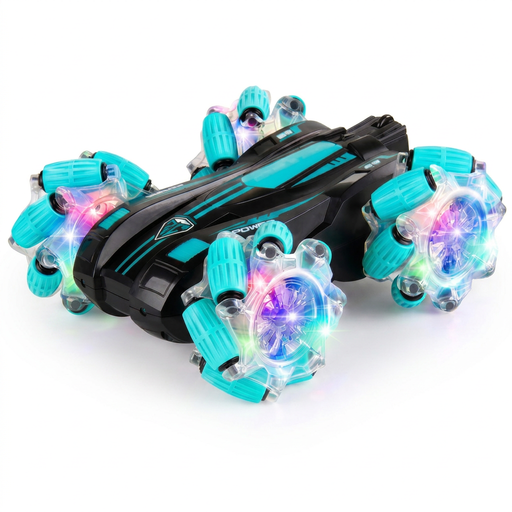
Why it suits this profile: This model combines button controls with double-sided driving and automatic demonstrations. That makes it a practical introduction for children who are still learning to steer.
The car does not rely on LED lighting alone: the product description mentions 4WD, Mecanum wheels and driving on both sides.
17.3 cm size, 9 cm LED wheels, 360-degree spins, and indoor and outdoor use according to the product information.
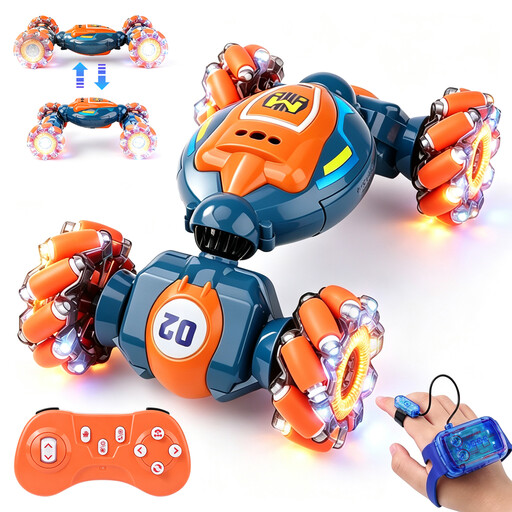
Why it suits this profile: This is a transformable toy car for children who want more than simply driving forwards and backwards. The combination of a remote control and gesture watch provides different ways to play.
The specifications explicitly mention a rechargeable 3.7 V battery, a USB cable and two control modes. Before ordering, however, check which battery version is supplied with your model.
Gesture control, on-road and off-road modes, LED wheels, 360-degree rotation and double-sided driving according to the product description.
Why it suits this profile: For children who play frequently and want to practise new tricks, the different directions, spinning and tilting functions offer more variety than a simple racing car.
The car is not limited to a single stunt mode: the product information lists forward, backward and sideways driving, double-sided driving and transformation.
The included car battery and USB cable are designed for repeated charging; according to the product information, both controllers use 2 AAA batteries.
We have put together a complete, up-to-date list of products that fully meet these strict selection criteria and the applicable European safety regulations.
Use this short checklist before ordering an RC gift for boys or girls:
With a model featuring a gesture watch, the child steers by making hand movements. The sensor translates these movements into driving directions or stunt commands. A standard remote control remains useful for more precise steering. Let the child practise on an open, flat floor first.
Playtime depends on speed, surface, lighting and the number of stunts performed. Manufacturers do not always state a fixed playtime under consistent conditions. Charge the battery according to the instructions provided and do not store it completely empty for long periods.
It can be, provided there is enough free space and the surface is flat. Check the dimensions beforehand and allow for sideways drifting and 360-degree spins. The car may respond differently on tiles or a smooth floor than it does on carpet.
