
Vandaag of morgen in huis

Kwaliteit gegarandeerd

Welkomstaanbiedingen ontgrendelen: GRATIS bezorging | Tot 80% korting | Gratis 30 dagen JoyPlus-proefperiode
Download de app
An RC stunt car for children needs to do more than just drive forwards and backwards. Parents and gift buyers often look for a model that lets children drift, flip and play both indoors and outdoors. However, impressive features on the packaging can disappoint if you don’t check the drive system, surface, battery and age guidance.
An RC stunt car with 360-degree rotation and LED lights looks spectacular. That doesn’t automatically mean it’s easy to control, though. Some models respond quickly or assign several functions to the same buttons, which can be frustrating for younger children.
Look for clearly laid-out controls, an automatic demo mode and, if available, a second way to steer, such as a wristband with motion sensors.
The term ‘off-road toy car’ doesn’t tell you much without technical details. A model with rear-wheel drive only may get stuck more easily on carpets, grass or small obstacles. 4WD means that all four wheels are driven. This can help with grip and drifting, but performance also depends on the tyre tread, the car’s weight and the surface.
A rechargeable RC car saves you from having to keep buying loose batteries. Still, check whether the battery is included, which cable you’ll need and whether the controller takes separate batteries. Some models can only be charged via USB, while the controller needs 2 AA or AAA batteries.
Three features are worth considering for stunts:
A double-sided RC car is handy for beginners, as a rollover doesn’t have to bring play to an immediate halt. Be sure to check the recommended age, and keep furniture, delicate decorations and slippery floors in mind.
Larger wheels with a clear tread are often better suited to grass, tiles, concrete and carpets than small, smooth wheels. The first product description, for example, specifies 9 cm Mecanum wheels and use on multiple surfaces. This is a product specification; the actual driving experience may vary depending on the surface.
For indoor use, turning space is especially important. A stunt car that rotates through 360 degrees needs room. Outdoors, sand, gravel and wet surfaces put extra strain on the motor, gears and electronics.
An RC car with LED lights is easier to see at dusk and makes play more exciting. Check whether the lights are built into the wheels or the body, and whether they stay on while the car is moving.
Be cautious about claims such as ‘waterproof’. Only consider a model for shallow water if its product information explicitly mentions a sealed housing and suitable use in water. Don’t let children drive a standard RC car through puddles or in a swimming pool. After using it on a damp surface, remove the battery if instructed to do so in the manual, and let all parts dry completely.
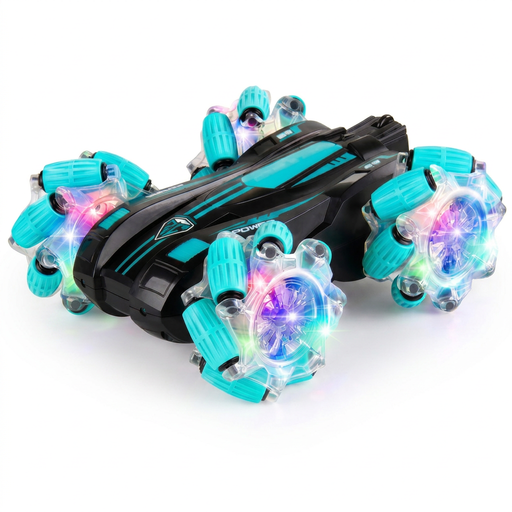
Why it suits this profile: A compact option for children who want to practise spinning, flipping and drifting on tiles, carpets or a flat outdoor surface.
The product description lists 4WD, double-sided driving and an automatic demo mode. This makes it easier to get to grips with than a model that only offers manual stunt controls.
Mecanum wheels, 9 cm wheel size, 360° rotation and LED lights. According to the product information, a rechargeable lithium battery is included.
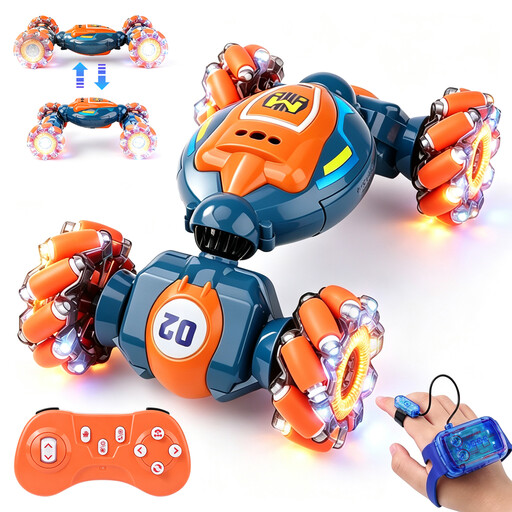
Why it suits this profile: A good choice for children who want to try interactive wrist control as well as a traditional remote control.
The car offers two control modes. If wrist control isn’t a hit, the standard remote control is still available. Please note: according to the description, AAA batteries for the controllers are not included.
Double-sided driving, 360° rotation, sideways movement, colourful LED wheels and a 3.7 V battery with USB cable included, according to the product information.
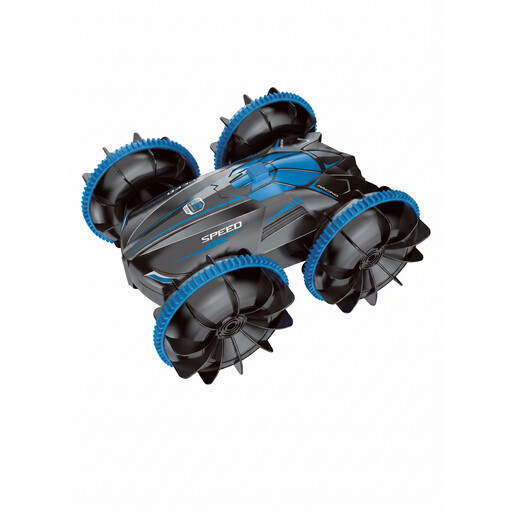
Why it suits this profile: An option for outdoor play that switches between land stunts and driving on water, such as during a trip to a field or a stretch of shallow water.
The description mentions a sealed housing and use on land and in water. Always check the manual, water depth and seals before use; ‘water-resistant’ is not an invitation to take it into deep water.
4WD, double-sided driving, 360° rotation, two control modes and propeller wheels for driving on land and moving through water, according to the product information.
We’ve put together a full, up-to-date list of products that meet these strict selection criteria and current European safety regulations.
Check the body, wheels and battery compartment before every play session. Don’t use an RC stunt car on stairs, at the edge of a pond or near traffic. Products with small parts are not suitable for children below the stated age. The models mentioned often have a minimum age of 3 years; always follow the warning on the packaging.
Let the battery cool down after intensive use, and only charge it with the cable supplied or specified. Store the car in a dry place to help reduce wear to the motor, gears and electronics.
Playtime depends on battery capacity, the surface, speed and how much you use the lights or stunt features. An exact runtime is only reliable if it’s provided by the manufacturer. Allow for an extra charging session if the car is used intensively.
It depends on the wheel tread, size and surface. Models with 4WD and larger tyres are generally more practical on grass, tiles and concrete. Indoors, a flat floor and plenty of clear space are important. Always check whether the model is suitable for use on damp surfaces, sand or gravel.
An RC stunt car can make a great gift for children who enjoy racing, drifting and tech toys. Don’t choose based only on colour or appearance; consider the age guidance, controls, battery type and where the child will be playing with it.
