
Vandaag of morgen in huis

Kwaliteit gegarandeerd

Welkomstaanbiedingen ontgrendelen: GRATIS bezorging | Tot 80% korting | Gratis 30 dagen JoyPlus-proefperiode
Download de app
An RC stunt car may seem easy to choose at first glance: eye-catching lights, spectacular spins and a remote control. However, these models vary considerably in terms of drive system, terrain capability, battery use and recommended age. A car that performs well on a smooth floor is not automatically suitable for grass or gravel.
For parents, grandparents and hobbyists, three pitfalls are particularly important: marketing claims without practical context, choosing the wrong surface and unclear battery information. Use the points below to compare a remote-controlled car based on verifiable specifications.
A stunt car with LED lighting, music, spray effects and automatic demonstrations attracts attention. That does not necessarily mean it is enjoyable to drive manually. Check whether the remote control has separate functions for speed, direction, turning and stunts. A 2.4GHz remote control is practical when several children want to drive at the same time, as this technology is intended, according to the product descriptions, to reduce interference between multiple vehicles.
Also pay attention to the difference between standard and proportional steering. With proportional steering, you can adjust speed and steering angle more gradually. This is particularly relevant for a drift RC car intended for older children and hobbyists.
The term off-road RC car does not say much on its own. Look at the tyres, ground clearance, suspension and drive system. A model with small, smooth wheels is mainly suitable for tiles, laminate or tarmac. For grass, sand and gravel, deep tread patterns, larger tyres and preferably 4WD are more useful.
A car may be able to drive over a small threshold, but that does not mean it is suitable for wet conditions. Only use a model with water when the product information explicitly states that it has a suitable, sealed construction.
A rechargeable RC car saves money on disposable batteries in the long term, but playtime per charge remains limited. Check:
A stated playtime is a product specification measured under certain conditions, not a guarantee for every play session. Driving on grass, frequent drifting and intensive climbing generally require more power.
2WD is often sufficient for flat indoor floors and straightforward racing. 4WD RC cars distribute power across all four wheels, making them a more logical choice for slopes, grass and light obstacles. Some stunt models use Mecanum wheels. According to the product description, these allow the car not only to move forwards and backwards, but also sideways or diagonally while drifting.
A 6WD model may provide additional traction, but also consider its weight, turning circle and controls. More drive power is not automatically necessary for a child who mainly drives in the living room.
Check the body material and whether the car has bumpers, suspension and rubber tyres. ABS plastic is mentioned in several product descriptions as a material used for the body. This tells you something about the material used, but does not automatically indicate how long a car will last after hard collisions.
Also look for:
For models intended for young children, always follow the stated age guidance and warnings. Even when a product is marketed as an RC toy car for children aged around 3 and over, supervision is still advisable. Small parts, cables and batteries should be kept out of reach of young children.
A double-sided car can continue driving after turning over. This is practical for beginners, as you do not have to keep helping them turn it back over. A drift model with interchangeable tyres is instead interesting for anyone who wants to practise controlled cornering on a smooth surface.
LED lighting and sound improve visibility and the play experience, but they do not add driving capability. Choose based on the drive system, controls and terrain first. Treat lighting effects as an added feature.
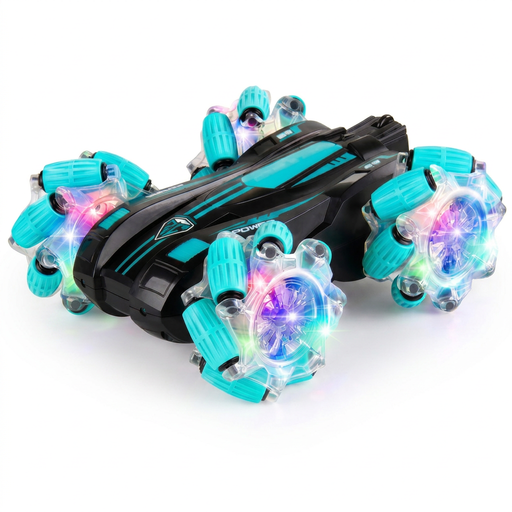
Why it suits this profile: The combination of double-sided driving, 360° spins and automatic demonstrations makes this model accessible for children trying out their first stunts.
The product description mentions 4WD, large Mecanum wheels and a rechargeable lithium battery. When buying, check which accessories are included and follow the charging instructions.
Double-sided driving, sideways drifting, LED lighting and indoor and outdoor control according to the product information.
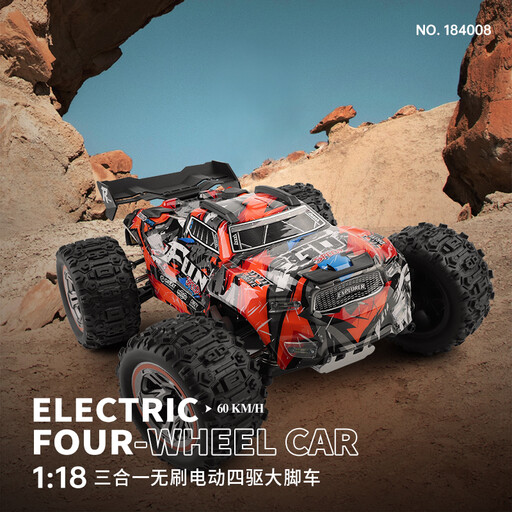
Why it suits this profile: This model is aimed at teenagers and hobbyists who value speed, off-road driving and a technical drive system.
The product information mentions independent suspension, 4WD, a brushless motor and water-resistant electronics. Read the instructions before driving in wet conditions.
Brushless drive, 4WD and three body configurations according to the product description.
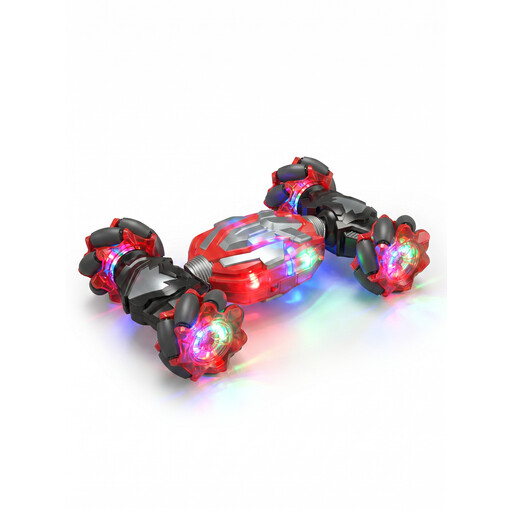
Why it suits this profile: The combination of a remote control and a gravity-sensitive watch is ideal for children aged around 8 and over who want to try new ways of controlling their car.
According to the product description, the car can drive on both sides and switch between a wide and narrow shape. This means it is not limited to just one stunt function.
Mecanum wheels, 4WD, 360° rotation, double-sided driving and two control modes.
We have put together a complete, up-to-date list of products that fully meet these strict selection criteria and the applicable European safety regulations.
Use an RC stunt car on a surface that suits its tyres and drive system. Indoors, tiles, laminate and a cleared carpet are generally easier to manage than a busy room filled with furniture. Outdoors, grass, tarmac and gravel are suitable when supported by the product description.
Also bear the following points in mind:
It varies by model. Some products are marketed for children aged 3 and over, while other models have a recommended age of 6, 8 or 14 and over. Do not just look at the appearance, but also consider speed, controls, small parts and warnings. Adult supervision is advisable for young children.
Playtime depends on battery capacity, surface, speed and the use of features such as lighting, music and stunts. The product specifications for some models, for example, state a playtime of 20 to 40 minutes or up to 30 minutes. Treat this as an indicative stated value. An additional compatible battery may be useful, but check first that it is officially suitable.
A 4WD RC car with deep-tread tyres, suspension and sufficient ground clearance is generally a more logical choice than a low drift model. Always check the specific product information. Waterproofing or water-resistant electronics is also different from being able to drive without restriction through puddles or underwater.
