
Vandaag of morgen in huis

Kwaliteit gegarandeerd

Welkomstaanbiedingen ontgrendelen: GRATIS bezorging | Tot 80% korting | Gratis 30 dagen JoyPlus-proefperiode
Download de app
An RC stunt car can do far more than simply drive forwards and backwards. Think drifting, 360-degree spins, driving on both sides and tackling grass or gravel. However, a long list of features does not necessarily tell you how practical a car is. A vehicle may sound impressive, for example, but disappoint because of a weak battery, limited ground clearance or a remote control that young children find difficult to use.
For parents, family members and gift buyers, three pitfalls are particularly important: marketing claims without measurable specifications, unclear battery information and a poor match between the vehicle and the surface it is used on. Read on to find out what to look for before buying a remote-controlled car.
Terms such as “360-degree spinning car” and “all-terrain” sound appealing. So check whether the product description clearly explains how the car moves. Mecanum wheels allow sideways movement and diagonal drifting, whereas a standard radio-controlled car usually only drives forwards, backwards and around corners.
Pay attention to the controls, too. A model with an automatic demonstration mode is accessible to beginners, but manual control remains important when an older child wants to perform precise stunts.
A rechargeable RC car is practical, but capacity alone does not tell you exactly how long you can drive. A 220 mAh battery and a 1,200 mAh battery cannot be compared directly without information about the motor, weight and driving conditions. So check:
The stated play time is a product specification. In practice, it may vary depending on speed, surface, temperature and whether lights or sound are being used.
A small stunt car for children will often drive well on tiles, wood and short-pile carpet, but that does not automatically mean it is suitable for mud, deep puddles or high kerbs. Check the wheel size, tread, ground clearance and drive system.
A 4WD RC car has four driven wheels, which can help with grip and climbing. However, that does not make every model suitable for demanding terrain. Only use a vehicle in water if the product information explicitly provides a water-resistance rating or clear instructions permitting it.
For stunts, independent drive and sturdy tyres are relevant specifications. Mecanum wheels support movement forwards, backwards, sideways and diagonally. This is interesting if you mainly want to drift or spin on the spot.
A standard remote-controlled off-road vehicle with large rubber tyres is often a more sensible choice for grass, gravel and small obstacles. For indoor use, compact dimensions and a moderate speed are at least as important. This reduces the risk of collisions with furniture and skirting boards.
With a stunt car that can continue driving on either side after turning over, you do not have to keep putting the vehicle back on its wheels manually. This is practical for children who are still learning to steer. In addition to this feature, look at the body material, rounded edges and how the wheels and axles are secured.
A sturdy housing reduces the risk of damage during normal play, but no RC car is indestructible. High-speed collisions, jumping from a height and driving into hard obstacles can put strain on the motor, gears and wheels.
Many models in this category are offered for children aged 3 and over. Always check the age rating, warnings and whether there are any small parts. With younger children, direct adult supervision is advisable, especially when using more powerful vehicles or models with accessories.
A CE marking or other conformity information is expected on toys offered on the European market, but also check the specific product information and safety warnings on the product page. Brand claims about materials or safety are not a guarantee for every usage scenario. According to the product descriptions of the models below, ABS plastic, rounded edges and protected electronics are among the features mentioned; always assess these alongside the official warnings.
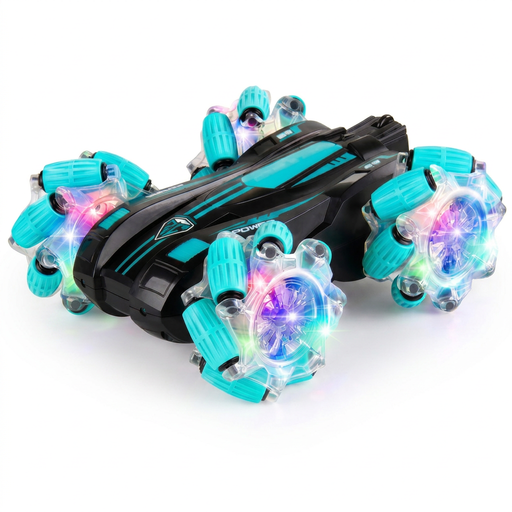
Why it suits this profile: This compact model is designed for basic stunts, indoor and outdoor use, and straightforward control. At 17.3 cm, it is suitable for play areas where a large off-road vehicle would be less practical.
The product description specifically mentions 4WD drive, driving on both sides, Mecanum wheels and LED lighting, rather than making only a general stunt claim.
360° spinning, sideways drifting, two-sided stunts and colourful LED wheels according to the product information.
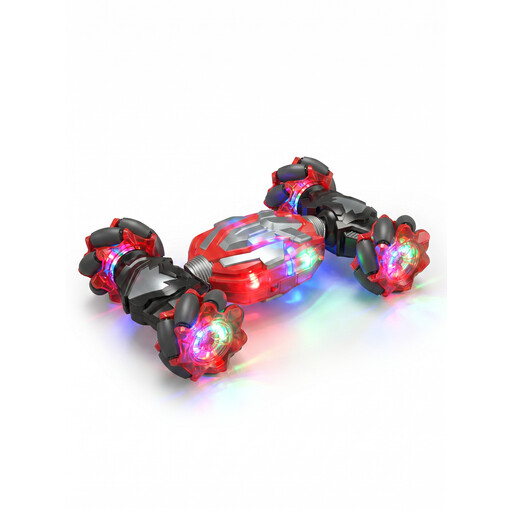
Why it suits this profile: The combination of a transformable body, two control methods and 4WD is well suited to older children looking for more control and variety than a basic stunt car can offer.
The description specifies both a hand controller and a gravity-sensitive watch. This lets you choose between button control and gesture control.
Switching between wide and narrow forms, driving on both sides, sideways movement and driving on surfaces including grass, concrete and gravel according to the product description.

Why it suits this profile: This model is designed for users looking for a remote-controlled off-road vehicle for both land and water. It is particularly suited to outdoor use, for example on grass, sand or in a shallow pool.
The product information explicitly states IPX7 water resistance, a 3.7 V 1,200 mAh battery and a stated play time of approximately 50 minutes. Before use, check the instructions for water use and maintenance.
4WD, 360° spinning, LED lighting, a stated range of approximately 80 metres, and driving on land and water according to the product specifications.
We have put together a complete, up-to-date list of products that fully meet these strict selection criteria and the applicable European safety regulations.
An RC stunt car will generally last longer if you check it after driving. Remove sand, grass and hair from the wheels and wipe the body dry. If a model is not described as water-resistant, avoid puddles and wet grass.
Charge a lithium battery according to the supplied instructions, and allow a warm or wet battery to cool down and dry first. Keep loose batteries out of the reach of young children. Also check the wheels, axles, charging cable and remote control regularly for damage.
First, insert the vehicle battery and the required batteries into the remote control. Then usually switch on the car and controller according to the manual. Test left, right, forwards and backwards on an open surface. Models with a watch or second controller may need to be paired first.
This varies by model and usage. Battery capacity, motor speed, surface, lighting and how often you perform stunts all affect play time. So do not look only at mAh; also check the stated driving time, charging time and whether a spare battery is available.
Some models are offered for children aged 3 and over, but the right choice also depends on speed, controls and supervision. Check the official age rating and warnings. For young children, choose a straightforward model and let them drive in a clear space under direct adult supervision.
