
Vandaag of morgen in huis

Kwaliteit gegarandeerd

Welkomstaanbiedingen ontgrendelen: GRATIS bezorging | Tot 80% korting | Gratis 30 dagen JoyPlus-proefperiode
Download de app
An RC stunt car captures the imagination: with the push of a button, it spins around, carries on driving after a tumble, or slides sideways across the floor. Yet a flashy exterior can also distract from important differences. Not every remote-controlled stunt car is suitable for grass, not every 4WD RC car can drift well, and a long playtime isn’t always clearly specified.
So pay particular attention to these three pitfalls:
For stunts, 4WD is a practical starting point. Four driven wheels distribute power more evenly than a simple two-wheel drive. For sideways movement and controlled drifting, Mecanum or omnidirectional wheels are relevant. These enable movements that a standard RC car can’t perform.
An RC drift car with interchangeable tyres is best suited to smooth surfaces such as tiles, wood or a flat driveway. Drift tyres often have less grip, which makes them less practical on grass. If you want to drive outside on sand, gravel or grass, it’s better to look for deep treads, larger tyres and a higher chassis. An off-road RC car with suspension is generally better adapted to uneven terrain.
For young children, a remote control with clear buttons is usually simpler to use than a complicated model with lots of combinations. An automatic demonstration mode can help them see the movements first. For older children, a wrist controller, proportional speed or two driving modes can offer extra play options.
When using several cars at once, 2.4 GHz control is practical. According to the product descriptions of various models, this technology supports simultaneous play without the signals normally interfering with each other. The actual range does depend on the environment, obstacles and the specific model.
A rechargeable RC car prevents you from constantly needing new disposable batteries. Do check exactly what is rechargeable. On some models, the car has a USB-rechargeable battery, while the remote control uses AA or AAA batteries.
A stated playtime of, for example, 20 to 40 minutes is a product indication and can change depending on speed, surface, lighting and stunt use. Let a lithium battery cool down before recharging it and store the car in a dry place. You should only assume water resistance when this is explicitly stated with the product. “Suitable for outdoor use” does not automatically mean driving through puddles is safe.
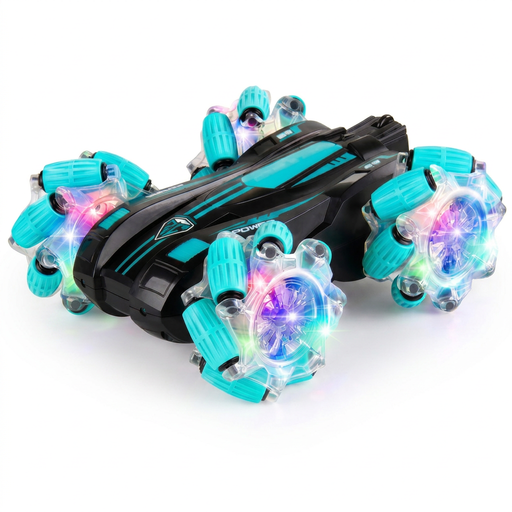
Why this fits the profile: A straightforward model for children who are using an RC toy car for the first time and mainly want to try out stunts.
The product description mentions 4WD, double-sided driving and large Mecanum wheels. This means the car doesn’t need to be manually turned back over after flipping.
Sideways drifting, 360° spinning, LED lights in the wheels and a rechargeable battery according to the product information.
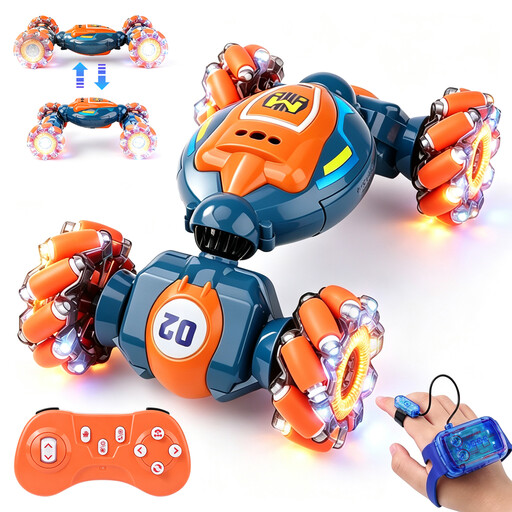
Why this fits the profile: Suitable for children aged 3 and up who want to try a wristwatch-style controller alongside a classic remote control.
The car has two control modes and can switch between road and off-road mode according to the product description. Do check the included batteries and cells before purchase.
Double-sided driving, 360° spinning, LED wheels and a 3.7V rechargeable lithium battery according to the product data.
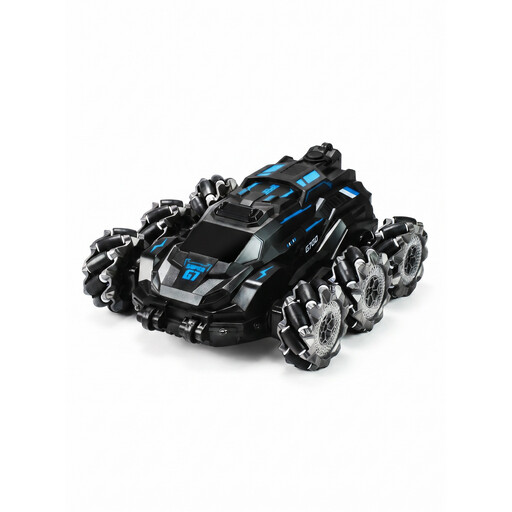
Why this fits the profile: Interesting for older children who want more than just driving on a smooth floor and are looking for various stunt features.
The product description mentions 6WD, swing arms and tyres with tread. This suits uneven terrain better than a low drift car designed only for smooth floors.
6-wheel drive, 2.4GHz remote control, LED lights and a water mist effect using clean water according to the product information.
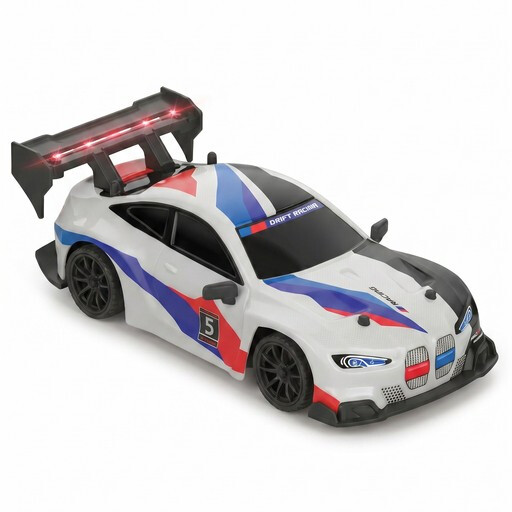
Why this fits the profile: A logical choice for children aged 8 and up who mainly want to race and drift on smooth surfaces.
The car comes with race and drift tyres. This means you can adjust the setup to the desired driving behaviour, rather than using one tyre type for everything.
4WD, proportional 2.4G control, LED lights and a stated playtime of 20 to 40 minutes per charge.
We’ve put together a full, up-to-date list of products that fully meet these strict selection criteria and comply with current European safety regulations.
Don’t just look at the age stated in an advert. Also check the warnings on the product page. Some models are suitable from age 3, while a faster RC drift car is only offered from age 8. Also pay attention to small parts, batteries and the required cells for the remote control.
Use an RC stunt car with young children under adult supervision. Choose an outdoor area free from traffic, water features or fragile windows. Don’t let children tamper with the battery, motor or electronics.
This varies depending on the battery, motor, speed and play style. Product descriptions for some models mention around 20 to 40 minutes per charge. LED lights, music, rough surfaces and frequent drifting can shorten the playtime.
That depends on the design. A model with larger tyres, 4WD or 6WD and sufficient ground clearance is better suited to grass, sand and uneven surfaces. A drift model with smooth tyres is usually more intended for tiles, wood or a flat road. Don’t drive through water unless the manufacturer explicitly states a water-resistant design.
Yes, provided the age, controls and play environment are a good match. For a child from around age 3, a simple double-sided car with clear buttons is often easier to manage. Older children may benefit more from a model with proportional control, interchangeable tyres or a wrist controller. Always check the safety warnings and exactly what’s included in the packaging.
