
Vandaag of morgen in huis

Kwaliteit gegarandeerd

Welkomstaanbiedingen ontgrendelen: GRATIS bezorging | Tot 80% korting | Gratis 30 dagen JoyPlus-proefperiode
Download de app
An RC stunt car for children can offer much more than simply driving forwards and backwards. Some models spin through 360 degrees, keep driving after tipping over or change shape at the press of a button. However, an eye-catching design does not tell you everything. For parents and gift buyers, age suitability, controls, battery and the driving surface are particularly important.
The wrong choice can often lead to disappointment: a car that only works on a smooth floor, a remote control that is difficult to understand or a battery that runs flat after a short time. Use the checks below to compare a remote-controlled car more practically.
Terms such as “off-road”, “climbing” and “drift” sound appealing. So check which surfaces the vehicle is suitable for according to the product description. For example, a remote-controlled off-road vehicle may be designed for grass, gravel and small obstacles, but that does not automatically mean it is suitable for deep mud, wet conditions or high kerbs.
The turning circle is also important for indoor use. A large 4WD RC car with wide wheels needs space. Measure beforehand to make sure there is enough room to play in the living room, hallway or garden.
A product for children aged 8 and over may have features that require explanation or adult supervision. In addition to the age recommendation, consider:
A toy car for children aged 8 and over is not automatically suitable for every child of that age. A child with little experience of radio-controlled toys may be better off starting with straightforward controls.
Check whether the vehicle battery is included and how the controller is powered. Some models come with a USB cable, while the remote control still requires AAA batteries. Also check the expected charging time, the play time stated in the product information and whether a replacement battery is available.
4WD means that all four wheels are powered. This can help when driving over grass, gravel and small uneven surfaces. Mecanum wheels go a step further: according to the product descriptions of the relevant models, they support sideways movement and diagonal travel. This makes a drift RC car or remote-controlled stunt car an interesting choice for children who mainly want to perform tricks.
Pay attention to the difference between marketing language and verifiable information. “Suitable for all terrains” is a broad claim. More specific details about the wheel type, drive system, ground clearance and recommended surface are more useful.
A traditional 2.4G remote control uses buttons and levers. This usually provides a direct way to control speed, direction and stunts. An RC car with gesture control uses a watch or wrist controller with a motion sensor. By tilting their hand, the child can control the car.
Gesture control is particularly fun as an interactive extra feature, but check whether a standard controller is included as well. This second option is useful when precise manoeuvres are needed or when the child is still learning to drive.
Check whether the product page includes a CE marking, manufacturer details and warnings. For toys, the European toy safety rules and relevant standards in the EN 71 series are among the important requirements. A CE marking is not a quality rating; it is a declaration that the responsible party states that the product meets the applicable EU requirements.
According to the product description of the RC stunt models mentioned, the vehicles are made from ABS plastic and have rounded edges. Treat this as information from the seller, not as an independent assessment. According to the seller’s own information, the wheels have soft rubber edges and a motor safety feature is built in. Always check the latest safety information before buying, and supervise use of an RC vehicle whenever recommended.
The choices below are linked to features, age and play style. This helps you avoid choosing based solely on colour or spectacular images.
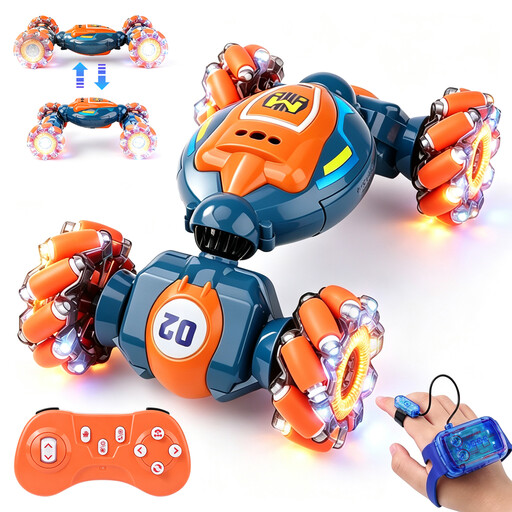
Why it suits this profile: This model combines a handheld controller with a gesture-control watch. According to the product information, a rechargeable 3.7V battery for the car is included, while the controllers use AAA batteries.
The product information lists both control methods and specifies which batteries are needed. However, check the current contents of the packaging.
Twist function, 360° rotation, double-sided driving and colourful LED wheels according to the product description.
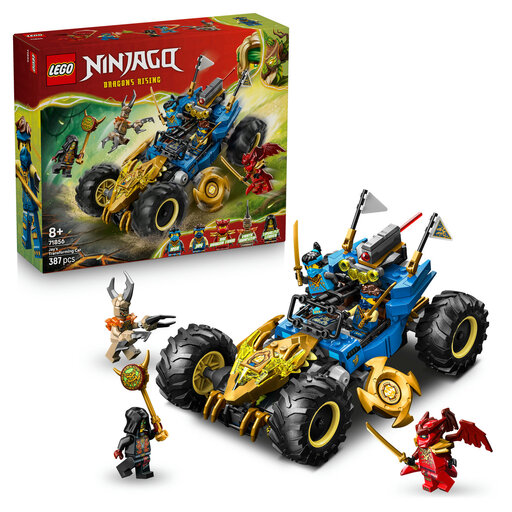
Why it suits this profile: This is not an RC vehicle, but a building and role-play set for children aged 8 and over who enjoy LEGO NINJAGO, vehicles and imaginative scenes.
The set does not use a battery or remote control. This means there are no recurring charging problems, but you should allow for building time and small parts.
387 pieces, two vehicle modes and five minifigures according to the product details. The set is approximately 20 cm long.
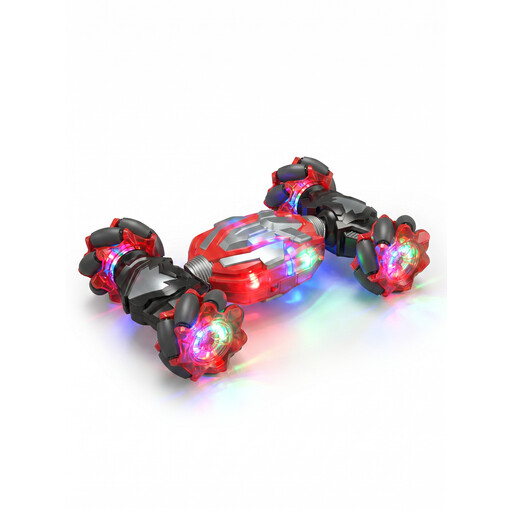
Why it suits this profile: This 26 cm transformable RC car is aimed at children aged 8 and over who want to drive outdoors and combine multiple stunts.
The product description mentions 4WD, Mecanum wheels, two control methods and double-sided driving. This makes the features easy to compare in advance.
Sideways driving, transforming, spinning and climbing over surfaces including grass and gravel according to the product information.
We have put together a complete, up-to-date list of products that fully meet these strict selection criteria and the applicable European safety regulations.
That depends on the specific model and its warnings. Check the stated minimum age, the controls and whether it contains small parts. Powerful models should ideally be used with guidance the first time. Preferably let the child drive on an open, clear surface away from traffic and fragile objects.
The play time varies depending on the battery, motor, surface and driving style. Product pages do not always state a fixed play time. So check the battery type, charging method and whether a USB cable or replaceable battery is included. Remember to allow for extra batteries for the controller or gesture-control watch.
Many models can be driven on a flat indoor floor and used on grass or gravel as well. Check the recommended surface and avoid water unless the seller explicitly states that the vehicle is protected against moisture. Indoors, a model with proportional controls and enough space is more practical; outdoors, 4WD, rubber wheels and ground clearance are more important.
