
Vandaag of morgen in huis

Kwaliteit gegarandeerd

Welkomstaanbiedingen ontgrendelen: GRATIS bezorging | Tot 80% korting | Gratis 30 dagen JoyPlus-proefperiode
Download de app
A 1:24 4WD RC drift car can look fully equipped on paper: four-wheel drive, LED lighting, a fast motor and a wireless remote control. However, models vary considerably in ease of use, control and accessories. Indoor drifting in particular quickly shows whether the car steers proportionally, whether the tyres suit the surface and whether the battery is practical to recharge.
This buying guide helps teenagers, adults and gift buyers compare marketing claims with verifiable product specifications.
A high top speed sounds appealing, but it is not automatically suitable for beginners. In a small living room or garage, precise throttle and steering control is often more important than speed. Check whether the car has multiple speed settings and whether the steering responds proportionally.
A low setting is useful for practising slaloms and corners. A higher setting can then be used for races on a flat course.
Drift tyres work particularly well on smooth surfaces such as tiles, laminate or a smooth indoor track. On a rougher surface, the car may not glide as smoothly. Interchangeable drift and racing tyres are therefore a tangible advantage: you can adapt your driving style without buying a second car.
On the product page, pay close attention to what is actually included. “Dual tyres” or “two sets of tyres” should preferably be explained as two separate sets for different driving modes.
An RC car with a gyro uses a gyroscope system to help stabilise the rear of the car while drifting. This can support beginners, but a gyro does not replace practice and does not automatically make every surface suitable. Adjustable sensitivity is more practical, as you can tailor the assistance to your driving style.
With a 4WD RC car, all four wheels are driven. This can provide an even distribution of power when accelerating and drifting. For precise manoeuvres, proportional throttle and proportional steering are also important. This means you can control not only whether the throttle or steering is on or off, but also how much throttle or steering input you apply.
According to a model’s product description, a mechanical steering mechanism can support fast responses. Also check whether the remote control operates at 2.4 GHz. This frequency is used by several RC cars and allows multiple vehicles to be driven at the same time, depending on the specific model and operating conditions.
A small 1:24 car is mainly suitable for flat surfaces. Consider tiled floors, laminate, smooth concrete or a dedicated indoor course. Larger off-road models are generally more suitable for grass, sand and larger obstacles.
Pay attention to the following:
After use, do not store the car with a dirty or blocked drivetrain. Dust and hair can collect around the axles and gears.
A rechargeable RC car means you do not need disposable batteries for the car for every session. Check which type of battery is supplied, how it is charged and whether the remote control still requires separate batteries.
For the Porsche version, the product description states a run time of 20 to 40 minutes per charge. Actual run time depends on factors including speed, LED use, surface and driving style. A lithium battery must be used and charged in accordance with the included instructions. Do not leave a battery charging unattended and do not use a damaged battery.
The recommended age also deserves attention. For children aged around 8 and over, supervision is advisable during their first drives. Before buying, check the warnings, small parts and information about the responsible economic operator in the EU.
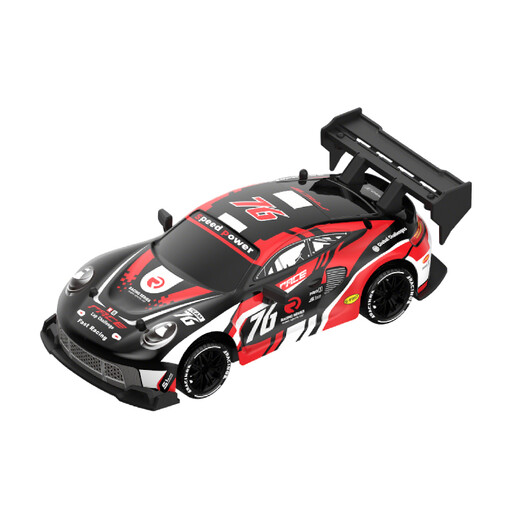
Why it suits this profile: This remote-controlled drift car combines a 4WD system with two sets of tyres and USB charging. This makes switching between drifting and racing straightforward for someone starting out in the RC hobby.
The product description mentions interchangeable drift and racing tyres and a stated run time of 20 to 40 minutes per charge. Check the current package contents before buying.
4WD drive, two quickly interchangeable tyre types, LED lighting and a USB-rechargeable lithium battery.
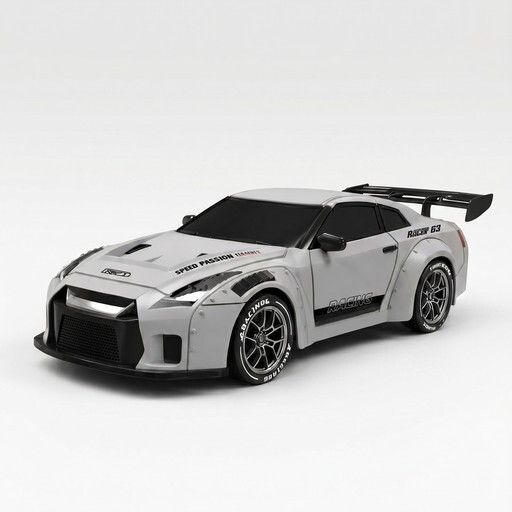
Why it suits this profile: According to the product description, this model is aimed at teenagers and adults looking for more adjustment options, with a gyro, servo, two speed settings and a 7.4V LiPo battery.
The adjustable gyro and low-speed setting offer more control than a model with only a fixed high speed. The included second set of tyres supports different driving modes.
7.4V LiPo battery, servo, independent suspension, 2.4G control and a complete accessory set according to the product listing.
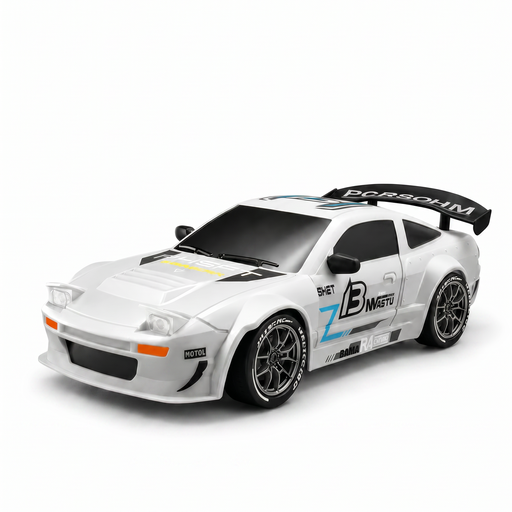
Why it suits this profile: This RC hobby car for adults and teenagers is designed for users who want to practise slaloms, point drifts, track drifts and time trials on a flat course.
The specifications mention two speed settings, an adjustable gyro and two interchangeable tyre types. This allows you to adjust the settings and grip while practising.
4WD, LED lights, lithium battery, ABS body and proportional throttle and steering control according to the product information.
We have put together a complete, up-to-date list of products that fully meet these strict selection criteria and the applicable European safety regulations.
Yes, a 1:24 model is relatively compact and well suited to indoor use on a flat, smooth floor. Remove loose objects and clear space around furniture. On deep-pile carpet, thresholds and uneven concrete, the steering may be less predictable.
This varies by model and driving style. The Porsche product description states 20 to 40 minutes per charge. Frequent acceleration, high speed and continuous use of the LED lighting can reduce the run time. Also check whether the charger and battery are included.
No. A gyro can help stabilise the car during a drift, but the tyres, surface, speed and steering input also affect the result. An adjustable gyro is particularly useful when several drivers with different levels of experience use the same 4WD RC car.
