
Vandaag of morgen in huis

Kwaliteit gegarandeerd

Welkomstaanbiedingen ontgrendelen: GRATIS bezorging | Tot 80% korting | Gratis 30 dagen JoyPlus-proefperiode
Download de app
An RC drift car can make a great gift for a child aged around 8 and over, as well as for teenagers and adults who want to race indoors or outdoors. The difference between a successful purchase and a car that soon ends up in a cupboard often has little to do with its appearance. The drive system, tyres, controls and spare parts all affect how much fun you’ll get from it.
A high top speed sounds appealing, but a fast car isn’t automatically easy to control. On a smooth tiled floor in particular, a model without proportional controls can quickly skid out of control. Check whether the remote control adjusts speed and steering angle gradually. This is more practical for beginners than a system that only offers slow or full-speed settings.
An electric drift car won’t perform the same on every surface. Smooth laminate, tiles and flat tarmac are usually better for drifting than carpet, gravel or an uneven garden path. An indoor model may not perform as well outdoors if it encounters small stones or uneven ground.
Also look at the difference between drift and racing tyres. Drift tyres make it easier to slide, while racing tyres generally provide more grip when driving in a straight line and around corners.
When choosing a rechargeable RC car, it’s important to check exactly what’s included. If the product information lists a lithium battery, that doesn’t necessarily mean the remote control or USB charger is powered in the same way. Also check the stated run time and charging time, and whether a spare battery is available.
A stated run time of 20 to 40 minutes per charge is an estimate from the product description. The actual time depends on factors including speed, surface and driving style.
A 4WD RC car is powered by all four wheels. According to the product information for the selected models, this helps with acceleration and drifting on flat surfaces. Four-wheel drive doesn’t make a car indestructible: collisions, extended use and dirt can all put strain on the gears and axles.
With a remote-controlled racing car, 2.4G control is useful when several cars are being used at once. Be sure to check the stated range, though. Several models in this selection list a range of around 50 metres. Indoors, the usable range is usually shorter because of walls and furniture.
An RC car with interchangeable tyres gives you more options. Use drift tyres for sliding, and racing tyres when control and grip matter more. Check whether you can change the tyres without special tools, too.
Independent suspension or a shock-absorbing chassis can be useful on flat tarmac with minor bumps. It won’t prevent damage in a hard collision. Some product descriptions mention an ABS body as a material that can withstand everyday use and light knocks.
An RC car with a gyro uses a stabilisation system that, according to the product information, can help you control the rear of the car more effectively while drifting. An adjustable gyro is a good feature for teenagers and adult hobbyists, as you can tailor the assistance to your driving ability.
A 1:24 RC car is compact enough to use indoors, while still being large enough to make features such as details, lights and interchangeable tyres practical. LED lights are mainly a visual extra. They don’t automatically make the car suitable for public roads or driving in complete darkness.
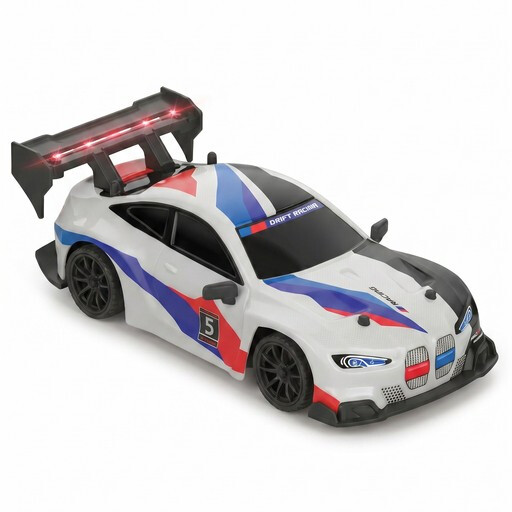
Why it suits this user: A straightforward model for children aged 8 and over and beginners who want to switch between racing and drifting.
The product information lists two interchangeable sets of tyres, so you’re not limited to one driving style. The stated run time is around 20 to 40 minutes per charge.
4WD, a USB-rechargeable lithium battery, LED lights and a stated range of 50 metres.
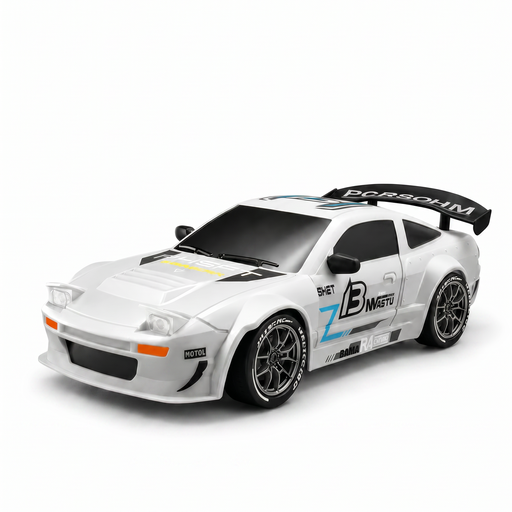
Why it suits this user: Designed for users who want more precise control and the option to practise more advanced drifting techniques later on.
The low- and high-speed settings make it possible to start at a gentler pace. According to the product information, the gyro is adjustable rather than fixed.
Proportional controls, two speed settings, an adjustable gyro, an ABS body and two types of tyre.
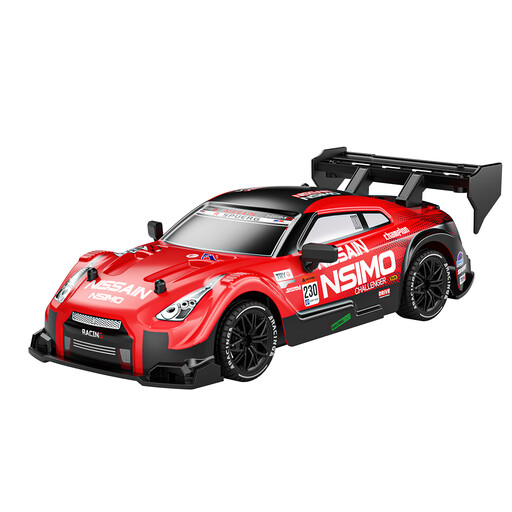
Why it suits this user: A good choice if you’re after a recognisable racing-car shape and want to drive indoors or on flat tarmac.
The two tyre options help avoid the problem of having a car that’s only suitable for drifting or only suitable for racing.
4WD, a mechanical steering mechanism, interchangeable drift and racing tyres, LED lights and a rechargeable lithium battery.
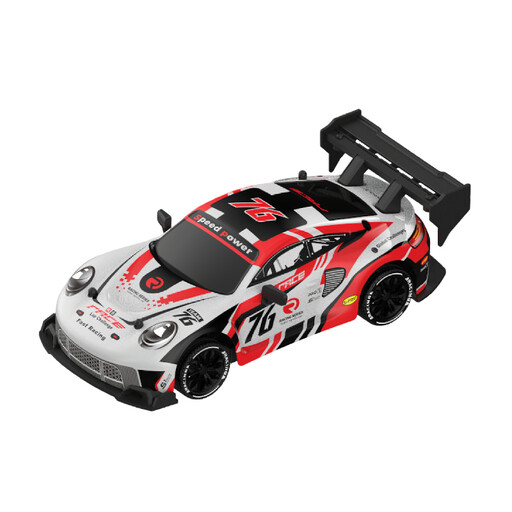
Why it suits this user: A handy option for a family or group of friends who want to race several cars on a flat track.
The 2.4G remote control and stated range of 50 metres are useful for a defined race track. Before buying, check how many sets can be used at once.
4WD, 2.4G control, two sets of tyres, LED lights and USB charging according to the product information.
We’ve put together a complete, up-to-date list of products that meet these strict selection criteria and the applicable European safety regulations.
Many models in this selection are marketed for children aged around 8 and over. Always check the age recommendation, small parts and controls. For younger drivers, a low-speed setting, proportional steering and supervision during their first few drives are useful.
Yes, as long as the floor is flat and clear. Tiles and smooth floors generally work better than deep-pile carpet. Move fragile items out of the way, and avoid using the car in shared indoor spaces where collisions could cause damage. Outdoors, flat roads are more suitable than gravel or grass.
Running costs mainly include electricity, spare batteries if needed, and wear-and-tear parts such as tyres. A USB-rechargeable lithium battery means you don’t have to keep buying disposable batteries for the car. Check whether the remote control needs its own batteries, and whether replacement tyres are available for the model.
