
Vandaag of morgen in huis

Kwaliteit gegarandeerd

Welkomstaanbiedingen ontgrendelen: GRATIS bezorging | Tot 80% korting | Gratis 30 dagen JoyPlus-proefperiode
Download de app
An RC car for children might seem easy to choose at first. But models can vary greatly in how they handle, their performance on different surfaces, battery life and recommended age. A shiny body or a long list of features doesn’t automatically mean a radio-controlled car is right for your child.
Look out for these common pitfalls:
First, check the manufacturer’s age recommendation and the warnings on the product page. A model for children aged 8 and over may be less suitable for a preschooler because it has proportional steering and a higher speed. Extra supervision is needed for vehicles with small accessories.
Look out for:
A statement such as “complies with international safety standards” is a claim made in the product description. Don’t treat it as a substitute for reading the specific safety information and age warnings.
4WD drive means that all four wheels are powered. This can help with drifting, turning and driving over small bumps, but it doesn’t automatically make a car suitable for mud or wet grass.
Choose according to the surface:
Mecanum wheels offer extra ways to move, such as driving sideways. This makes them an interesting feature for an RC stunt car, though the controls usually take some practice.
A rechargeable RC car means you won’t need new batteries for every play session. Still, check the stated play time per charge. According to their product descriptions, the BMW and GTR models below offer around 20 to 40 minutes of play time and USB charging.
Also check:
A stated range of, for example, 50 metres is a product specification based on certain conditions. Indoors, the practical range is often shorter because of walls and furniture.
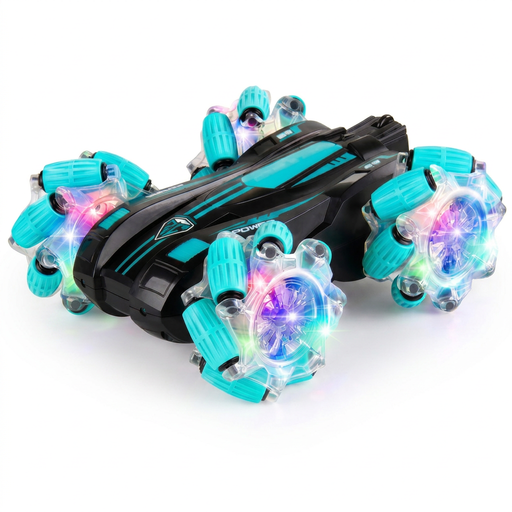
Why it suits this profile: This car combines several ways to play in one model: driving upside down, spinning and moving sideways. It gives beginners plenty of variety without needing to buy separate vehicles.
The double-sided design means the fun doesn’t stop as soon as the car overturns. Do check that the surface is suitable for its wheels.
4WD, Mecanum wheels, 360° spins and LED lights, according to the product description.
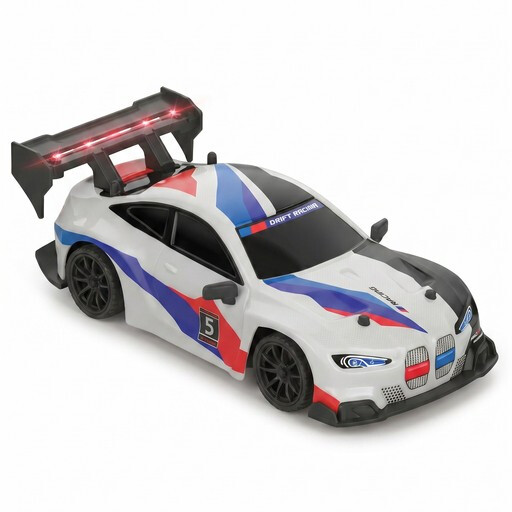
Why it suits this profile: This model is designed for older children aged 8 and over who want more precise control and the option to switch between racing and drifting.
The two interchangeable sets of tyres make the difference between drift tyres and racing tyres clearer than on a model with just one type of tyre.
4WD, proportional speed control, LED lights and a stated play time of 20–40 minutes per charge.
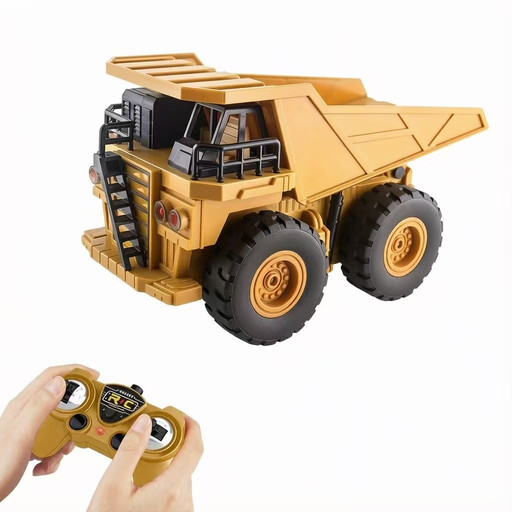
Why it suits this profile: For children who would rather load and unload than race, an RC dump truck is a natural choice. Its load bed sets the scene for imaginative construction play.
The load bed is more than decorative: the product description lists forward and reverse movement, steering and a remotely operated tipping bed.
6-channel controls, rubber tyres, LED lights, sound and a 3,7 V 500 mAh battery included, according to the product information.
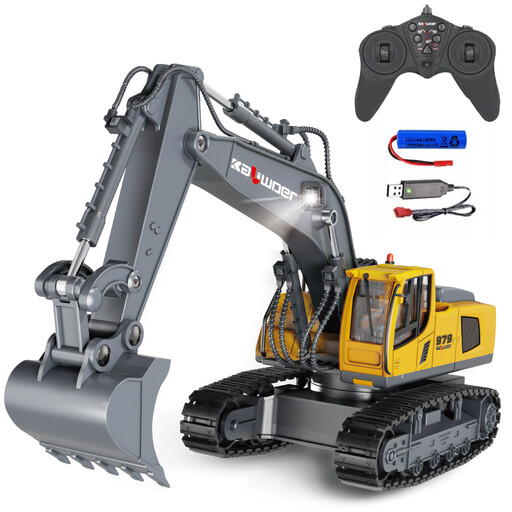
Why it suits this profile: An RC excavator is a good fit for children who enjoy role-playing construction sites and combining several activities.
Choosing a construction vehicle rather than a fast car from the outset makes the toy a better match for calmer, task-based play.
An 11-channel 2,4GHz remote control and a metal bucket are listed in the product title.
We’ve put together a complete, up-to-date list of products that meet these strict selection criteria and the applicable European safety requirements.
Choose a model with a clear age recommendation of 3 years and over, simple controls and as few small loose accessories as possible. Make sure an adult supervises play and check the warnings beforehand. Older children may enjoy an RC racing car, RC drift car or RC stunt car with more features.
It varies by model and how it’s used. LED lights, high speeds and constant drifting can all affect play time. Some 1:24 drift models are listed as offering 20 to 40 minutes per charge, according to their product descriptions. Let a lithium battery cool down before recharging it, and use the supplied or a compatible USB cable.
That depends on the tyres, ground clearance and construction. Flat concrete and an even pavement are usually more suitable than wet grass, mud or gravel. A low-bodied racing car is mainly designed for smooth surfaces. For outdoor play on varied surfaces, larger rubber tyres and a shock-resistant body are a better choice.
