
Vandaag of morgen in huis

Kwaliteit gegarandeerd

Welkomstaanbiedingen ontgrendelen: GRATIS bezorging | Tot 80% korting | Gratis 30 dagen JoyPlus-proefperiode
Download de app
A remote-controlled RC car may seem simple at first glance: pick up the remote, charge the battery and drive off. In practice, models vary considerably in terms of controls, surfaces, batteries and recommended age. As a result, an inexpensive remote-control car may not be the best choice for a child who wants to drive outdoors, while a more powerful radio-controlled car could be too fast or complicated for a beginner.
Pay particular attention to these three common pitfalls:
A 4WD RC car will generally handle grass, gravel and uneven paving better than a model with rear-wheel drive only. For indoor use on a smooth floor, 2WD may be sufficient. If you want to drive outdoors, it is worth looking for:
An off-road remote-control car with large rubber tyres is not automatically suitable for mud, water or snow. Check whether the product description specifically mentions these surfaces. Also, do not drive a non-waterproof model through puddles.
A 2.4GHz remote control is used with many models. According to the product descriptions of the models mentioned, this frequency makes it possible to use several vehicles at the same time without the usual signal confusion. This remains a product specification; the actual experience may depend on distance, obstacles and the surrounding environment.
For young drivers, a low-speed setting is useful. Some drift models offer two speed settings, allowing you to practise at a gentler pace first. A model with proportional throttle and steering control offers more control than a basic system that only drives fully forwards or backwards.
Before buying, check:
A rechargeable RC car means you do not need to buy new vehicle batteries for every play session. Actual play time depends on speed, surface and use of lights or sound. Allow lithium batteries to cool down after intensive driving and charge them according to the supplied instructions.
Many RC models are not suitable for children under three because they contain small parts. Direct supervision is advisable with young children, particularly when using stunt functions, water or spray effects, or when driving on the street. Use an RC toy car on a safe, clear surface and away from traffic.
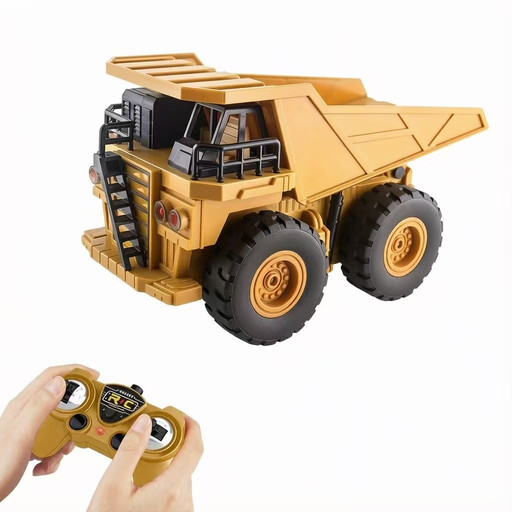
Why it suits this profile: This remote-control car is designed for straightforward role play. The tipper bed can be raised and lowered using the 6-channel controller, allowing children to act out loading, transporting and unloading.
The functions are clearly described: forwards, backwards, turning and operating the tipper bed. The product page includes a warning for children under three and recommends supervision.
3.7V 500mAh battery, USB cable, rubber tyres, LED lighting and a horn sound, according to the product description.
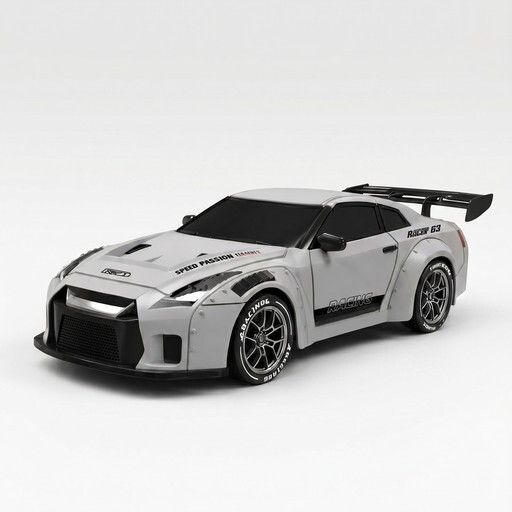
Why it suits this profile: For teenagers and RC enthusiasts who want to switch between racing and drifting, this model offers more adjustment options than a basic RC toy car.
The product description mentions two speed settings, an adjustable gyro system and two interchangeable tyre types. This allows you to adapt the controls to your experience and the surface.
4WD drive, ABS body, LED lights, suspension and a 7.4V lithium battery, according to the product information.
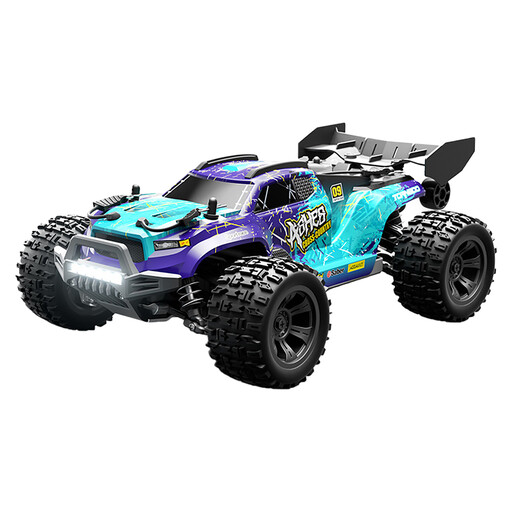
Why it suits this profile: This model is intended for older users aged 14 and over who want to drive outdoors and value speed, suspension and off-road capability.
The specifications list a 7.4V 1500mAh battery, 2.4GHz transmitter, aluminium chassis plate and large all-terrain tyres. This makes the model’s intended use clearer.
4WD, metal reinforcement, adjustable controls, LED headlights and a rechargeable battery included.
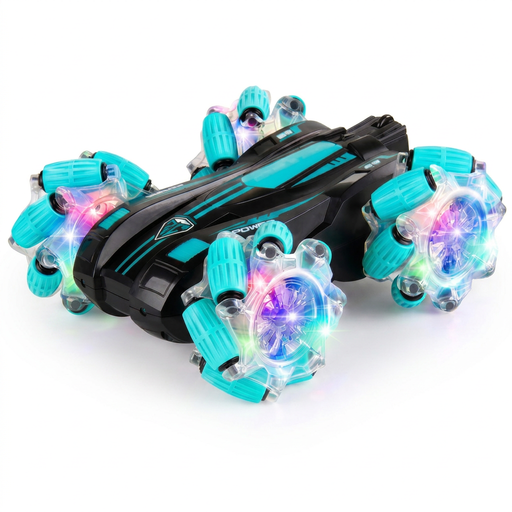
Why it suits this profile: For children who mainly want to spin, tilt and drive sideways. The car is suitable for indoor and outdoor use, depending on the surface.
The Mecanum wheels support sideways drifting, and according to the product description, the car can drive on either side. If it overturns, you therefore do not need to turn it over by hand straight away.
4WD, double-sided driving, 360° rotation, LED wheels and a rechargeable lithium battery.
We have put together a complete, up-to-date list of products that fully meet these strict selection criteria and the applicable European safety regulations.
Choose a model with a moderate speed, straightforward controls and clear age guidance. Check the warning about small parts. A model described by the manufacturer as suitable from age three must still be used under supervision, particularly outdoors or when using stunt functions.
This varies by vehicle and usage. Driving at high speed, drifting, LED lighting and sound all use more energy. So do not just look for the word “rechargeable”; also check the voltage and capacity, such as 3.7V 500mAh or 7.4V 1500mAh. The product page remains the best source for expected play time and charging instructions.
For models with 2.4GHz control, the product description often states that several vehicles can be used at the same time. However, check that all the models genuinely use this frequency and leave enough space between drivers. For races, flat, open areas are safer than a busy pavement or public road.
