
Vandaag of morgen in huis

Kwaliteit gegarandeerd

Welkomstaanbiedingen ontgrendelen: GRATIS bezorging | Tot 80% korting | Gratis 30 dagen JoyPlus-proefperiode
Download de app
An RC car may seem simple at first: pick up the remote control, charge the battery and off you go. In practice, models vary considerably. A small remote-controlled car for indoor use needs different features from a 4WD RC car for grass, sand or gravel. A drift RC car for teenagers also calls for more control than a basic toy RC car for children.
Most disappointing purchases come down to three common misunderstandings:
So, a good choice starts with how it will be used: who will be driving it, on what surface and for what purpose?
A 2.4GHz remote control is useful when several cars are being used at the same time. On many models, this technology is designed to reduce interference between vehicles. Also check whether the controls are proportional. This means the throttle and steering respond more gradually, rather than only to on/off commands.
For driving on grass, tiles, carpet or uneven outdoor surfaces, 4WD is a useful feature. Four driven wheels can improve traction, although the result also depends on the tyres, weight and motor power. A 2WD model may be enough for a flat floor and is often easier for younger children to use.
With a drift RC car, interchangeable tyres and an adjustable gyro are worth considering. Drift tyres make it easier for the car to slide, while racing tyres generally offer more grip. According to the product description, a gyro can help stabilise the car’s direction during a drift; the level of assistance varies by model and setting.
A rechargeable RC car means you won’t need new batteries for the car every time you want to use it. However, check the battery capacity and voltage. A 3,7V battery is common in compact toy models; larger off-road models may use 7,4V, for example.
Check the following:
Some product listings give an estimated play time, but actual usage time depends on speed, surface, temperature and driving style. Treat any stated time as a guide, not a guarantee.
For a toy RC car for children, simple controls are often more important than speed. A stunt function, automatic demo mode or gesture control can be appealing, but young children may need guidance to use these features safely.
Always check the age rating and warnings. Products with small parts are not suitable for children below the stated age. Use an RC car outdoors in a place away from traffic, water and fragile objects. Even when a manufacturer describes the body as water-resistant, that doesn’t mean it’s safe to submerge it for a long time. Follow the instructions and care guidelines.
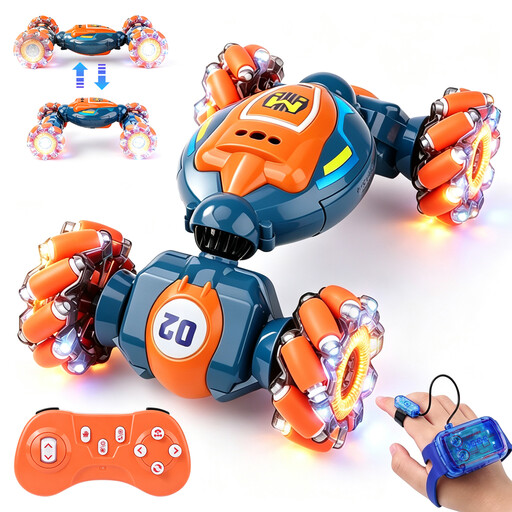
Why it suits this type of user: This model combines a standard handheld transmitter with a gesture-control watch. This gives children different ways to try steering without needing to move straight on to a hobby-grade car.
The product listing specifies a rechargeable 3,7V battery and two control modes. Check which AAA batteries the controllers need, and bear in mind the warning about small parts.
Drives on both sides, spins through 360°, colourful LED wheels and a switch between road and off-road modes, according to the product description.
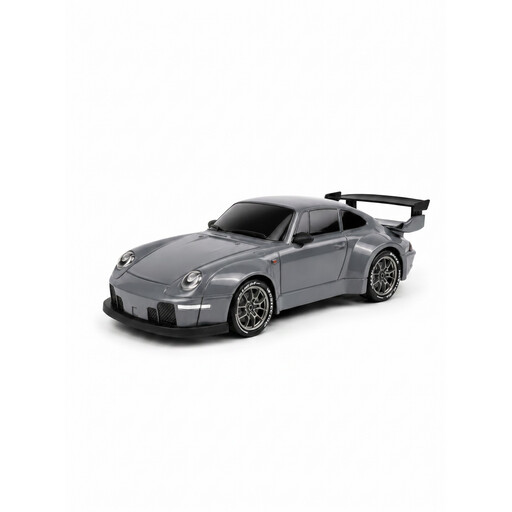
Why it suits this type of user: A good fit for teenagers and adults who want to practise drifting, slaloms and track racing. Proportional controls offer more precision than basic toy transmitters.
Being able to choose between low and high speed helps you avoid starting at full speed. The product listing also specifies an adjustable gyro and two types of interchangeable tyres.
4WD, LED lights, independent suspension, 7,4V battery and a complete set of accessories, according to the product information.
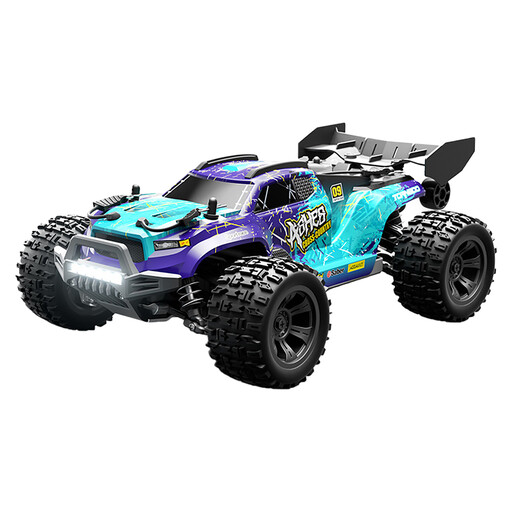
Why it suits this type of user: This off-road RC car is aimed at teenagers aged 14 and over, and adults who want to drive outdoors on grass, sand or rougher terrain.
Rather than focusing on speed alone, the product information lists 4WD, all-terrain tyres, suspension and a metal chassis plate. Always check the instructions on water and maintenance before use.
7,4V 1500mAh battery, 2.4GHz pistol-grip transmitter, LED headlights and large all-terrain tyres, according to the product description.
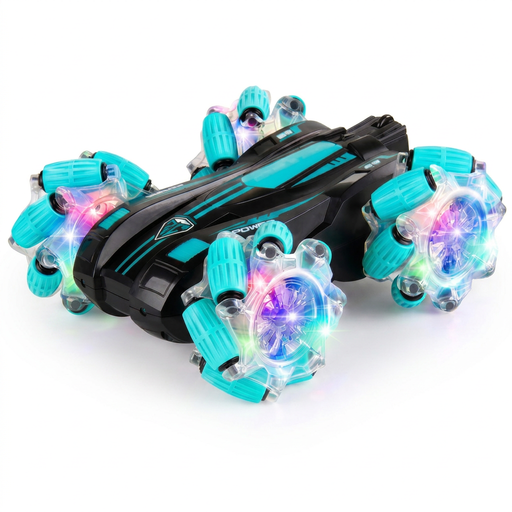
Why it suits this type of user: A practical choice for children who enjoy 360° stunts, sideways driving and LED lights, indoors or outdoors on a suitable surface.
The listing specifies Mecanum wheels, 4WD and the ability to drive on both sides. This makes it clearer which features enable the stunts than with a model described simply as a “stunt car”.
Sideways drifting, 360° spins, an automatic demo programme and colourful LED wheels, according to the product information.
We’ve put together a full, up-to-date list of products that meet these strict selection criteria and comply with current European safety regulations.
It depends on the battery capacity, speed, surface and driving style. A compact toy car often has a smaller battery than an off-road model. Check the product page for the voltage, capacity and any stated play time. Don’t leave a lithium battery completely flat for a long time after use, and use the supplied charging cable or a suitable charger.
Look for 4WD, ground clearance, tyre tread and suspension. An off-road RC car with large tyres is more practical on grass and gravel than a low-profile racing car. A lower speed setting is useful for young children. Don’t drive on public roads, and only use a model in water if the manufacturer explicitly permits it.
As well as the purchase price, batteries, spare parts, tyres and batteries for the transmitter can add to the cost. A rechargeable RC car will generally save you buying separate batteries for the car, but check whether the remote control needs AA or AAA batteries. If you’ll be using it intensively, interchangeable tyres and a replaceable battery are useful features to consider.
