
Vandaag of morgen in huis

Kwaliteit gegarandeerd

Welkomstaanbiedingen ontgrendelen: GRATIS bezorging | Tot 80% korting | Gratis 30 dagen JoyPlus-proefperiode
Download de app
An RC car may seem easy to choose at first. However, models vary considerably in speed, drive system, battery type and the surfaces they’re designed for. A small toy car for indoors needs different features from a 4WD remote-controlled off-road car for teenagers or adult hobbyists.
The most common buying mistakes come down to three pitfalls:
So don’t focus only on appearance, lights or marketing claims. Pay close attention to the technical specifications and how the car will be used.
A 2WD model is powered by two wheels and is often enough for flat floors and straightforward driving. A 4WD RC car sends power to all four wheels. This can help with drifting, climbing and driving over uneven surfaces.
For indoor use on wood, tiles or a smooth play mat, a compact electric toy car may be enough. For grass, sand or small obstacles, larger tyres, tread and ground clearance matter more. Check whether the product description only mentions flat roads, too. That’s a sign the model isn’t designed for tough terrain.
A remote-controlled car with just forwards, backwards, left and right controls is easy for beginners to get to grips with. Models with proportional controls respond more gradually to the accelerator and steering. This is particularly useful for older children and hobbyists.
An RC stunt car may have features such as:
Mecanum wheels allow sideways movement, but they’re not the same as classic off-road tyres. So choose a stunt model for fun on flat surfaces, and an off-road model when grip and climbing matter more.
Check whether the car is rechargeable and whether the battery is included. Some models don’t include the AA batteries for the remote control. A model with a replaceable battery can be handy if you want to enjoy several play sessions in a row.
Also look out for:
A statement such as “complies with international toy safety standards” comes from the product description. It’s no substitute for checking the actual product information, age warning and CE marking. Always use a model according to the manufacturer’s instructions, and supervise young children.
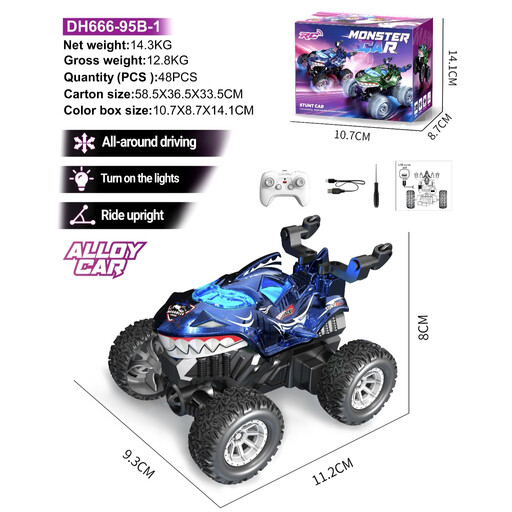
Why it suits this type of user: This compact RC toy car has straightforward forwards, backwards and steering controls, plus two speed settings. That lets beginners start slowly and try the faster setting later.
The two speed settings mean you don’t have to start at full speed. You can switch off the lights when saving battery power is more important.
2.4G remote control, lights with a separate switch and a 360° spinning stunt feature, as described.
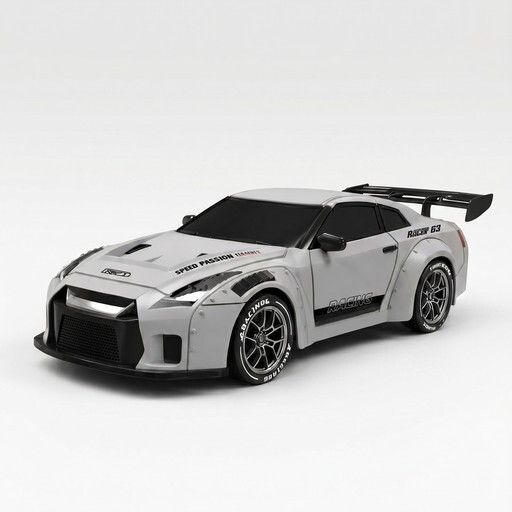
Why it suits this type of user: This model is for users looking for greater control and more variety. The product description mentions 4WD, an adjustable gyroscope system, two speed settings and interchangeable tyres.
You’re not limited to one driving style: according to the product information, you can switch the tyres between drift and racing. The low-speed setting gives you time to get used to the controls first.
Gyro stabilisation, independent suspension, 7.4V LiPo battery and front and rear LED lights.
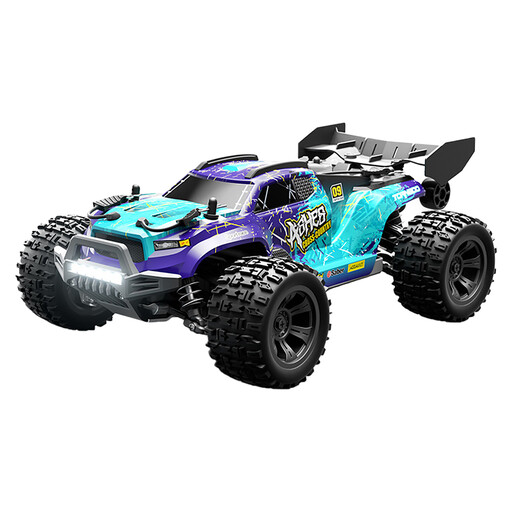
Why it suits this type of user: According to the product details, this remote-controlled off-road car is designed for teenagers and users aged 14 and over who want to drive outdoors on grass, sand, gravel and other rough surfaces.
The choice is based on off-road features rather than speed alone: 4WD, deep tyre treads and a reinforced chassis are all explicitly mentioned.
7.4V 1500mAh battery, 2.4G transmitter with speed control and LED headlights. According to the description, the transmitter requires three AA batteries, which aren’t included.
We’ve put together a complete, up-to-date list of products that meet these strict selection criteria and the applicable European safety requirements.
Look for a model with simple controls, a lower speed and clear age information. Always check the warnings about small parts. Young children should ideally play under adult supervision. Models for older children, with high speeds or interchangeable accessories, aren’t automatically suitable for this age group.
It depends on the battery capacity, speed, surface and driving style. Some drift models state a playtime of around 20 to 40 minutes per charge. Treat this as a product specification for certain conditions, not a guarantee. An extra interchangeable battery can be useful for longer play sessions.
It depends on the model. Drift tyres usually work better on smooth floors, tiles or flat surfaces. For grass, sand and gravel, you’ll need a model with 4WD, larger tyres and suitable tread. Also check whether the manufacturer allows driving in damp conditions or shallow water; lights or a sealed body don’t automatically mean that every model is waterproof.
