
Vandaag of morgen in huis

Kwaliteit gegarandeerd

Welkomstaanbiedingen ontgrendelen: GRATIS bezorging | Tot 80% korting | Gratis 30 dagen JoyPlus-proefperiode
Download de app
An RC car may seem straightforward: connect the remote control, charge the battery and off you go. In practice, models vary considerably in terms of controls, drive system, battery type and suitability for indoor or outdoor use. As a result, an inexpensive remote-controlled car may prove awkward on carpet, while a powerful off-road model could be too fast or complicated for a young child.
Pay particular attention to these three common pitfalls:
A 4WD RC car drives all four wheels. This can help when driving over grass, small obstacles and uneven surfaces. However, it does not automatically mean that every model is suitable for mud, deep puddles or steep slopes. Also look at the tyre tread, ground clearance and information about water resistance.
For indoor use, compact models with drift tyres are practical on smooth floors such as tiles, laminate or a smooth racing track. An off-road RC car generally needs larger tyres with more tread. After outdoor use, check whether sand and grass have collected around the axles or gears.
A rechargeable RC car means you do not have to keep buying separate batteries for the car. Do bear in mind the difference between the vehicle’s battery and the batteries in the remote control. On various models, the battery is included, while the remote control still requires AA or AAA batteries.
A 7,4V battery will generally deliver different performance from a 3,7V battery, but voltage alone says nothing about the exact runtime. Therefore, check:
An RC car with a gyroscope can help stabilise the direction of travel while drifting. According to the manufacturer’s product description, some 1:24 models have an adjustable gyro and two speed settings. This can be useful for beginners who want to practise at a slower pace first and then drive faster. It does not guarantee that every driver will be able to drift perfectly straight away.
For young children, simple forward, reverse and steering functions are often easier to understand than a model with transformation, sideways driving or multiple stunt programmes. Always check the age recommendation, warnings about small parts and the presence of CE marking and EU responsible-person information. Young children should use a remote-controlled toy car under adult supervision.
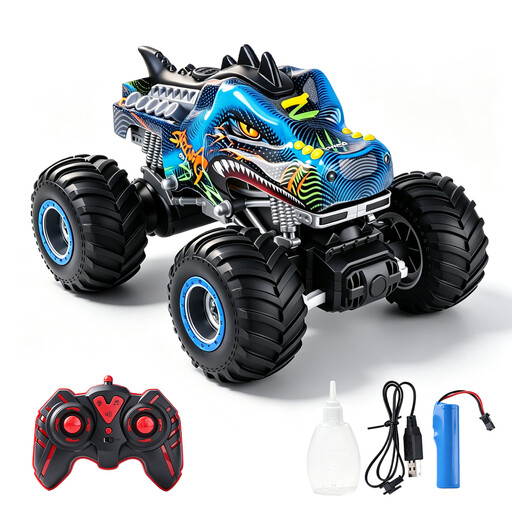
Why it suits this profile: A striking gift for children aged 3 and over who particularly enjoy stunts, lights and sounds. The controller has buttons for driving, lighting, music and the spray function.
The product information states that a 3,7V battery and USB cable are included. Please note: the remote control uses 2 AA batteries, and small parts require supervision.
Large rubber tyres, 360° rotation, three lighting modes and a water reservoir for the stated mist function.
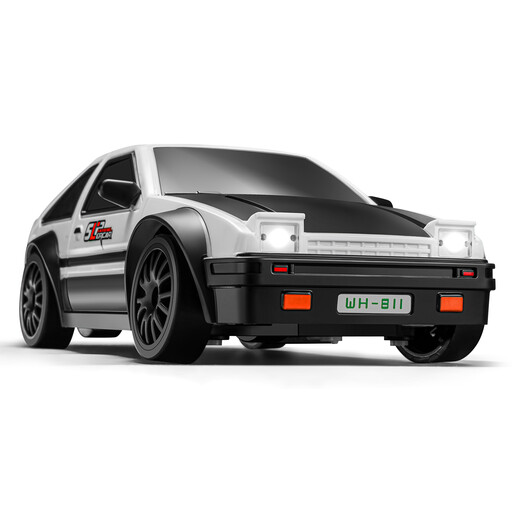
Why it suits this profile: For teenagers, adults and hobbyists who want to alternate between drifting and racing with one compact radio-controlled car.
The product description states that it has two speed settings, an adjustable gyro and interchangeable drift and racing tyres. This means the car is not limited to one driving style.
4WD drive, 7,4V rechargeable battery, LED lighting, independent suspension and proportional steering.
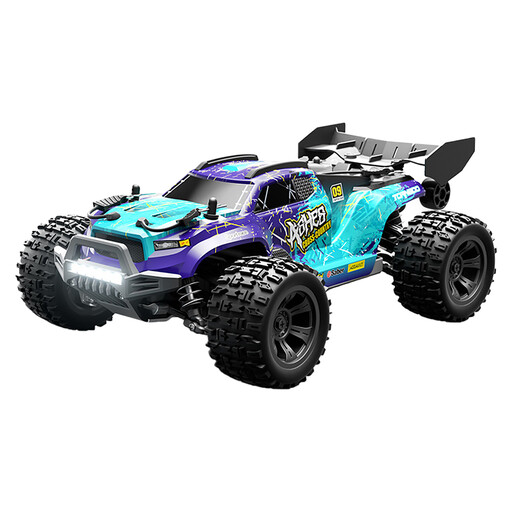
Why it suits this profile: Designed for teenagers aged 14 and over and adults who want to drive outdoors on grass, sand, gravel and similar surfaces.
The product information mentions 4WD, deep-tread off-road tyres, an aluminium protective plate and a 7,4V battery. Always check the limits of its water resistance and maintenance requirements before use.
40+ km/h according to the product listing, independent suspension, LED headlights and a battery with USB cable included.
We have put together a complete, up-to-date list of products that fully meet these strict selection criteria and the applicable European safety regulations.
Ideally, use a drift model on a smooth, clean floor. An off-road model is better suited to outdoor use, but remove sand and grass from the wheels after driving. Do not leave a lithium battery empty for long periods, and only use the supplied or recommended charging cable. Store the car in a dry place and remove the batteries from the remote control when the toy will not be used for an extended period.
Also pay attention to your surroundings. Keep away from traffic, ponds and fragile objects. With stunt models featuring LED wheels, spray or music, it is sensible to check beforehand that the sound and water use are suitable for the play area.
Its lifespan depends on driving style, surface, collisions, battery care and cleaning. A sturdy ABS body and replaceable tyres can be practical, but wear to the gears, motor and battery is still possible. Check whether spare parts or a replacement battery are available.
Choose a model with a clear age recommendation, simple controls and few loose parts. Always check the warnings on the product page. A stunt model may be appealing, but speed and features such as spinning or transforming require extra supervision.
With a rechargeable RC car, ongoing costs mainly consist of electricity, any batteries needed for the remote control and parts that need replacing due to wear. A removable battery and supplied USB cable generally make charging convenient. However, check the charging time, battery capacity and availability of replacement parts.
