
Rolling your own ravioli sheets
If you want to roll prepared dough into individual sheets yourself, an adjustable roller lets you choose the thickness step by step. Marcato lists ten thickness settings for the Atlasmotor+.


If your main aim is to make individual ravioli sheets and control their thickness, choose a powered roller. If you have a suitable stand mixer, a roller attachment can do the same job. A pasta maker is a better fit if you also want the machine to mix and knead the dough, but check that the specific model includes the right attachment for making sheets. None of these methods automatically means the machine will fill and seal the ravioli too.
If you want to roll prepared dough into individual sheets yourself, an adjustable roller lets you choose the thickness step by step. Marcato lists ten thickness settings for the Atlasmotor+.
If you would rather not mix and knead the dough yourself, consider a pasta maker and check in advance which shapes are included with the specific model. Philips says the HR2665/93 automatically mixes, kneads and extrudes dough.
If you already have a suitable mixer, a roller attachment can be an alternative to a standalone machine. KitchenAid describes the 5KSMPSA as an attachment with eight thickness settings; a mixer is required.
Best for: you want to roll prepared dough into individual sheets and set the thickness yourself.
Bear in mind: preparing the dough, filling the ravioli and sealing them are still separate steps.
Best for: you already have a compatible mixer and want to use it to roll pasta sheets.
Bear in mind: the attachment won’t work on its own; check which mixer is required too.
Best for: you also want the machine to mix and knead the dough.
Bear in mind: an extrusion shape is not the same as adjustable roller settings; check whether the specific model makes the sheets or shapes you want.
| What to consider | What should you check? | Which consumers is this for? |
|---|---|---|
| Individual sheets and thickness | Check whether the machine has roller attachments, which thickness settings are available and which parts are included. | If I want to roll prepared dough into individual ravioli sheets and control the thickness myself, I look at the roller and its settings. Around 40% of consumers put control over individual sheets first on their list when buying. |
| Less work with the dough | Check the exact model code to see whether mixing and kneading are automatic and whether the required sheet-making attachment is included. | If I want to spend less time preparing dough after a visit to the market, I look at both mixing and kneading and the attachment I need. Around 30% of consumers prioritise doing less work with the dough. |
| Existing mixer | Check the make and model of your mixer and whether you need a roller attachment or any additional parts. | If I want to keep using my existing mixer rather than make space for a standalone machine, I check compatibility. Around 20% of consumers prioritise reusing a mixer they already own. |
| Cleaning | Read the instructions for the specific model and check which parts can be removed or rinsed. | If I mainly want to cut down on tidying up after making pasta, I look at how the parts are cleaned. Around 10% of consumers put ease of cleaning first on their list when buying. |
Extruding and rolling are different methods. A mention of a ravioli shape doesn’t, on its own, mean the machine makes individual sheets or fills and seals ravioli.
First decide whether you want to roll or extrude the dough. Then check the model code and the parts included in the box, and find out which steps you’ll need to do yourself.
A roller attachment is powered by a compatible mixer, so it can’t roll pasta sheets by itself.
Before buying, check that your mixer is compatible and that the model you’re considering includes the parts you need.
The Dutch government says that statutory warranty in the Netherlands has no fixed duration, and that the seller is your point of contact if a product is faulty.
Read what additional cover is offered, and don’t treat it as a replacement for your statutory rights.
The features listed apply to the models and versions described, not to every product from each brand. Manufacturer information is not the same as independent performance testing.
The Atlasmotor+ is a standalone, motorised roller for rolling out prepared dough.
The 5KSMPSA is a powered roller attachment for owners of a compatible KitchenAid mixer.
The 7000 Series HR2665/93 is an automatic pasta maker for anyone who also wants the machine to mix and knead the dough.
The Pastamania 10034566 is described as an automatic pasta extruder with pasta attachments.
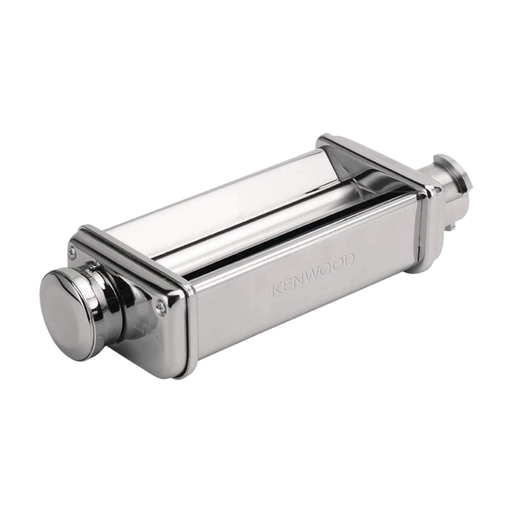
This selection includes a roller attachment for a Kenwood food processor and an automatic pasta maker. For the automatic machine, check that the specific model includes a suitable attachment for making pasta sheets.
 No image available
A good fit if you already have a compatible Kenwood food processor and want to roll individual pasta sheets.
The product information lists nine adjustable thickness settings and says it can be used for ravioli. This is an attachment, not a standalone pasta maker.
 No image available
Ideal if you want an automatic machine to take care of mixing, kneading and extrusion.
The product information lists automatic and manual programmes and four types of pasta, but doesn’t specify which shapes this model makes. Check that the right attachment for pasta sheets is included.
Not automatically. A roller makes individual sheets for you to fill and seal yourself. With an extruder, check what the listed ravioli shape does and which parts are included with the specific model.
For the 5KSMPSA, KitchenAid recommends starting at the widest setting, passing the dough through the roller again and gradually increasing the setting. The manufacturer recommends setting 4 or 5 for ravioli with this roller; don’t assume these settings will suit another machine.
Don’t assume they can: follow the instructions for your specific machine and parts. For the 5KSMPSA, KitchenAid describes using a cleaning brush and a dry cloth; for the Pastamania mentioned above, Klarstein says its seven attachments can be rinsed.
For eligible distance purchases, you generally have 14 days to change your mind, according to the Dutch government. Statutory warranty in the Netherlands has no fixed duration; if a product is faulty, the seller is your point of contact. This is separate from any manufacturer’s or additional seller’s warranty.
Check the information for the specific model on parts that come into contact with dough and on electrical safety. The NVWA sets out the Dutch requirements for food contact materials; EU low-voltage rules apply within their scope to equipment designed for 50–1,000 V AC. This general guidance doesn’t prove that any individual product complies.