
Vandaag of morgen in huis

Kwaliteit gegarandeerd

Welkomstaanbiedingen ontgrendelen: GRATIS bezorging | Tot 80% korting | Gratis 30 dagen JoyPlus-proefperiode
Download de app
A ratchet wrench set may seem straightforward at first glance: choose a selection of sizes, check the material and place your order. In practice, DIY enthusiasts and beginner mechanics often make the same mistakes. A set may not include the right drive size, the ratchet may not work well in a confined space, or a torque wrench may be used as though it were an ordinary ratchet wrench.
This buying guide will help you assess the differences between ratchet wrenches, wrench sets and torque wrenches in practical terms. We look at sizing, the ratchet mechanism, materials and the type of job you need the tools for.
A set with lots of pieces is not automatically more useful. First check which sizes are actually included. Smaller sizes are often more relevant for bicycle and motorcycle maintenance, while car maintenance may also require larger fittings and a 1/2 inch drive.
Also pay attention to the difference between:
A 3/8 inch ratchet wrench refers to the square fitting for sockets. This is not the same as a socket measuring, for example, 10, 13 or 17 mm. The drive size determines which sockets and accessories will fit. A 3/8 inch ratchet is a practical medium size for many car, motorcycle and machinery maintenance jobs, but it is not suitable for every heavy-duty connection.
A flexible ratchet wrench can provide extra freedom of movement in confined spaces. However, the head must remain firmly seated on the fitting. An adjustable spanner is versatile, but it requires precise adjustment. If the jaws are set too wide, the nut may be damaged or the spanner may slip off.
For most jobs in the Netherlands, a metric ratchet wrench set with millimetre sizes is the logical choice. Check that the sizes are clearly marked on the spanner and that the range suits your job. A 12-piece set from 8 to 19 mm covers many common sizes for garage and maintenance work, but bicycle repairs may require smaller sockets instead.
A ratcheting combination spanner set is useful when you want to switch quickly between fasteners. A double-ended ratcheting set can provide extra reach around obstructions, for example inside an engine bay.
The number of teeth indicates how small the return angle can be. According to the product descriptions, several DURATECH models have 72 teeth and a working angle of approximately 5 degrees. Another model has 90 teeth and a working angle of 4 degrees. A smaller angle is practical when you can barely move the handle.
The number of teeth is not the only consideration. Also look for:
According to the product information, many of the selected models are made from chrome vanadium steel or a similar chrome alloy. A polished or chrome-plated finish can make cleaning easier and help protect against corrosion. Nevertheless, store your tools in a dry place and wipe away oil, moisture and dirt after use.
Do not use an ordinary ratchet as a striking tool, and do not extend the handle unless the manufacturer permits it. Seized bolts may require a suitable breaker bar or impact solution rather than simply applying extra force to a small ratchet.
A torque wrench is intended for situations where the manufacturer of a vehicle, bicycle, machine or component specifies a particular tightening torque. An ordinary ratchet gives you an idea of how much force you are using, but it does not measure torque.
A digital torque wrench may offer additional functions. According to MoveCrab’s own product information, certain models have a range of 4.2 to 85 Nm or 6.8 to 135 Nm, a stated accuracy of ±2%, various units and an alert via sound, vibration and an LED. Always check the manual, the direction of rotation and the specified calibration requirements. Do not exceed the stated range, and store a torque wrench according to the instructions.
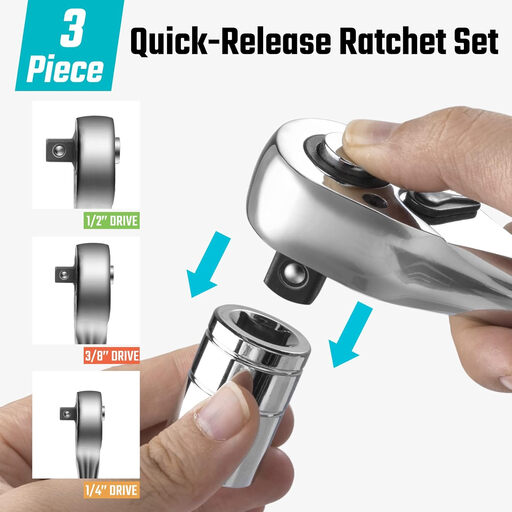
Why it suits this profile: The three drive sizes provide a practical foundation for garage jobs, bicycle repairs and general maintenance without having to buy several separate ratchets straight away.
The set clearly indicates the drive size and includes 1/4, 3/8 and 1/2 inch. This reduces the risk of buying a ratchet that is incompatible with your existing sockets.
72-tooth mechanism, reversible ratchet, quick-release function and storage case according to the product description.
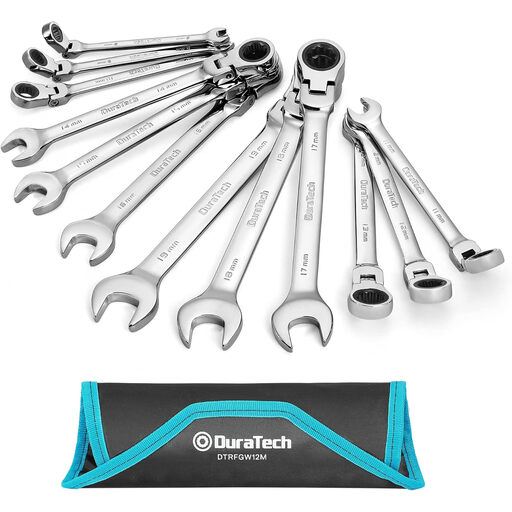
Why it suits this profile: For daily work on vehicles, machinery and installations, this set offers a broad metric range with a flexible head.
The sizes from 8 to 19 mm are marked on both sides. The 180-degree flex head is designed for places where a fixed spanner offers less room to manoeuvre.
72 teeth, approximately 5-degree working angle, chrome vanadium steel and a storage pouch according to the product details.
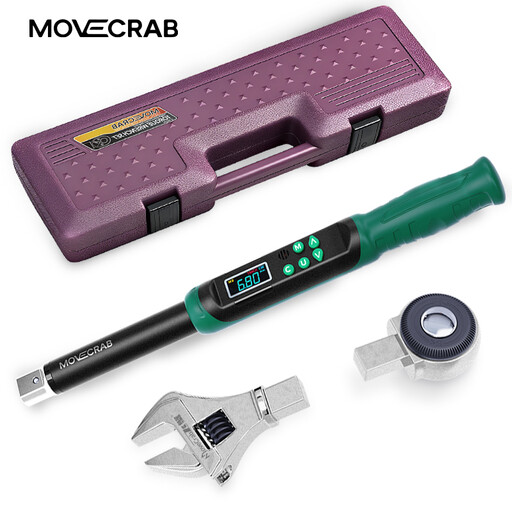
Why it suits this profile: For anyone working on cars, motorcycles or machinery who wants to follow a set tightening torque with a ratchet or open-ended head.
The digital display makes the selected range visible. According to MoveCrab’s own research, the stated accuracy is ±2%; always check the manual and calibration requirements before use.
Range of 6.8-135 Nm, interchangeable ratchet and open-ended heads, four measurement units and storage for up to 500 values according to the product information.
We have put together a complete, up-to-date list of products that fully meet these strict selection criteria and the applicable European safety regulations.
Clean ratchets and spanners after use with a dry or slightly damp cloth. Do not use aggressive solvents unless the manufacturer permits this. Regularly check the teeth, switch, jaws and square fitting for wear. A damaged spanner can round off the fastener or slip.
A digital torque wrench requires extra care when it comes to batteries, storage and returning it to the recommended resting position. Do not use a torque wrench as an ordinary ratchet to loosen seized bolts unless the manual explicitly permits this.
For general car maintenance, a set with 1/4, 3/8 and 1/2 inch drives is versatile. You can combine it with a metric socket set and a torque wrench when specific tightening torques are important.
That depends on the available workspace. A flexible head can help with fasteners behind pipes or inside an engine bay. For maximum control and higher loads, a fixed head may be more practical. Always check that the head remains properly aligned while you apply force.
Its service life depends on the load, storage conditions, moisture and correct use. Chrome vanadium steel and a protective finish are verifiable material properties, but they do not guarantee resistance to wear. Use the correct size, avoid overloading the tool and replace it as soon as the teeth, jaws or fittings show visible damage.
