
Vandaag of morgen in huis

Kwaliteit gegarandeerd

Welkomstaanbiedingen ontgrendelen: GRATIS bezorging | Tot 80% korting | Gratis 30 dagen JoyPlus-proefperiode
Download de app
A ratchet tool set can make many jobs much easier, but a large number of components does not automatically mean the set is right for your project. A compact set with the correct sizes is often more useful than a heavy case full of accessories you rarely use. So don’t focus only on the price or the number of pieces. Pay particular attention to the drive size, metric measurements, accessibility and storage.
A set with 100 or more pieces sounds appealing. However, many of those pieces may be small bits, adapters or sizes that are rarely used in the Netherlands. Check which metric sockets are actually included. For car and motorbike maintenance, common sizes such as 8 to 19 mm are often more important than a large number of unusual accessories.
A ratchet with fewer teeth generally needs to move further before the mechanism engages again. This can be awkward when working on bolts under a bonnet, in a bicycle rack or between machine components. According to the product descriptions, a 72-tooth ratchet has a working angle of approximately 5 degrees. A 90-tooth ratchet from the product selection mentioned has a working angle of approximately 4 degrees, according to its description. You’ll notice the difference most in confined spaces.
A ratchet is designed for tightening and loosening, but not for accurately setting a specified tightening torque. For certain bicycle, motorbike or car components, for example, you’ll need a separate torque wrench set. Do not use a ratchet as an impact tool unless the socket is specifically designed for this purpose.
The most common drive sizes are:
A complete ratchet set sometimes combines all three sizes. Also check whether extension bars, universal joints and adapters are included. These help you reach fastening points that cannot be accessed straight on.
Many sets use chrome vanadium steel, often referred to as Cr-V. According to the product descriptions, the components are heat-treated and have a chrome-plated finish. These are verifiable product specifications, but they do not by themselves indicate how long the tools will last. Also look for:
Some sets use S2 steel for their bits. According to the product information, this material is harder and more wear-resistant than standard bit materials. However, always use bits with the appropriate drive size and avoid applying excessive force.
A ratchet tool set may contain sockets, but it can also include combination ratchet spanners. A ratchet combination spanner set is useful when a socket with an extension bar will not fit. Flexible ratchet spanners with an adjustable head can tilt up to 180 degrees, according to the product description. This is helpful when working on bolts at awkward angles.
Before buying, check that the set contains all the sizes you need. A 12-piece set ranging from 8 to 19 mm is practical for many car and household jobs, but it may not be suitable if you regularly use larger sizes or specialist sockets.
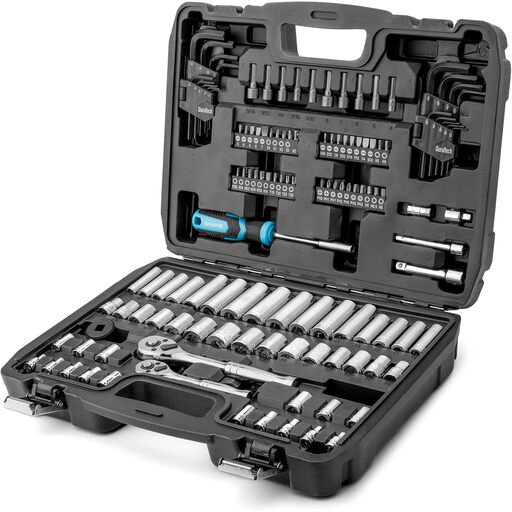
Why it suits this user profile: This set combines common metric and SAE sockets with 1/4- and 3/8-inch ratchets, bits and hex keys. It’s a practical choice for anyone looking for one tool set with a case for household maintenance, bicycle repairs and light car work.
The contents are specified with quantities, drive sizes and size markings. This means you can check in advance that the set is not made up mainly of unnecessary accessories.
121 pieces; Cr-V steel sockets; quick-release ratchets; sturdy storage case with individual compartments.
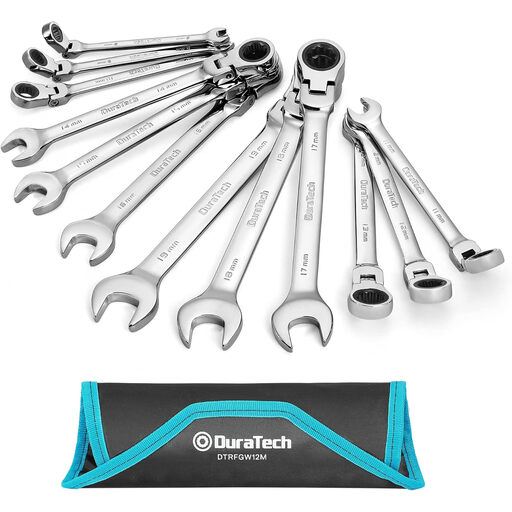
Why it suits this user profile: This metric tool set is designed for better access and faster working. The combination of a flexible head and ratchet mechanism is ideal for car and motorbike enthusiasts who often work in confined spaces.
The product description specifies a 180-degree flex head, 72 teeth and a 5-degree working angle. The 8 to 19 mm sizes are marked on both sides.
12 metric sizes; Cr-V steel; flex head up to 180 degrees; roll-up storage bag.
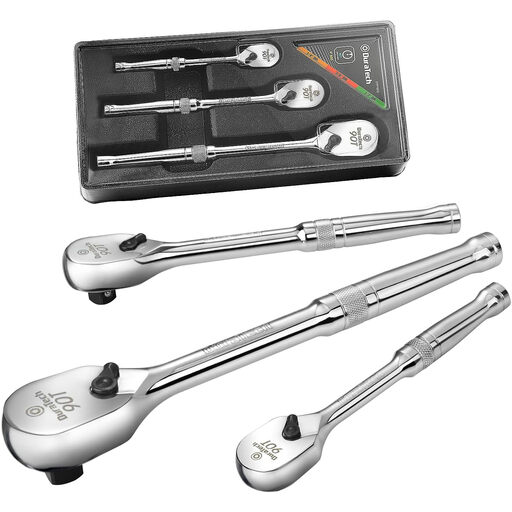
Why it suits this user profile: If you already have a socket set but need different drive sizes, this separate ratchet set lets you expand your toolkit in a targeted way. The compact head is designed for jobs where there is very little room to manoeuvre.
According to the product description, the mechanism has 90 teeth and a 4-degree working angle. The fully enclosed ratchet head is designed to help prevent dirt from getting inside, according to the same description.
1/4-, 3/8- and 1/2-inch drive; 90-tooth mechanism; reversing function; storage case.
We’ve put together a complete, up-to-date list of products that fully meet these strict selection criteria and the applicable European safety regulations.
A ratchet tool set remains useful when you handle it carefully. Wipe away oil and dirt after use, and store metal components dry in the case or bag. Before starting a job, check that the ratchet switches smoothly and that the sockets show no signs of cracking.
For high torque, use the correct 1/2-inch socket wrench or an impact socket designed for the job. A standard chrome socket is not automatically suitable for use with an impact wrench. Fit the socket fully onto the bolt and avoid extending a ratchet with a random pipe. This could damage the mechanism, the bolt or yourself.
For general car maintenance, a set with 1/4-, 3/8- and 1/2-inch drive is versatile. Check that it includes metric sockets of approximately 8 to 32 mm, extension bars and a universal joint. A separate impact socket set may be required for wheel nuts.
According to the product description mentioned, a 90-tooth ratchet requires a smaller working angle than a 72-tooth ratchet. This can make it more convenient in very confined spaces. A 72-tooth mechanism remains suitable for many garage and household jobs. Also consider the head shape, handle and accessibility.
Only if the vehicle, machine or component manufacturer specifies a particular tightening torque. A ratchet tightens a connection but does not measure torque accurately. In that case, use a suitable torque wrench set and follow the instructions for the relevant component.
