
Vandaag of morgen in huis

Kwaliteit gegarandeerd

Welkomstaanbiedingen ontgrendelen: GRATIS bezorging | Tot 80% korting | Gratis 30 dagen JoyPlus-proefperiode
Download de app
Working on a car, machine, or a complex job at home often means maneuvering in tight spaces. Anyone who has ever tried to loosen a bolt in a hard-to-reach spot knows the frustration. A standard combination wrench needs to be constantly repositioned, which costs time and patience. A good ratcheting wrench set is not a luxury in these situations, but a necessity for efficient and pleasant work.
As a Joybuy Product Recommendation Officer, I'm here to help you make the right choices. In this article, we'll look at what to consider when purchasing a ratcheting combination wrench set and highlight some popular choices for 2026. No marketing fluff, just practical information based on product specifications.
Before you make a choice, it's helpful to understand a few key features. These determine how the set will perform in practice.
The heart of a ratcheting wrench is its gear mechanism. The number of teeth determines the swing arc: the minimum angle you need to move the wrench to make the next 'click'.
The smaller the swing arc, the faster you can work without removing the wrench from the bolt or nut.
A ratcheting combination wrench set comes in two main types: with a fixed or a flexible head.
Good professional-grade tools are built to last. Look for wrenches made from Chrome Vanadium steel (Cr-V). This material is strong, durable, and resistant to corrosion, especially with an added chrome finish.
Furthermore, a good storage solution is essential. A set in a case or a roll-up pouch keeps your tools organised, protected, and easy to transport. Clear size markings on both the case and the wrenches themselves will save you a lot of searching time.
Based on the criteria above, we have selected a few sets that stand out for their specifications and functionality.
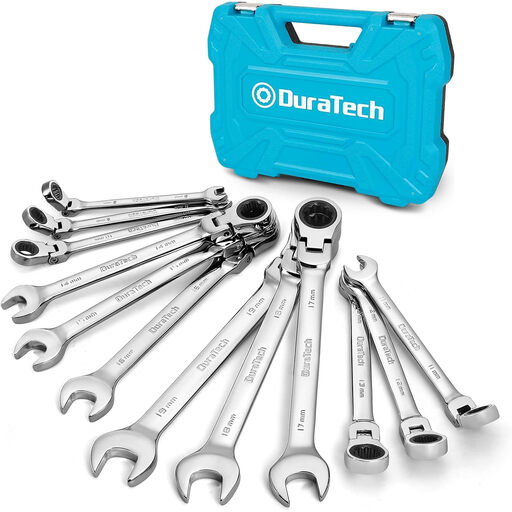
Why It Stands Out: This set combines a 72-tooth ratchet mechanism with a flex head that pivots up to 180 degrees. According to the manufacturer, DURATECH, this is designed to tackle even the most hard-to-reach fasteners. The clear directional markings on the wrench help you quickly find the right turning direction.
Key Features:
Who Is It For? For the automotive mechanic or serious DIYer who regularly works in awkward places and needs the flexibility of a pivoting head.
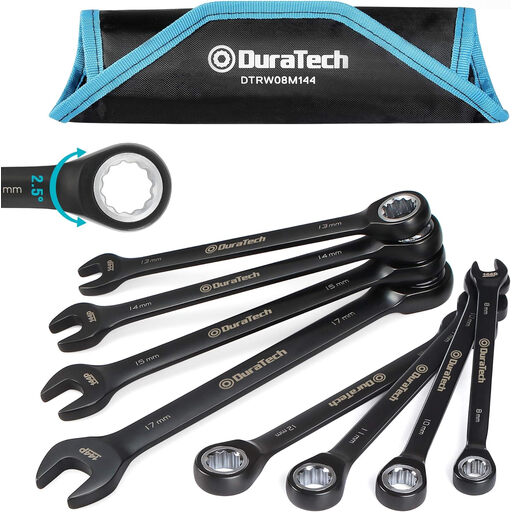
Why It Stands Out: The key feature of this ratcheting wrench set is its 144-tooth ratchet mechanism. This provides an extremely small swing arc of just 2.5 degrees. According to DURATECH, this is ideal for work in very tight spaces where every millimetre counts.
Key Features:
Who Is It For? For the professional who needs maximum precision and efficiency in the tightest of environments. Think engine rebuilds or work on complex machinery.
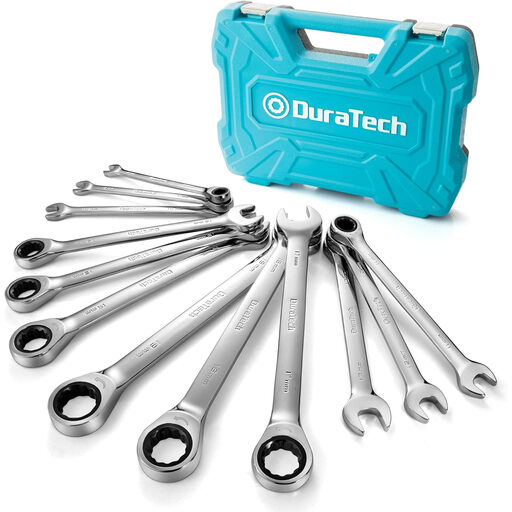
Why It Stands Out: This set is a classic workhorse. It features a robust design with a fixed head and a reliable 72-tooth mechanism. With no moving parts in the head, this is a very strong and durable option for general repair and maintenance tasks.
Key Features:
Who Is It For? An excellent all-around choice for both professionals and DIYers looking for a reliable, strong, and no-nonsense ratcheting wrench set for daily use.
If the perfect set for your job isn't listed here, or if you're looking for a specific tool like a lug wrench, remember that good tools are the foundation of any project. Feel free to browse our wider assortment to find the right tool for your needs.
Explore our full range of lug wrenches and other hand tools.
1. What is the advantage of a ratcheting wrench over a regular combination wrench? The biggest advantage is efficiency. Thanks to the ratchet mechanism, you don't have to remove the wrench from the bolt or nut after every turn. You can keep turning continuously, which saves an enormous amount of time and effort, especially in tight spaces.
2. How many teeth should a good ratcheting wrench have? A 72-tooth mechanism (5-degree swing arc) is an excellent standard for most applications. For extremely tight spaces, a mechanism with more teeth, such as 144, offers an even smaller swing arc (2.5 degrees) and therefore greater ease of use.
3. Is a set with a flex head always better? Not necessarily. A flex head is indispensable for reaching bolts at an odd angle. For situations where you can work directly on the bolt and need to apply maximum force, a fixed head can sometimes feel more robust and transfer power more directly. The choice depends on the type of work you do most often.
